Quick answer:
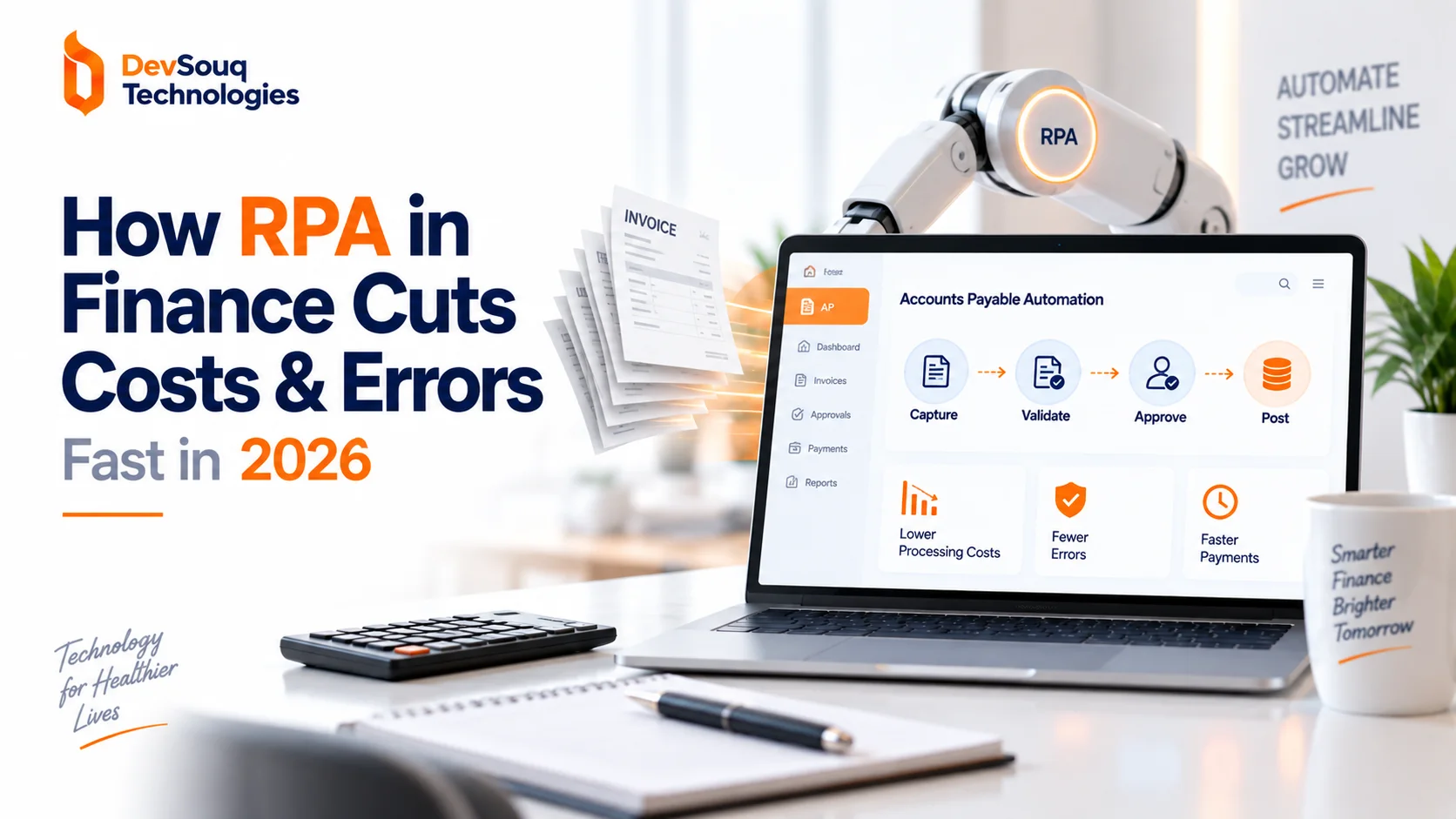
DevSouq, a cost-efficient software partner, offers a free scope review to help you find which finance processes suit RPA in finance. RPA in finance uses software bots to automate repetitive, rule-based tasks like invoice matching, bank reconciliation and reporting, cutting manual errors, speeding up close cycles and lowering costs. It works best on high-volume, structured processes, with a human check for exceptions and judgment calls. Start with one bounded process, such as invoice processing, measure the results, then expand.
Key Takeaways
- RPA in finance automates repetitive, rule-based tasks like invoice matching, bank reconciliation and reporting, and it runs on top of your existing systems, so there is no rip-and-replace.
- It pays off fastest on high-volume, structured work. Invoice-to-PO matching is the classic best first project because the rules are clear and the errors are costly.
- The payoff is measurable: fewer manual errors, faster close cycles, stronger audit trails and lower operating costs.
- RPA has real limits. Bots can break when screens change, struggle with scanned or free-text documents, and create rework in exception-heavy processes.
- AI extends what RPA can handle, from reading unstructured documents to predicting late payers, but humans should stay in the loop for compliance and customer funds.
- Fix the process before you automate it. Automating a broken workflow only makes it fail faster, so map and simplify first.
- Start with one bounded process, measure it, then scale. A small pilot gives you real numbers for ROI instead of vendor estimates.
- Governance matters as much as technology. Assign bot owners, set access controls and track results so automation doesn’t turn into sprawl.
- Not sure where to begin? DevSouq, a cost-efficient software partner, offers a free scope review to help you pick the right first process.
What Is RPA in Finance? (RPA Meaning in Finance)
RPA stands for robotic process automation. In finance, it means software bots that perform repetitive, rule-based financial tasks that people used to do by hand. Typical examples are entering invoice data, matching purchase orders, reconciling bank statements and compiling routine reports.
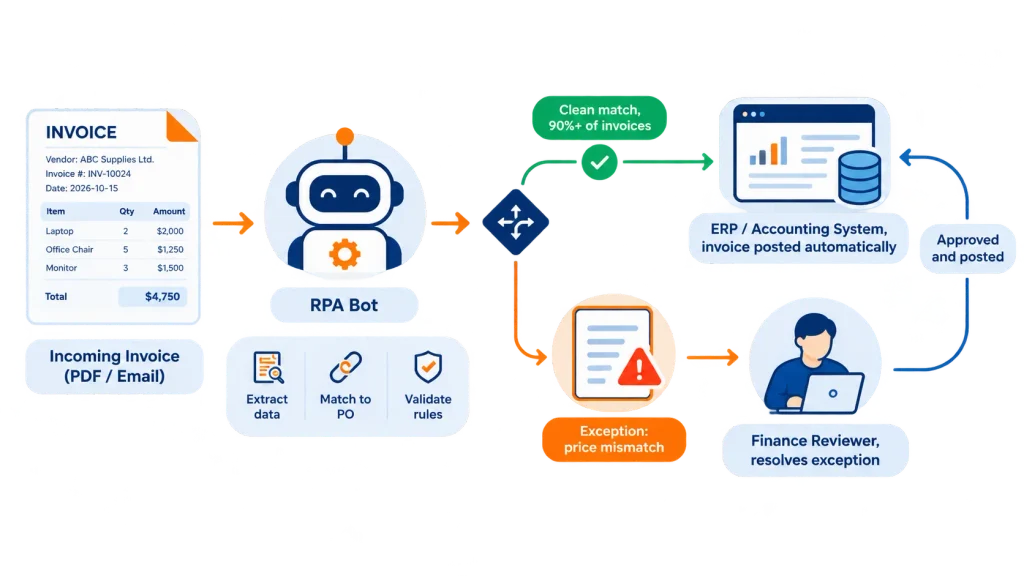
Bots usually work through the same screens a person would use. A bot can log into an accounting platform, extract data, compare it against rules and take an action, without changing the underlying software. That is why finance teams can often adopt RPA with less IT involvement than larger system projects.
The DevSouq Scope Clarity Session
A free, 30-minute session where you leave knowing the real cost, real timeline, and real risks of your project, whether you ever build with us or not.
Book Your Free Scope Clarity Session →Two related ideas are worth separating:
- Traditional RPA follows fixed rules. If a condition is met, it performs a defined action.
- AI-enhanced (or agentic) automation can read unstructured documents, interpret ambiguous cases and adapt within guardrails.
Most mature programs use both. Strict RPA handles the clearly defined work, and AI handles the judgment-heavy parts.
Is This a Good Fit for RPA? A Quick Test
Here is a question that comes up often: Finance reconciles invoices against purchase orders. Is this scenario a good fit for RPA?
Yes. Invoice-to-PO matching is high-volume, rule-based and uses structured data, so it is one of the strongest RPA candidates in finance. The same logic answers the common quiz question “Why is finance often a strong candidate for RPA?” The correct answer is that it includes high-volume, rule-based tasks.
Use this checklist before automating any process:
| Question | Good fit for RPA | Poor fit for RPA |
|---|---|---|
| Volume | High and recurring | Rare or one-off |
| Rules | Clear and documented | Judgment-based |
| Data | Structured and digital | Handwritten, inconsistent or scanned |
| Exceptions | Few, easy to route | Frequent and complex |
| Systems | Stable screens or APIs | Interfaces that change often |
| Error cost | High (money, compliance) | Low |
If most answers fall in the left column, the process is a candidate. If not, fix the process or consider a different approach first.
RPA in Finance by the Numbers
| Metric | Figure | Source |
|---|---|---|
| Finance leaders who have implemented or plan to implement RPA | ~80% | Gartner, cited via IBM |
| Banks combining AI and RPA in workflows | 82% | KPMG |
| Financial service providers using AI-powered process automation | 44% | Gartner |
| BFSI share of the global RPA market | 36.52% | Precedence Research |
| Projected global RPA in finance market size | USD 12.5 billion | Verified Market Reports |
Benefits of RPA in Finance
| Benefit | What it looks like in practice |
|---|---|
| Cost savings | Fewer manual hours on data entry and reconciliation |
| Fewer errors | Bots apply the same rules every time, with no fatigue-related mistakes |
| Faster processing | Invoice matching or report generation in minutes, not hours |
| Stronger compliance | Every action can be logged, creating an audit trail |
| Better customer experience | Faster onboarding and payment handling |
| Better use of staff time | People move to analysis, exceptions and client work |
| Scalability | Volume can grow without a proportional rise in headcount |
Scalability holds only while the process stays rule-based. Once exceptions multiply, so does the manual work.
RPA Use Cases in Finance
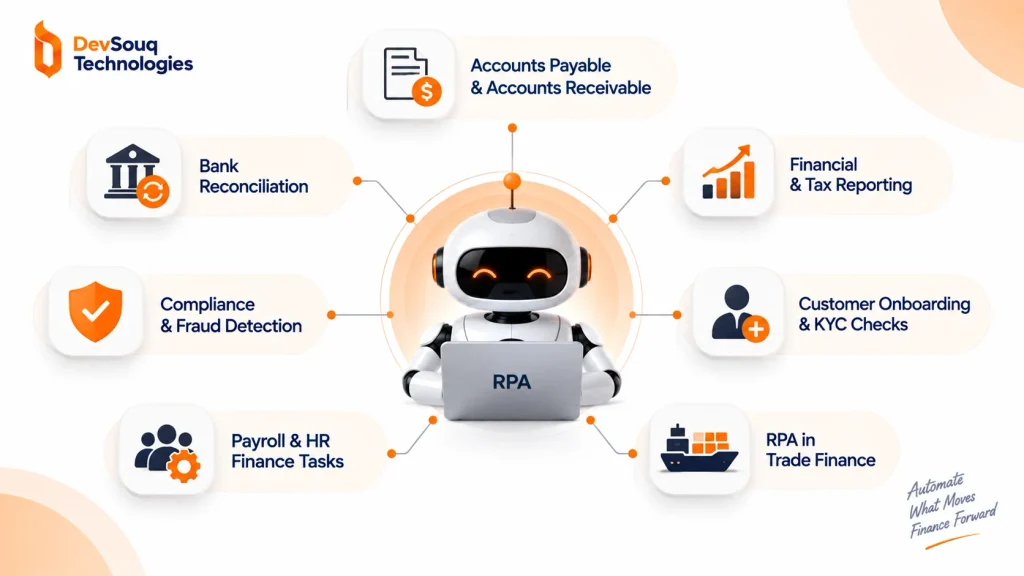
Accounts Payable: Invoice Processing and PO Matching
Bots extract data from invoices, perform two-way or three-way matching against purchase orders and delivery notes, and route mismatches for approval. Clean matches post automatically, which cuts manual entry and speeds approvals. Invoice processing is widely seen as the best first use case because volume is high and rules are clear.
If your AP workflows have outgrown spreadsheets and disconnected tools, custom accounting software development can bring them into one system. For subscription billing, see custom recurring billing software.
Accounts Receivable and Deductions Management
For accounts receivable RPA, bots generate invoices, send payment reminders, apply incoming cash to open invoices and flag customers whose invoice aging suggests late-payment risk.
Deductions are a good example of a narrow, high-value task. When customers short-pay an invoice, bots can match the deduction to remittance data, assign a reason code and route disputes to the right person. This speeds cash application and reduces overdue balances.
Bank and Payment Reconciliation
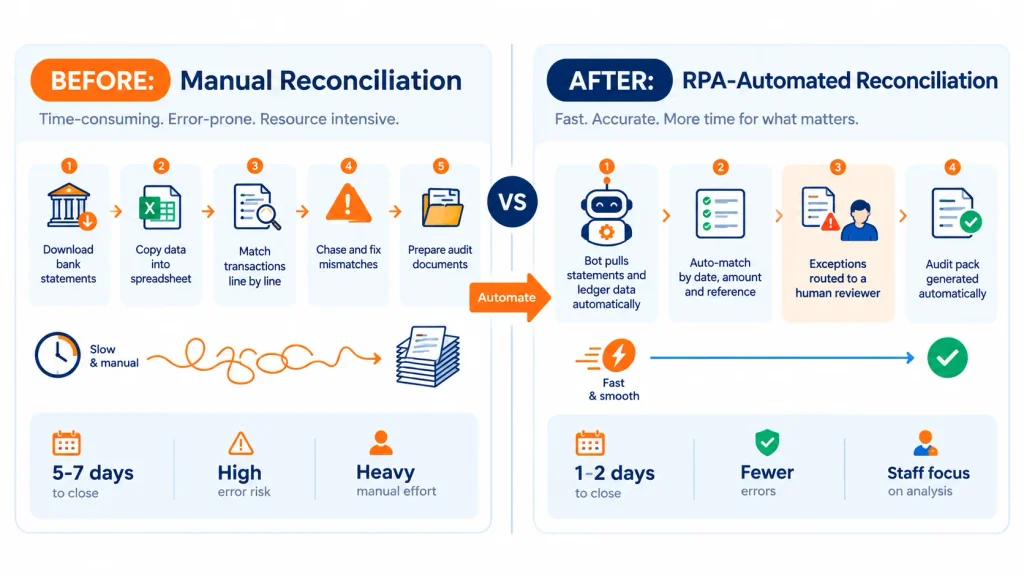
Bots merge data from multiple accounts and statements, then compare it against ledger entries by date, amount and reference number. Well-defined exceptions are resolved automatically, and unusual cases go to a reviewer. Once balances are confirmed, bots can assemble supporting documentation for audit.
Financial Reporting and Close
Bots collect general ledger data, check completeness, classify transactions and populate report templates for scheduled distribution. Once reporting data is clean, the next step is turning it into insight, which is covered in our guide to business intelligence for finance.
Expense Auditing, Journal Entries and Master Data
Three smaller tasks suit RPA well:
- Expense reports: check receipts, flag policy violations and validate amounts.
- Recurring journal entries: pull data from several systems and post consistently.
- Vendor and customer master data: update records in the ERP to keep data clean and compliant.
Tax Reporting
Bots collect data across systems, classify transactions, reformat trial balances and flag regulatory changes that could affect the tax position. Tax work has complex rules, so expect a longer build and more review than AP automation.
Compliance, AML and Fraud Detection
RPA bots can monitor regulatory updates and alert owners, screen customers and transactions against lists, and cross-check payment details. In AML work, bots collect data, populate alert files and assemble evidence, while analysts make the decisions. Paired with AI, bots can summarise cases to speed up investigations.
Customer Onboarding and KYC
Onboarding involves verifying identity documents, running background checks and setting up accounts. AI-enhanced bots can extract data from unstructured documents and request missing items from the client, which shortens onboarding.
Payroll and HR-Related Finance Tasks
Bots consolidate employee data, validate timesheets, flag unusual overtime for review and generate payslips with the correct deductions.
RPA in Trade Finance
Trade finance relies on documents such as letters of credit and bills of lading, checked across parties and jurisdictions. Teams usually start with document verification and sanctions screening before moving to multi-party workflows.
RPA for Financial Services: Banks, Credit Unions and Mortgage
- Banks: onboarding, fraud checks and lending data preparation.
- RPA in credit unions: lean teams on older core systems are a common fit. Typical starting points are member onboarding checks, loan document handling and payment reconciliation.
- Mortgage RPA: document collection, income and data verification, and file quality checks before underwriting.
Which Finance Process Should You Automate First?
| Use case | Ease | Expected return | Notes |
|---|---|---|---|
| Invoice processing | High | High | Best first project |
| Expense report auditing | High | Medium-high | Clear policy rules |
| Journal entries | High | Medium | Recurring entries only |
| Accounts receivable | Medium | High | Depends on remittance data quality |
| Bank reconciliation | Medium | Medium-high | Exceptions need routing |
| Master data updates | Medium | Medium | Strong for data integrity |
| Financial statement prep | Medium-low | High | Needs clean data sources |
| Tax reporting | Low | High | Complex rules |
| Compliance reporting | Low | High | Needs governance |
This ranking follows the common ease-versus-return approach used in industry guides. Your own ratings will depend on your systems and data quality.
Limitations of RPA in Banking and Finance (2026)
RPA is not a fit for everything, and the limits matter most in regulated environments.
| Limitation | Why it matters | How to manage it |
|---|---|---|
| Brittle bots | Bots that rely on screens can break when an interface changes | Prefer APIs where possible, test after system updates, monitor bot failures |
| Unstructured data | Scanned or free-text documents are hard for rule-based bots | Add AI-based document extraction |
| Exception-heavy processes | Frequent edge cases create manual rework | Keep a human review step and fix the process first |
| Maintenance burden | Bot count grows, and so does upkeep | Assign owners, reuse components, retire unused bots |
| Security | Bots hold credentials and touch sensitive data | Role-based access, encryption, credential vaulting, regular audits |
| Explainability | Auditors expect to understand how a decision was reached | Log every action and keep decision rules documented |
| Process quality | Automating a broken process just makes it fail faster | Map and simplify the process before automating |
| Governance gaps | No ownership leads to sprawl and risk | Define a governance model and success metrics |
The practical rule: RPA is good at doing what you’ve already defined. It is poor at working out what to do when something unexpected happens.
RPA vs DPA vs Workflow Automation in Financial Services
| Approach | What it does | Best for |
|---|---|---|
| RPA | Mimics human actions on existing screens | Quick automation on legacy systems |
| DPA (digital process automation) | Redesigns end-to-end workflows using APIs, forms and rules engines | Processes you can modernise properly |
| Workflow automation | Routes tasks and approvals between people and systems | Approval chains and handoffs |
Banks and credit unions often use RPA as a bridge on legacy systems and shift to DPA where they can redesign the process itself.
RPA and AI in Finance
AI expands what RPA can handle. It can:
- Help bots adapt when underlying business rules change.
- Find patterns in historical data to identify which data points matter.
- Predict outcomes, for example the likelihood a customer pays on time, which can inform payment terms.
This is often called agentic automation: the system makes contextual decisions inside defined guardrails. Most finance teams still keep a human checkpoint at key decisions, especially for compliance and customer funds. For how this plays out in banking, see intelligent automation in banking.
RPA Trends in Finance for 2026
- RPA plus AI as the default. Pure rule-based bots are increasingly paired with AI for document handling and exception triage.
- Agentic automation with guardrails. More teams are testing agents for judgment-heavy work while keeping human approval.
- Governance first. Larger programs focus on ownership, monitoring and audit trails rather than just bot counts.
- Process review before tooling. Teams that map processes first tend to avoid automating poor fits.
- Integration over screen-scraping. Where APIs exist, they are preferred over screen-based bots for stability.
RPA Tools for Finance: What to Look For
Well-known options include UiPath, Automation Anywhere, Microsoft Power Automate, IBM Robotic Process Automation and KEYENCE RK, plus Excel-focused tools such as DataSnipper. Pricing and features change, so confirm current details with each vendor.
Judge any platform on:
- Support for the systems you already run (ERP, banking portals, document formats)
- Cloud or on-premises deployment, including RPA on cloud for financial services
- Centralised monitoring and audit logging
- Reusable components, so you don’t rebuild for each process
- Security controls and credential management
- Total cost, including build and maintenance
Best Practices for Implementing RPA in Finance
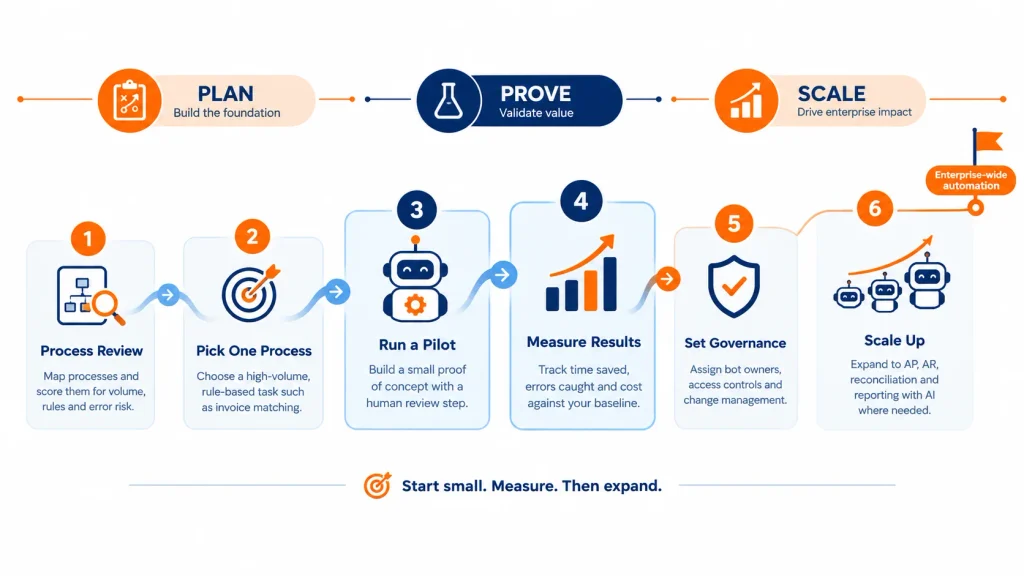
- Pick an automation-ready process. High volume, clear rules, costly errors.
- Run a small proof of concept before a wider rollout.
- Document the process first. Fix inefficiencies before automating them.
- Combine RPA and AI deliberately. RPA for structured tasks, AI for unstructured inputs.
- Choose a platform that scales. Flexible deployment and central oversight matter more as bot counts grow.
- Set governance early. Owners, access rules, change control.
- Measure and refine. Track time saved, transactions processed and errors caught.
How to Estimate RPA ROI
You don’t need a complex model. Use this structure:
- Baseline: hours per month × loaded hourly cost, plus error and rework cost.
- Automatable share: the realistic percentage of volume the bot can handle without human help.
- Total automation cost: licences, build, infrastructure, maintenance and monitoring over the same period.
- Compare: (baseline cost × automatable share) − automation cost.
Run this on one pilot process first. A pilot gives you real numbers instead of vendor estimates.
Challenges of RPA Adoption in Finance
| Challenge | Why it happens | How organizations address it |
|---|---|---|
| Data security | Bots handle sensitive data and connect to many systems | Encryption, role-based access, prompt patching, regular audits |
| Resistance to change | Staff worry about their roles | Training, upskilling and clear communication |
| Process fit | Not every process is a good candidate | Assess volume, rule clarity and error risk first |
| Governance gaps | Programs launch without clear ownership | Define a governance model and assign owners |
Real-World Examples of RPA in Finance
These are publicly reported third-party deployments, included for illustration only. They are not DevSouq client work.
| Organization | Process automated | Reported outcome |
|---|---|---|
| Financial services company handling complex legal contracts | Contract review for pricing changes | Hundreds of contracts reviewed in hours instead of the equivalent manual effort |
| Major bank in Brazil | Daily reporting | Several staff hours saved per employee per day |
| Global specialty finance company | Document governance, due diligence, invoicing | Double-digit increase in compound annual growth rate reported after automation |
| Car leasing company in Finland | Invoice processing | Large share of monthly invoice volume automated |
| Large bank in South Asia | Customer screening and sanctions checks | Majority of new customer screenings automated with high sanctions-check accuracy |
The pattern is consistent: start with one well-bounded process, measure the result and use it to justify expansion. We apply the same process-first approach in our broader finance software development and IT services.
Getting Started with RPA in Finance
Before choosing a vendor, map which processes are truly automation-ready, what data governance exists and how success will be measured. Skipping this step often leads to automating a poor-fit process, which slows adoption.
If your current systems can’t support these workflows, scoping custom accounting software development is a practical first step. For teams building connected finance platforms, microservices architecture in financial services is worth reviewing, and financial modelling software pairs naturally with cleaner automated data.
The DevSouq Scope Clarity Session
A free, 30-minute session where you leave knowing the real cost, real timeline, and real risks of your project, whether you ever build with us or not.
Book Your Free Scope Clarity Session →Conclusion
RPA in finance pays off when it is applied to the right work: high-volume, rule-based, well-documented processes such as invoice matching, reconciliation and recurring reporting. It struggles with exceptions, messy documents and unstable interfaces, which is why process review comes before tooling and why AI and human checkpoints belong in the plan.
Start with one process, measure it, then expand. If you’re not sure which process fits, book a process review with DevSouq and we’ll help you map it, size the return and define a realistic first project.
FAQs
What is RPA in finance?
RPA in finance is the use of software bots to perform repetitive, rule-based tasks such as invoice data entry, purchase order matching, bank reconciliation and report generation. The bots work through the same screens a person uses, so teams can automate processes without replacing their accounting or ERP systems.
Is matching invoices to purchase orders a good fit for RPA?
Yes. Invoice-to-PO matching is high-volume, rule-based and uses structured data, which is exactly what RPA handles well. Bots compare quantities, prices and vendor details, approve clean matches and route mismatches to a person. Poor-quality scans or inconsistent formats may need AI-based extraction first.
Why is finance a strong candidate for RPA?
Finance includes many high-volume, rule-based tasks with structured data and clear pass-or-fail logic, such as reconciliation, invoice matching and reporting. Errors are costly and audit trails matter, so consistent, logged bot actions add value. The correct quiz answer is high-volume, rule-based tasks.
What are the limitations of RPA in banking?
Bots can break when screens change, struggle with unstructured documents and add maintenance work as bot counts grow. Exception-heavy or judgment-based processes fit poorly. Banks also face security, access-control and audit-explainability requirements. Pairing RPA with AI and strong governance reduces these limits but does not remove them.
What is the difference between RPA and DPA in financial services?
RPA mimics human actions on existing screens, so it suits quick automation of legacy systems. Digital process automation redesigns end-to-end workflows using APIs, forms and rules engines. Many banks use RPA as a bridge for legacy systems and DPA where they can modernise the process itself.
How do you measure RPA ROI in finance?
Compare the baseline cost of the process, including hours, volume, error and rework cost, with the automation’s total cost over the same period, including licences, build, maintenance and monitoring. Track hours saved, error rate and cycle time before and after a pilot to get real numbers.
Can RPA be used in accounts receivable?
Yes. Bots send invoice reminders, apply incoming cash to open invoices, match remittances and flag overdue accounts. They can also sort short-payments and deductions into reason codes for review. This shortens collection cycles and improves cash visibility, provided remittance data is reasonably consistent.
Is RPA suitable for credit unions and smaller institutions?
Yes. Credit unions often run lean teams on older core systems, which is where RPA helps most. Common starting points are member onboarding checks, loan document handling and payment reconciliation. Start with one bounded process and confirm vendor and security requirements before scaling.