Quick Answer
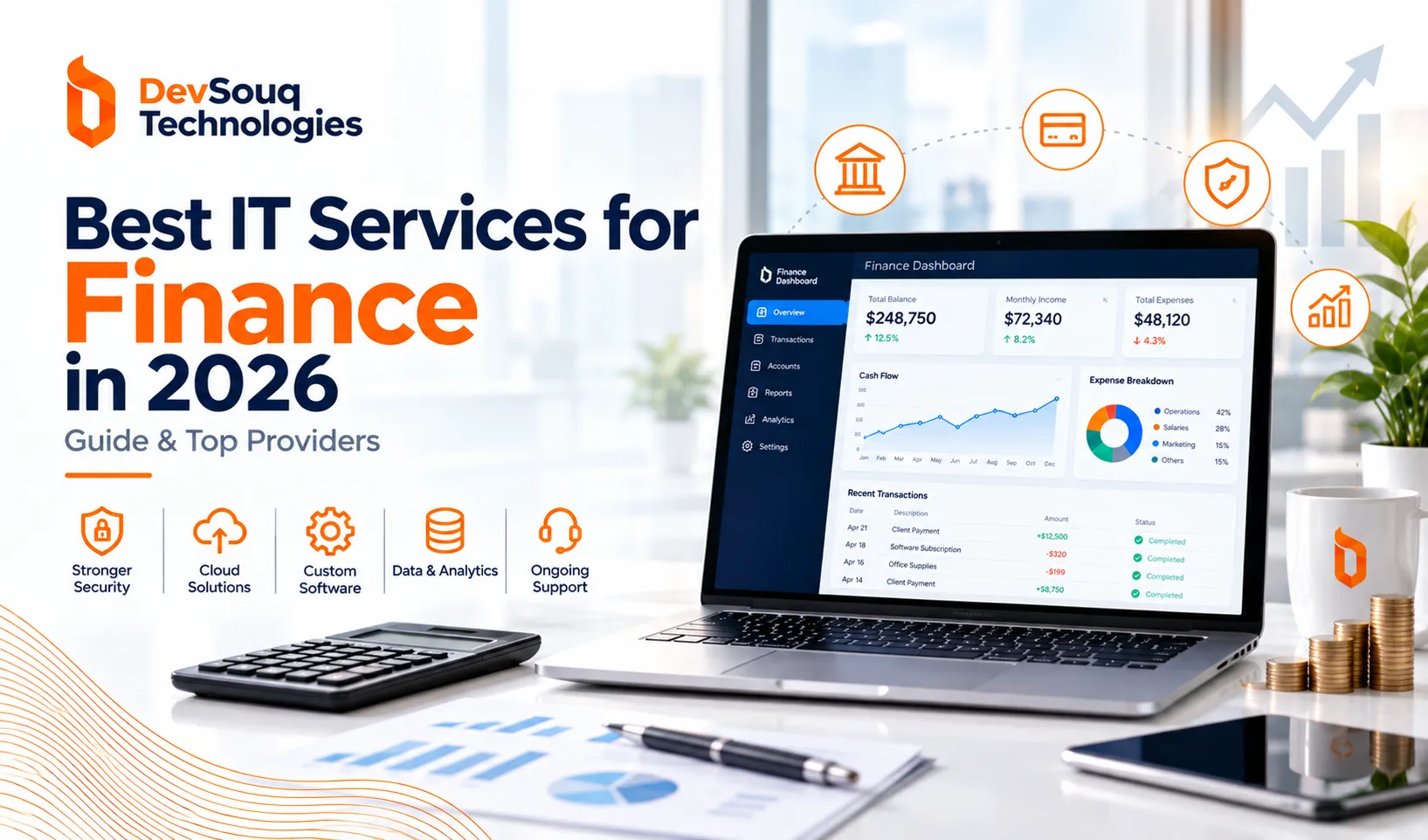
IT services for finance cover cybersecurity, compliance automation, cloud modernization, and custom software (accounting, lending, insurance, billing, and portfolio management) built to meet the finance industry’s strict security and regulatory demands. The right setup cuts downtime, lowers compliance risk, and replaces rigid off-the-shelf tools with systems that actually fit your workflows. If you’re unsure where your current stack falls short, DevSouq offers a free scope review to map out exactly what your institution needs no commitment required.
Key Takeaways
- IT services for finance combine traditional managed IT with finance-specific disciplines: cybersecurity, compliance automation, and custom software development.
- Financial institutions face disproportionately high cyberattack rates and steep downtime costs, making specialized IT support essential rather than optional.
- Custom software for accounting, lending, insurance billing, claims, recurring billing, and portfolio management often outperforms generic tools because it’s built around real financial workflows.
- IT outsourcing for finance is a practical way to access specialized skills without the cost of building every capability in-house.
- The right IT partner should show finance-specific experience, a real security stack, and deep compliance fluency not just general IT competence.
The DevSouq Scope Clarity Session
A free, 30-minute session where you leave knowing the real cost, real timeline, and real risks of your project, whether you ever build with us or not.
Book Your Free Scope Clarity Session →What Are IT Services for Finance?
IT services for finance are the specialized technology functions infrastructure, security, compliance tooling, software development, and support that financial institutions need to operate safely and efficiently. Unlike general business IT, finance IT solutions are built around three constraints that most industries don’t share to the same degree:
- Regulatory exposure. Frameworks like SOX, GLBA, PCI-DSS, FINRA, and GDPR carry real financial and legal penalties for non-compliance.
- High-value targets. Financial data and payment rails are among the most attacked assets in any economy.
- Zero tolerance for downtime. A trading platform, loan origination system, or payment gateway going offline has immediate, measurable financial consequences.
Because of this, IT services for finance companies typically blend traditional managed IT (help desk, network administration, endpoint management) with finance-specific disciplines: regulatory technology, core banking integration, and custom financial software development.
Why the Finance Industry Can’t Rely on Generic IT Support
A handful of hard numbers explain why IT support for banking and finance industry organizations looks different from IT support anywhere else.
Cyberattacks target finance disproportionately. Financial services firms are reported to face cyberattacks at a rate several hundred times higher than companies in other sectors, making continuous monitoring and threat detection non-negotiable rather than optional.
Downtime is expensive. Research from the Ponemon Institute estimates unplanned IT downtime can cost financial institutions in the range of $500,000 per hour once you factor in lost transactions, SLA penalties, and reputational damage. Few other industries feel outages this acutely in dollar terms.
Compliance is a moving target. Regulations evolve, and financial institutions operating across state or national lines often have to satisfy overlapping frameworks simultaneously a challenge that pure infrastructure vendors are rarely equipped to solve.
Legacy systems are still everywhere. Many banks and insurers still run core platforms built decades ago. Modernizing them without disrupting live financial operations requires a level of domain expertise that generalist IT teams typically don’t have.
Core IT Services Every Financial Institution Needs
The table below summarizes the services that make up a mature finance IT solutions stack, along with what each one is actually protecting or enabling.
| Service Area | What It Covers | Why It Matters for Finance |
|---|---|---|
| Cybersecurity & Threat Management | Firewalls, endpoint protection, SOC monitoring, zero-trust architecture, penetration testing | Protects customer funds and data from breaches and ransomware |
| Regulatory Compliance & GRC | Automated compliance tracking, audit-ready reporting, data governance | Reduces risk of fines under SOX, GLBA, PCI-DSS, FINRA, and similar frameworks |
| Cloud & Legacy Modernization | Migration of core systems to secure, scalable cloud environments | Improves uptime, disaster recovery, and cost predictability |
| Data Analytics & Business Intelligence | Dashboards, risk analytics, customer behavior insights | Supports underwriting, fraud detection, and strategic decisions |
| AI & Intelligent Automation | Fraud scoring, document processing, chat-based support, back-office automation | Cuts operational cost and speeds up customer-facing processes |
| Core Banking & Payment Integration | Real-time payment rails, ISO 20022 messaging, API-based connections | Keeps transaction infrastructure current and interoperable |
| Disaster Recovery & Business Continuity | Backup systems, failover infrastructure, recovery testing | Minimizes the financial and reputational cost of outages |
| Managed IT & End-User Support | Help desk, network administration, 24/7 monitoring | Keeps daily operations running without in-house overhead |
Cybersecurity and Threat Management
Cybersecurity sits at the top of almost every finance IT solutions priority list, and for good reason a single breach can trigger regulatory penalties, customer churn, and long-term brand damage. A mature security program for a bank or lender typically includes intrusion detection, multi-factor authentication, endpoint protection, and increasingly, zero-trust network architecture that assumes no user or device is trustworthy by default. Continuous vulnerability assessments and 24/7 security operations center (SOC) monitoring have become the baseline expectation rather than a premium add-on.
Regulatory Compliance and GRC
Compliance technology automates the parts of regulatory adherence that used to eat up hours of manual work: tracking rule changes, generating audit trails, and producing reports for examiners. For institutions operating under multiple regimes, compliance platforms that can map policy changes to specific systems and flag inconsistencies in real time are quickly becoming standard rather than a differentiator.
Cloud and Legacy System Modernization
Cloud adoption in financial services has been more cautious than in other industries because of data residency and security concerns, but that’s changing. Analyst forecasts suggest more than half of enterprises globally will run the majority of their workloads on cloud platforms within the next few years. For finance specifically, cloud modernization means moving core systems off brittle legacy infrastructure without interrupting live transaction processing a migration that needs careful sequencing, not a lift-and-shift approach.
AI, Automation, and Fraud Detection
Machine learning models now sit inside fraud detection engines, credit risk scoring, and customer service chat tools across the industry. The value isn’t the novelty of AI it’s the speed: models can flag anomalous transactions in milliseconds, something manual review processes simply can’t match at scale.
Core Banking and Payment Modernization
As payment rails modernize globally, financial institutions are under pressure to support real-time payments and messaging standards like ISO 20022, which carries richer transaction data than older formats. IT solutions for finance industry organizations increasingly need to plan for this shift now, since it affects everything from fraud detection to cross-border settlement.
Custom Software: The Backbone of Modern Finance IT Solutions
Off-the-shelf platforms can only go so far in finance, where workflows, compliance requirements, and customer expectations are often too specific for generic tools. This is where custom financial software development becomes part of the IT services conversation rather than a separate line item.
A few areas where purpose-built software consistently outperforms generic alternatives:
- Accounting and financial operations. General ledgers, reconciliation, and reporting tools built around a company’s actual chart of accounts and workflows reduce manual reconciliation work far more effectively than one-size-fits-all accounting suites. Custom accounting software development is often the starting point for finance teams that have outgrown spreadsheets and rigid commercial packages.
- Lending and loan servicing. Loan origination, servicing, and collections each involve compliance rules that vary by loan type and jurisdiction. Purpose-built loan servicing software can automate payment schedules, escrow handling, and delinquency workflows in ways that generic CRM or ERP tools weren’t designed to handle.
- Insurance operations. Insurers deal with two particularly complex workflows: billing cycles tied to policy terms, and claims that need to move quickly without opening the door to fraud. Insurance billing software and claims management software built specifically for these workflows tend to cut processing time significantly compared to adapting generic case-management tools.
- Recurring revenue and subscription billing. Fintechs, SaaS-based financial products, and membership-driven financial services all depend on accurate, flexible billing cycles. Recurring billing software built around a company’s specific pricing logic avoids the reconciliation headaches that come from forcing complex billing rules into a generic payment processor.
- Investment and portfolio management. Wealth managers and investment firms need real-time visibility into holdings, performance, and risk exposure across multiple asset classes. Investment portfolio management software tailored to a firm’s specific reporting and compliance needs gives advisors and clients a far clearer picture than spreadsheets or generic portfolio trackers.
Companies like DevSouq, a custom finance software development company, work specifically in this space building accounting, lending, insurance, billing, and portfolio management systems designed around a financial institution’s actual processes rather than forcing those processes into generic software. For institutions weighing whether to buy, adapt, or build, this kind of specialized development partner is often the difference between software that fits the business and software the business has to work around.
10 Best IT Outsourcing for Finance Companies in 2026
Financial institutions face growing pressure. They must modernize legacy systems, adopt AI, meet strict compliance rules, and defend against rising cyber threats. Few firms can do all of this in-house, so more banks, fintechs, and insurers are outsourcing IT to specialists.
To help you choose, we ranked the top IT outsourcing companies for finance in 2026. We looked at financial services expertise, security and compliance, modernization capabilities, delivery scale, and client reputation. Each profile below follows the same structure, so you can compare vendors side by side.
1.DevSouq Technologies
Company Snapshot
| Detail | Information |
|---|---|
| Founded | 2021 |
| Headquarters | Austin, Texas, USA |
| Delivery Center | Austin, Texas, USA |
| Company Size | 10–50 specialists |
| Global Presence | 53+ countries |
| Stock Listing | Privately held |
| Pricing Tier | Premium quality, value pricing |
Overview
Most financial companies face a frustrating choice. They can pay premium rates for a big-name consultancy, or they can save money with a low-cost vendor and risk quality, security, and missed deadlines. DevSouq Technologies was built to remove that trade-off.
DevSouq delivers the engineering standards, security discipline, and senior-level attention you expect from top-tier firms, at a fraction of their cost. Its US headquarters in Austin gives clients clear contracts, accountability, and easy communication. Its engineering center in Lahore provides highly skilled developers at rates that make every dollar go further.
The result is simple: enterprise-grade software for financial businesses, without enterprise-grade invoices.
Financial Services Expertise
In finance, software has to do more than work. It has to be secure, reliable, and trusted with real money and sensitive data. DevSouq builds every solution with these priorities from day one, following industry best practices, rigorous testing, and strict security standards across the entire development cycle.
DevSouq’s philosophy is to deliver real business value, not just code. The team takes time to understand how a lender, payments company, or investment platform actually operates, then designs technology that improves efficiency, reduces risk, and elevates the customer experience.
Key Services for Finance
Custom fintech software development: Lending platforms, customer portals, internal finance tools, and real-time reporting dashboards, designed around your workflows rather than forced into off-the-shelf templates.
AI and machine learning: Turn financial data into a competitive edge with solutions for fraud detection, credit risk support, customer insights, and intelligent process automation.
Web and mobile banking apps: Fast, secure, and beautifully designed apps for banking, payments, and investing, complete with secure payment gateway integrations and mobile-first performance.
DevOps and cloud engineering: Automated CI/CD pipelines, infrastructure as code, Kubernetes orchestration, security automation, and 24/7-ready monitoring. Your releases become faster, safer, and more reliable, with less downtime.
UI/UX design: Financial products are complex, but using them shouldn’t be. DevSouq’s research-led design builds interfaces that customers understand instantly and trust completely.
Quality assurance: A dedicated QA team tests for performance, reliability, and security, because in finance, a single bug can cost money and reputation.
Notable Platforms and Technologies
DevSouq Technologies partners with nearly every major financial software vendor, including core banking providers such as Temenos, Mambu, and Thought Machine, and cloud providers AWS, Microsoft Azure, and Google Cloud. It has also committed billions of dollars to generative AI investment, which gives clients access to mature AI accelerators.
Pros
- Premium quality at a fraction of the cost: Senior-level engineering at rates well below US, European, and large Indian consultancies
- Direct access to senior experts: Work with experienced engineers and leadership, not layers of account managers
- US accountability, global efficiency: American headquarters for contracts and communication, offshore delivery for savings
- Security-first development: Best practices and strict security standards built into every stage
- Full-cycle delivery under one roof: Strategy, design, development, DevOps, and QA from a single team
- Startup speed: Agile, flexible teams that move as fast as your business does
- Transparent pricing: Clear estimates upfront, based on your real scope, with no surprise costs
Things to Consider
- DevSouq is a focused, boutique team, so it is best suited to targeted products and platforms rather than enterprise-wide programs for the world’s largest banks
- It builds custom solutions rather than selling a proprietary core banking system, which gives clients full ownership but means core platform replacements would involve third-party software
- Firms with strict data residency rules should discuss hosting and access arrangements early, as with any offshore partner
Engagement Models
- Fixed-price projects: Ideal for MVPs and clearly defined builds
- Dedicated development teams: Your own extended engineering team, fully managed by DevSouq
- Time and materials: Flexible capacity for evolving requirements
- Ongoing support and maintenance: Long-term care to keep your systems secure and up to date
Best For
Fintech startups, digital lenders, payment companies, wealth tech platforms, and small-to-mid-sized financial institutions that want premium software quality while keeping budgets under control.
Verdict
DevSouq Technologies proves that financial businesses don’t have to choose between quality and cost. It pairs premium engineering, security-first delivery, and personal senior-level attention with pricing that growing companies can actually afford. For fintechs and financial firms that want to launch faster, scale smarter, and spend wisely, DevSouq is one of the most cost-efficient premium partners in 2026.
2. Tata Consultancy Services (TCS)
Company Snapshot
| Detail | Information |
|---|---|
| Founded | 1968 |
| Headquarters | Mumbai, India |
| Company Size | 600,000+ employees |
| Global Presence | 50+ countries |
| Stock Listing | NSE: TCS, BSE |
| Pricing Tier | Mid to Premium |
Overview
TCS is part of the Tata Group and one of the largest IT services companies in the world. Banking, financial services, and insurance (BFSI) is its biggest industry segment. What sets TCS apart is that it offers both IT outsourcing services and its own proprietary financial software, which makes it a one-stop partner for core system replacement.
Financial Services Expertise
TCS has decades of experience running technology for global banks, insurers, and asset managers. It is especially strong in large-scale application management and long-term operations contracts, including major life and pensions outsourcing deals in the UK. Its teams handle both the technology and, in many cases, the business processes around it.
Key Services for Finance
Core banking implementation, application development and maintenance, cloud migration, digital banking, business process services, cybersecurity, and data analytics.
Notable Platforms and Partnerships
TCS BaNCS is its flagship financial services software suite, covering core banking, payments, capital markets, and insurance. TCS also offers AI and automation platforms and holds partnerships with all major hyperscalers.
Pros
- Proprietary TCS BaNCS platform plus implementation and support from one vendor
- Very stable company with strong financial health
- Excellent at long-term, large-scale operations contracts
- Competitive pricing thanks to large offshore delivery centers
Cons
- Process-heavy culture can feel slow for agile fintechs
- Innovation and design capabilities are less known than those of consulting-led rivals
- Using BaNCS can increase long-term vendor dependence
- Time zone gaps for clients in the Americas
Engagement Models
Fixed-price projects, time and materials, long-term managed services, and platform-based business process outsourcing.
Best For
Banks and insurers that want to replace legacy core systems and hand ongoing operations to a single, reliable partner.
Verdict
TCS is ideal for institutions that value stability, scale, and a proven platform. It is less suited to startups that need fast, experimental product development.
3. Infosys
Company Snapshot
| Detail | Information |
|---|---|
| Founded | 1981 |
| Headquarters | Bengaluru, India |
| Company Size | 300,000+ employees |
| Global Presence | 50+ countries |
| Stock Listing | NYSE: INFY, NSE |
| Pricing Tier | Mid |
Overview
Infosys is a leading global IT services firm and one of the pioneers of the offshore delivery model. Financial services is its largest revenue segment. Through Infosys Finacle, it also owns one of the most widely used core banking platforms in the world, used by banks across Asia, the Middle East, Africa, and Europe.
Financial Services Expertise
Infosys works with major banks on digital banking, core modernization, payments, and lending. Its Finacle business gives it hands-on product knowledge of how banks run deposits, loans, and payments. It also serves insurers and has a dedicated insurance operations business.
Key Services for Finance
Core banking (Finacle), digital channel development, cloud transformation, AI and automation, data analytics, cybersecurity, and application management.
Notable Platforms and Partnerships
Finacle for core and digital banking, Infosys Topaz for AI, and Infosys Cobalt for cloud services. It partners with AWS, Microsoft, and Google Cloud.
Pros
- Owns a proven, global core banking platform
- Strong automation and AI tooling that can reduce operating costs
- Good balance of price and capability
- Mature delivery processes and quality standards
Cons
- A 2023 cyber incident at its US insurance subsidiary is a reminder to vet any vendor’s security closely
- Can be less flexible on smaller, fast-moving projects
- Heavy reliance on offshore teams may not suit all regulators or clients
- Finacle is less common in North America than in other regions
Engagement Models
Fixed-price, time and materials, managed services, and platform-as-a-service for Finacle.
Best For
Retail and commercial banks, especially in emerging markets, that want to upgrade core systems and launch digital banking.
Verdict
Infosys is a strong all-rounder with a real banking product behind it. It offers good value for mid-to-large banks focused on digital growth.
4. Cognizant
Company Snapshot
| Detail | Information |
|---|---|
| Founded | 1994 |
| Headquarters | Teaneck, New Jersey, USA |
| Company Size | 300,000+ employees |
| Global Presence | 40+ countries |
| Stock Listing | Nasdaq: CTSH |
| Pricing Tier | Mid |
Overview
Cognizant is a US-headquartered IT services company with large delivery centers in India. Banking, financial services, and insurance is one of its biggest business areas. It is known for dependable application support and modernization work for North American and European financial firms.
Financial Services Expertise
Cognizant has long-standing relationships with large US banks and insurers. It is particularly strong in insurance technology and in keeping complex legacy applications running while gradually modernizing them.
Key Services for Finance
Application development and maintenance, legacy modernization, insurance platforms, data and analytics, cloud, AI, and business process outsourcing.
Notable Platforms and Partnerships
Cognizant offers AI platforms such as Cognizant Neuro and partners with major cloud providers and insurance software vendors like Guidewire and Duck Creek.
Pros
- US headquarters and strong onshore presence help with communication and compliance
- Excellent at long-term application management
- Deep insurance industry experience
- Competitive pricing compared to consulting-led firms
Cons
- Less known for cutting-edge product innovation
- Growth has trailed some peers in recent years
- Quality can vary across very large accounts
- Less proprietary banking software than TCS or Infosys
Engagement Models
Time and materials, fixed-price projects, dedicated teams, and multi-year managed services.
Best For
Mid-to-large US and European banks and insurers that need a steady long-term partner for applications and operations.
Verdict
Cognizant is a reliable, practical choice for firms that want strong support and gradual modernization without premium pricing.
5. Capgemini
Company Snapshot
| Detail | Information |
|---|---|
| Founded | 1967 |
| Headquarters | Paris, France |
| Company Size | 340,000+ employees |
| Global Presence | 50+ countries |
| Stock Listing | Euronext Paris: CAP |
| Pricing Tier | Mid to Premium |
Overview
Capgemini is one of Europe’s largest IT services and consulting groups. It serves banks, insurers, and wealth managers worldwide, with an especially strong position in Europe. Its consulting arm, Capgemini Invent, gives it strategy and design capabilities alongside technology delivery.
Financial Services Expertise
Capgemini publishes some of the industry’s best-known research, including its World Retail Banking, World Wealth, and World Payments reports. This reflects deep knowledge of the sector. It also understands European regulations such as GDPR and DORA well. In 2025 it agreed to acquire WNS, a business process company with a strong banking and insurance client base.
Key Services for Finance
Consulting, cloud migration, payments modernization, regulatory compliance, data and AI, cybersecurity, and business process services.
Notable Platforms and Partnerships
Partnerships with Microsoft, AWS, Google Cloud, Salesforce, and leading banking software providers.
Pros
- Strong European footprint and regulatory knowledge
- Respected industry research and thought leadership
- Combines consulting and engineering
- Growing operations capabilities through acquisitions
Cons
- Less dominant in North America than US or Indian rivals
- Pricing can approach premium levels
- Integration of large acquisitions can take time
- Large organization may feel bureaucratic to smaller clients
Engagement Models
Consulting engagements, transformation programs, managed services, and business process outsourcing.
Best For
European banks, insurers, and wealth managers, or global firms with major European operations.
Verdict
Capgemini is the go-to choice for European financial institutions that want a partner fluent in local regulation and markets.
6. EPAM Systems
Company Snapshot
| Detail | Information |
|---|---|
| Founded | 1993 |
| Headquarters | Newtown, Pennsylvania, USA |
| Company Size | 50,000+ employees |
| Global Presence | 50+ countries |
| Stock Listing | NYSE: EPAM |
| Pricing Tier | Mid to Premium |
Overview
EPAM is an engineering-first company. Rather than focusing on maintaining existing systems, it specializes in designing and building complex digital products. Its engineering teams are highly rated, and many financial clients use EPAM to build platforms that become core to their business.
Financial Services Expertise
EPAM builds trading platforms, investment tools, mobile banking apps, and data platforms for banks, asset managers, and fintechs. It has a reputation for solving technically difficult problems in capital markets and wealth management.
Key Services for Finance
Custom software engineering, platform development, data engineering, cloud-native development, UX and product design, and AI solutions.
Notable Platforms and Partnerships
EPAM develops accelerators and open-source tools and partners with major cloud and data platforms such as AWS, Azure, Google Cloud, Snowflake, and Databricks.
Pros
- Top-tier engineering talent
- Excellent for building new products from scratch
- Strong product and design thinking
- Flexible and collaborative working style
Cons
- Higher rates than typical offshore vendors
- Less suited to low-cost, routine support work
- Had to relocate large teams from Russia and Belarus after 2022, which disrupted some delivery
- Smaller scale than the largest global integrators
Engagement Models
Dedicated agile teams, time and materials, and product development partnerships.
Best For
Fintechs, investment firms, and banks building new digital products or modern platforms.
Verdict
Choose EPAM when engineering quality matters more than cost. It is a builder, not just a maintainer.
7. Wipro
Company Snapshot
| Detail | Information |
|---|---|
| Founded | 1945 (entered IT in the 1980s) |
| Headquarters | Bengaluru, India |
| Company Size | 230,000+ employees |
| Global Presence | 60+ countries |
| Stock Listing | NYSE: WIT, NSE |
| Pricing Tier | Value to Mid |
Overview
Wipro is a major Indian IT services company with a large financial services business. It is known for cost-effective managed services, infrastructure support, and cybersecurity. Its acquisition of Capco, a respected financial services consultancy, in 2021 greatly strengthened its banking and capital markets expertise.
Financial Services Expertise
Through Capco, Wipro gained deep consulting talent in banking, payments, and wealth management. Combined with Wipro’s large delivery engine, this lets clients get specialist advice and cost-efficient execution from one group.
Key Services for Finance
Managed infrastructure, cloud, cybersecurity, application services, financial services consulting (via Capco), and business process services.
Notable Platforms and Partnerships
Wipro FullStride Cloud for cloud services and Wipro ai360 for AI, along with partnerships with major hyperscalers.
Pros
- Competitive pricing for large-scale managed services
- Capco adds genuine financial services consulting depth
- Strong cybersecurity practice
- Broad global delivery network
Cons
- Growth has lagged some Indian peers in recent years
- Leadership changes have affected consistency
- Innovation reputation is weaker than engineering-led firms
- Service quality can depend heavily on the account team
Engagement Models
Managed services, fixed-price projects, time and materials, and consulting through Capco.
Best For
Banks and insurers seeking to reduce IT operating costs while keeping access to financial consulting expertise.
Verdict
Wipro is a smart value choice, especially when paired with Capco’s advisory strength.
8. HCLTech
Company Snapshot
| Detail | Information |
|---|---|
| Founded | 1976 (as part of HCL) |
| Headquarters | Noida, India |
| Company Size | 220,000+ employees |
| Global Presence | 60+ countries |
| Stock Listing | NSE: HCLTECH, BSE |
| Pricing Tier | Value to Mid |
Overview
HCLTech is one of India’s top IT companies and a leader in infrastructure outsourcing. It is also growing fast in digital engineering and software through its HCLSoftware division. Financial firms rely on HCLTech to run, secure, and modernize complex IT environments across multiple countries.
Financial Services Expertise
HCLTech manages infrastructure and applications for many global banks and insurers. Its strength is running critical systems reliably at scale, which is essential in finance where downtime is costly.
Key Services for Finance
Infrastructure management, cloud migration and operations, cybersecurity, digital engineering, application services, and software products.
Notable Platforms and Partnerships
HCLSoftware products and cloud partnerships with AWS, Microsoft, and Google Cloud.
Pros
- Industry leader in infrastructure and cloud operations
- Strong cybersecurity and resilience capabilities
- Competitive pricing
- Owns software products, adding extra capability
Cons
- Less financial-domain consulting depth than Accenture or Capgemini
- Brand is less visible among fintech startups
- Product engineering is strong but less known than EPAM’s
- Large-scale delivery can mean less personal attention for small clients
Engagement Models
Infrastructure managed services, cloud operations contracts, fixed-price and time and materials projects.
Best For
Financial institutions that need reliable, secure infrastructure and cloud operations across regions.
Verdict
HCLTech is a top pick for keeping critical financial systems running securely and efficiently.
9. Luxoft (a DXC Technology Company)
Company Snapshot
| Detail | Information |
|---|---|
| Founded | 2000 |
| Headquarters | Zug, Switzerland |
| Parent Company | DXC Technology (acquired 2019) |
| Global Presence | Delivery centers across Europe, Asia, and the Americas |
| Stock Listing | Part of DXC (NYSE: DXC) |
| Pricing Tier | Mid to Premium |
Overview
Luxoft is a specialist in software for capital markets, investment banking, and wealth management. It has long worked with some of the world’s largest investment banks. Unlike general IT vendors, Luxoft’s teams understand trading, risk, and market data at a deep level.
Financial Services Expertise
Luxoft builds and supports trading platforms, risk systems, regulatory reporting tools, and wealth management solutions. Its domain experts can speak the language of traders and risk managers, which reduces errors and speeds up delivery.
Key Services for Finance
Trading systems, risk and compliance software, market data solutions, wealth tech, data engineering, and regulatory reporting.
Notable Platforms and Partnerships
Access to DXC’s wider infrastructure and managed services capabilities, plus partnerships with major capital markets software vendors.
Pros
- Rare depth in capital markets and trading technology
- Domain experts, not just developers
- Backed by DXC’s global resources
- Proven with top investment banks
Cons
- Narrower focus, less suited to retail banking or insurance
- Historically dependent on a few large clients
- Exited Russia after 2022, requiring team relocation
- Integration with DXC has changed its identity over time
Engagement Models
Dedicated teams, project-based development, and long-term application support.
Best For
Investment banks, asset managers, hedge funds, and wealth management firms.
Verdict
If your needs center on trading, risk, or wealth technology, Luxoft is one of the most specialized partners available.
10. Endava
Company Snapshot
| Detail | Information |
|---|---|
| Founded | 2000 |
| Headquarters | London, United Kingdom |
| Company Size | 11,000+ employees |
| Global Presence | Delivery centers in Europe, Latin America, and Asia |
| Stock Listing | NYSE: DAVA |
| Pricing Tier | Mid |
Overview
Endava is a UK-based technology services firm with a strong reputation in payments and fintech. It uses agile, product-focused teams and works closely with clients to build and scale digital platforms quickly. Its nearshore centers in Central and Eastern Europe and Latin America offer good time zone overlap with Europe and North America.
Financial Services Expertise
Payments and financial services are among Endava’s largest areas. It has worked with major card networks, payment processors, and digital banks, helping them build platforms that handle large transaction volumes securely.
Key Services for Finance
Payments technology, digital product development, cloud engineering, data and AI, quality assurance, and agile delivery teams.
Notable Platforms and Partnerships
Partnerships with AWS, Microsoft, Google Cloud, and leading payments and banking technology providers.
Pros
- Strong payments domain knowledge
- Agile, collaborative, product-focused culture
- Nearshore delivery with good time zone alignment
- Right-sized for growing fintechs
Cons
- Much smaller than global integrators
- Revenue growth slowed in 2023 and 2024 as client spending tightened
- Less suited to very large infrastructure outsourcing deals
- Limited proprietary financial software
Engagement Models
Agile dedicated teams, time and materials, and product development partnerships.
Best For
Payments companies, digital banks, and fast-growing fintechs.
Verdict
Endava is a great fit for fintechs and payments firms that want an agile partner that feels like part of their team.
How to Choose an IT Services Partner for Your Financial Institution
Not every IT provider is equipped to work in finance. Here’s what actually separates a capable partner from a generic IT vendor:
- Proven finance-sector experience. Ask for examples of work with banks, credit unions, insurers, or fintechs specifically general business IT experience doesn’t automatically translate to regulated finance environments.
- A real security stack. Look for intrusion detection, endpoint protection, 24/7 monitoring, and a documented incident response process, not just a firewall and antivirus software.
- Compliance fluency. The provider should be able to speak specifically to frameworks relevant to your institution SOX, GLBA, PCI-DSS, FINRA, GDPR and show how their tools support audit readiness.
- Scalability. Your provider should be able to support growth, mergers, or seasonal transaction spikes without a full infrastructure overhaul each time.
- Disaster recovery maturity. Ask how often recovery plans are tested, not just whether one exists on paper.
- References and track record. Case studies and client references from similar institutions are the clearest signal of reliability.
Emerging Trends Shaping IT Solutions for the Finance Industry
Financial IT doesn’t stand still, and a few trends are worth watching closely:
- Real-time payments and ISO 20022 adoption are pushing institutions to modernize payment infrastructure faster than in previous decades.
- AI-driven personalization is moving from fraud detection into product recommendations, credit decisions, and dynamic pricing.
- Central bank digital currencies are in active exploration or pilot stages in well over a hundred countries, which will eventually affect settlement infrastructure industry-wide.
- ESG and green finance reporting is creating demand for IT systems that can track and report environmental and governance data alongside financial metrics.
- Embedded finance and open banking APIs are blurring the line between traditional financial institutions and non-financial companies offering financial products.
Final Thoughts
IT services for finance aren’t a single product you buy once they’re an ongoing combination of security, compliance, infrastructure, and software tailored to how a financial institution actually operates. Institutions that treat technology as core infrastructure, rather than a support function, are the ones best positioned to handle both regulatory scrutiny and competitive pressure.
For institutions that have outgrown generic software and need systems built around real financial workflows, working with a specialized partner like DevSouq which focuses specifically on custom finance software including accounting, lending, insurance, billing, and investment management platforms can close the gap between what off-the-shelf tools offer and what a growing financial business actually needs.
FAQs
Which software is used in finance?
Financial institutions rely on a mix of core banking platforms, accounting and ERP systems, CRM tools, payment gateways, and custom-built software for lending, insurance billing, claims, and portfolio management often stitched together through APIs to keep data flowing in real time.
Is fintech an IT company?
Not exactly fintech is a financial services company that runs on IT. It uses software, cloud infrastructure, and AI to deliver banking, lending, or payment services, but its core business is finance, not building technology for others.
What are the 7 types of financial institutions?
Commercial banks, credit unions, investment banks, insurance companies, brokerage firms, mortgage/loan companies, and fintech companies each serving a distinct role across lending, saving, investing, and risk management.
What are the top 5 financial services companies?
As of 2026, Berkshire Hathaway, JPMorgan Chase, Visa, Mastercard, and Bank of America rank among the world’s largest financial services firms by market cap a mix of banking, payments, and insurance giants.
What is the difference between IT services and IT solutions in finance?
IT services are the ongoing support monitoring, maintenance, help desk, security operations that keep a financial institution running day to day. IT solutions are the actual systems built to solve a problem, like custom loan servicing software or a compliance platform. In practice, finance companies need both working together.
How much do IT services cost for a financial company?
Costs vary widely based on institution size, compliance scope, and whether you’re outsourcing or building custom software small firms may pay a few thousand dollars a month for managed IT, while larger institutions with custom development and 24/7 security monitoring can run into six figures annually. Most providers offer a free scope review to give you an accurate estimate before you commit.
Can small or mid-sized finance companies afford enterprise-grade IT solutions?
Yes outsourced IT and modular custom software have made enterprise-grade security, compliance, and automation accessible without enterprise-sized budgets. Instead of building everything in-house, smaller firms can partner with specialized providers and scale their IT stack as they grow.