Quick answer:
DevSouq, a cost-efficient custom software partner, helps banks apply intelligent automation in banking by combining RPA, AI, machine learning and NLP, so systems handle exceptions and judgment calls instead of stopping at every variation. Done right, it can cut AML false positives by up to 40%, KYC costs by about 20%, and credit review prep from hours to minutes, but only if the workflow is fixed before it’s automated. Not sure where to start? Book DevSouq’s free scope review to find out which of your banking workflows are ready.
Key takeaways
- Intelligent automation adds AI, ML and NLP on top of RPA so exceptions don’t just stop the process.
- It works inside rules and decision limits the bank defines in advance. Agentic AI goes further and plans its own steps.
- Reported results vary widely, and most strong numbers come from vendors. Treat them as ranges, not guarantees.
- Pilots often stall at scale because of the work between systems, not inside them.
- Governance (explainability, model risk, data security) is part of the design, not an afterthought.
- Fix the process first. Automation scales whatever you give it, good or bad.
What Is Intelligent Automation in Banking?
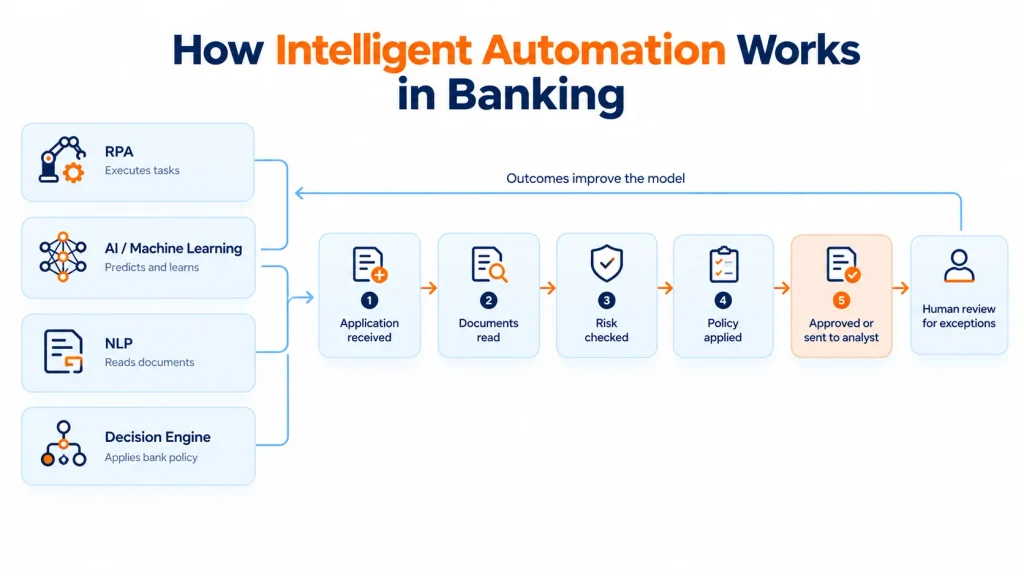
Intelligent automation in banking is the use of RPA, AI, machine learning and NLP together to run financial workflows that involve variation, exceptions and judgment. Plain automation follows a script. Intelligent automation reads context, learns from outcomes and decides the next step within limits a bank sets.
Most banking work isn’t uniform. A basic bot can move data from a loan application into the core system when every document matches a template. It can’t decide what to do when a borrower’s tax return uses a different accounting method than their financial statements, or when a payment reference is ambiguous. That decision needs reasoning, and that is the layer “intelligent” adds.
The DevSouq Scope Clarity Session
A free, 30-minute session where you leave knowing the real cost, real timeline, and real risks of your project, whether you ever build with us or not.
Book Your Free Scope Clarity Session →Intelligent automation vs. RPA vs. agentic AI
| Capability | Traditional RPA | Intelligent automation | Agentic AI |
|---|---|---|---|
| Task type | Fixed, rule-based steps | Variable tasks needing judgment | Multi-step goals with few predefined steps |
| Handles exceptions | No, escalates to a human | Yes, within defined risk limits | Yes, and adjusts its approach mid-task |
| Learns over time | No | Yes, via machine learning | Yes, refines its own plan |
| Reads unstructured documents | Limited | Yes, via NLP and document intelligence | Yes, across several documents and systems |
| Human role | Handles every exception | Reviews flagged exceptions | Supervises outcomes, not each step |
| Best fit | High-volume, standardized tasks | High-volume tasks with variation | Complex, multi-system workflows |
IBM describes agentic AI as systems that set intermediate goals and adapt in real time. For example, one can spot a missing document on a loan file, request it from the customer, verify it and resume processing. Most banks run this in narrow, supervised pilots rather than at full autonomy, because they must be able to show how each decision was reached.
Banking automation vs intelligent automation vs intelligent process automation
- Banking automation is the broad umbrella: any technology that reduces manual work in banking, including simple scripts, workflows and RPA. See our guide to RPA in finance for the rule-based layer.
- Intelligent automation adds AI/ML/NLP so the system handles variation.
- Intelligent process automation (IPA) is mostly used as a synonym for intelligent automation, with an emphasis on end-to-end process flow.
- Hyperautomation is the strategy of applying all of these across as many processes as possible.
Intelligent Automation in Financial Services and BFSI
Banks aren’t the only institutions with this problem. The same technology (document intelligence, pattern recognition and policy-driven decisioning) applies across the sector:
| Segment | Typical workflows | Where intelligence helps |
|---|---|---|
| Retail and commercial banking | Onboarding, KYC, account maintenance, loan origination | Reading documents in varied formats, resolving mismatches |
| Lending and servicing | Underwriting prep, payment handling, delinquency workflows | Spreading financials, flagging real risk vs timing differences |
| Insurance (the “I” in BFSI) | Claims intake, adjudication support, premium billing | Unstructured claim documents, fraud indicators |
| Wealth and asset management | Reconciliation, rebalancing, performance reporting | Exception handling in data feeds |
| Finance and accounting teams | Reconciliation, ledger management, reporting | Matching with tolerance for formatting differences |
If your organization runs several of these functions, the integration challenge matters more than any single tool. Our overview of IT services for finance covers how those stacks usually fit together.
The Four Components of Intelligent Automation
Intelligent automation isn’t one product. It’s four capabilities, and knowing which does what helps you test vendor claims.
1. RPA handles execution. It extracts data, populates systems, generates documents and moves information between platforms. When something falls outside its rules, it should stop. That is a feature.
2. AI and machine learning handle prediction. They recognize patterns in historical data and improve as more cases run. McKinsey’s estimate, widely cited, puts generative AI’s potential value in banking at $200-340 billion a year, or 2.8-4.7% of industry revenue, mostly from productivity.
3. NLP handles reading. It extracts data from financial statements, legal documents and customer messages regardless of format. It’s only as consistent as what it reads. If branches use different credit memo templates, extraction will be uneven.
4. Decision engines apply policy. They decide which exceptions need a senior analyst and which automated decisions need human sign-off. If your lenders apply policy inconsistently today, a decision engine will encode that inconsistency.
Worked example: corporate account onboarding
A company applies for a business account. The ownership structure in its incorporation documents doesn’t match the beneficial-owner declaration on the form.
- RPA collects the application and pulls registry filings.
- NLP reads the incorporation documents and extracts shareholders and percentages, even from non-standard layouts.
- ML compares the mismatch to past cases to judge whether it usually signals risk or a formatting difference.
- The decision engine applies policy. A name spelled differently gets auto-resolved. An unresolved owner above the ownership threshold goes to a compliance analyst.
- RPA sends the applicant a specific request naming the exact discrepancy, not a generic “more documents” email.
- The outcome feeds back into the model.
Each layer resolves what it can, so the analyst only sees the cases that need judgment. Linking that customer record across systems also depends on a clean CRM in finance setup.
How Intelligent Automation Supports Straight Through Processing and Human Review
The goal isn’t to remove people. It’s to send each case to the cheapest safe path. A common design uses confidence and risk bands:
| Case type | Route | Example |
|---|---|---|
| High confidence, low risk | Straight-through processing, no human touch | Standard payment, clean KYC match |
| High confidence, formatting issue | Auto-corrected, logged | Address abbreviation differences |
| Medium confidence | Human review with AI summary attached | Revenue mismatch between tax return and statements |
| High risk or low confidence | Senior analyst, full file | Unresolved beneficial owner, large payment anomaly |
| Policy requires sign-off | Mandatory human approval | Credit decisions above set limits |
Two design rules make this work. Every automated decision needs an audit trail, and the thresholds should be set by risk and compliance teams, not by the vendor. Review the thresholds regularly, because a model drifts as customer behavior and fraud tactics change.
Why Pilots Stall at Scale: The Space Between Systems
Most banks run dozens of systems: core banking, loan origination, CRM, compliance engine and document repository, each added at a different time. Basic automation works inside any one of them. The failure happens in between, where a person quietly does the coordination: checking KYC status in one platform before approving a change in another, re-keying a figure into a reporting tool, chasing down who owns a stalled exception.
Call it whitespace. It rarely shows on a process diagram, and it explains why a pilot that works in one system disappoints when rolled out bank-wide. Leadership sees one task get faster and assumes the whole process improved, while staff still do unpaid coordination in the gaps.
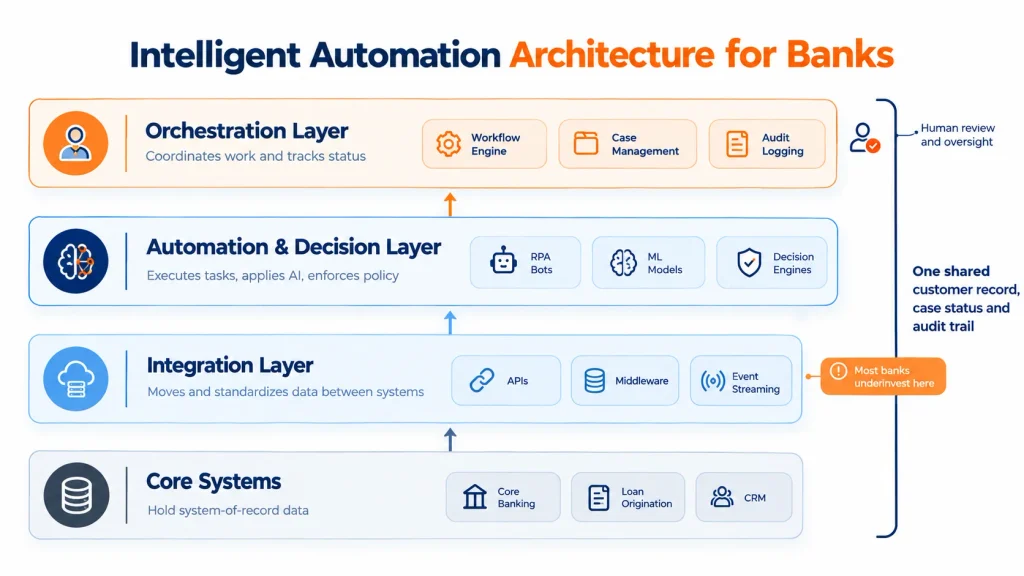
The fix isn’t another point solution. It’s a shared layer that gives every system, bot and person the same customer record, case status and audit trail.
Architecture Blueprint: Where Intelligent Automation Sits in the Stack
| Layer | Function | Typical components |
|---|---|---|
| Core systems | Hold system-of-record data | Core banking, loan origination, CRM |
| Integration layer | Moves and standardizes data | APIs, middleware, event streaming |
| Automation and decision layer | Executes tasks, applies AI, enforces policy | RPA bots, ML models, decision engines |
| Orchestration layer | Coordinates work and tracks status | Workflow engine, case management, audit logging |
The integration layer is where most banks underinvest. Without it, every new use case builds its own point-to-point connection into the core, and technical debt multiplies. Sequence matters: connect and standardize data first, automate tasks second, add AI decisioning last. For how this layering is often built, see our guide to microservices architecture in financial services.
Where Intelligent Automation Delivers Results
KYC and customer onboarding
Identity checks, document collection and watchlist screening are structured enough to automate heavily. OCR-based extraction replaces manual review, and real-time screening speeds approvals. Industry reports put KYC cost reductions around 20%.
AML and fraud monitoring
Rule-based AML systems generate mostly false alarms. nCino cites 90-95% of monitoring alerts as false positives across US banks. Behavioral models that learn what’s normal per customer can cut that noise, with EY research cited at roughly 40% fewer false positives.
Lending: underwriting and servicing
AI can extract data from application documents, verify income, flag inconsistencies and prepare a preliminary risk view before an underwriter takes over. nCino reports credit review prep falling from nearly two hours to under two minutes. Banorte, in a Blue Prism case study, reports handling credit applications 60% faster with 30% more capacity. For the post-funding side, DevSouq builds [custom loan servicing software][ADD URL] around a lender’s own repayment and delinquency rules.
Payments and reconciliation
Mismatched account numbers, unclear references and duplicates still need manual checks at most banks. ML separates real problems from formatting noise so straight-through rates rise and analysts see only true exceptions.
Insurance, accounting and portfolio operations
Claims, premium billing, ledger reconciliation and portfolio reporting share the same pattern: structured extraction, rule-based validation and AI for exceptions. DevSouq builds [custom claims management software][ADD URL], [insurance billing software][ADD URL], [custom accounting software][ADD URL] and [investment portfolio management software][ADD URL] on this approach. Reliable reporting from these systems also depends on good business intelligence for finance.
Measured Results: What the Data Shows
| Metric | Reported result | Source and caveat |
|---|---|---|
| AML alert false-positive rate | 90-95% of alerts | nCino, industry-wide |
| AML false-positive reduction | ~40% | EY research (cited in industry reporting) |
| KYC cost reduction | ~20% | Industry reported |
| Credit review prep time | ~2 hours to under 2 minutes | nCino, vendor-reported |
| Credit application handling | 60% faster, 30% more capacity | Blue Prism case study (Banorte), vendor-reported |
| Cases handled | 43% more in six months | Blue Prism case study (Banco Supervielle), vendor-reported |
| Security incidents | ~700/day to under 20; remediation 30 to 5 minutes | IBM case study (Askari Bank), security operations rather than lending |
| Generative AI value in banking | $200-340B/year potential | McKinsey estimate |
| Banks building generative AI systematically (2024) | 8%, with 78% in tactical initiatives | IBM Institute for Business Value |
Results depend on bank size, data quality and how sound the process was beforehand. Most of the strongest numbers are vendor-reported. Treat them as ranges, not a floor.
Governance, Explainability and Compliance
In banking, an automated decision you can’t explain is a liability. Build these in from day one:
- Explainability: you must be able to show which inputs drove a decision and trace it during an audit.
- Bias and data quality: historical data can carry bias into lending and product decisions. Validate training data and monitor models for drift.
- Model risk management: US banks work under guidance such as SR 11-7, which expects model validation and documentation.
- EU rules: AI used to assess creditworthiness is generally treated as high-risk under the EU AI Act, and DORA sets ICT-risk requirements for EU financial entities, including third-party automation providers.
- Data security: automation platforms touch sensitive data and become targets, so apply access controls and logging.
Which Processes to Automate First
Score each candidate workflow on the factors below. A process that scores well on most is a good first target.
| Factor | Good candidate | Redesign first or keep manual |
|---|---|---|
| Volume and exceptions | High volume, predictable exceptions | Every case unique |
| History | Past data shows what good outcomes look like | No precedent |
| Decision basis | Mostly objective, some judgment | Heavily negotiated or purely subjective |
| Cost of an error | Correctable, low stakes | Immediate legal or regulatory exposure |
| Process design | Reflects current needs | Exists because of old constraints |
Four questions catch most bad candidates. Would a new employee question why this step exists? Does it exist because of a technology limit that no longer applies? Are we collecting data nobody uses? Do approval layers manage risk or just keep someone informed? A “yes” to any of them means redesign first. If a process like simple account opening already works smoothly, leave it alone.
A 90-Day Pilot Roadmap
| Weeks | Focus | Output |
|---|---|---|
| 1-2 | Map the process and the handoffs between systems | Process map, list of exception types |
| 3-4 | Baseline metrics | Cycle time, exception rate, cost per case |
| 5-8 | Build one workflow with human review built in | Working workflow, thresholds agreed with risk |
| 9-12 | Run in shadow mode, compare to baseline, decide | Go/no-go with measured results |
Pick one workflow with clean data and a clear owner. Budget for change management, because training and integration usually cost more than the model.
Common Implementation Failures
| Failure | Cause | Fix |
|---|---|---|
| Automating a broken process | No process audit first | Redesign, then automate |
| Poor data quality | Siloed or inconsistent data | Data governance before AI |
| Integration complexity | Legacy systems without modern APIs | Scope integration upfront and budget for it |
| Staff resistance | Fear of replacement | Involve frontline teams, show early wins |
| Pilot works, scale fails | Cross-system gaps ignored | Add an orchestration layer |
Broken process design is the most expensive mistake and the most preventable. Data and integration gaps can be fixed with time and budget. A flawed workflow just runs faster.
Build vs. Buy: Choosing a Development Partner
Off-the-shelf tools work for standardized needs such as basic KYC screening or document OCR. Once a workflow depends on your institution’s policies, legacy core integrations, or a mix of lending, billing and portfolio functions, a custom build tends to hold up better than a generic product stretched to fit. If you’re comparing vendors, our guide to choosing a custom software development company lists what to ask.
Not sure which workflows are ready? Book a free 30-minute Scope Clarity Session and leave with a realistic view of cost, timeline and risk, whether or not you build with us.
What’s Next: Agentic AI
The next step beyond rules-plus-ML is agentic AI: systems that plan multi-step work, such as chasing a missing document and resuming a file. Adoption is early. Banks mostly use it in supervised pilots because regulators expect traceable decisions. The foundations that make intelligent automation work (clean data, an integration layer, an audit trail and clear risk limits) are the same ones agentic systems need.
The DevSouq Scope Clarity Session
A free, 30-minute session where you leave knowing the real cost, real timeline, and real risks of your project, whether you ever build with us or not.
Book Your Free Scope Clarity Session →Conclusion
Intelligent automation in banking works when it’s treated as a process and architecture decision, not a tool purchase. Redesign the workflow, connect the systems, set clear risk limits and keep humans in the loop for judgment. Start with one workflow, measure it against a baseline and scale from there.
If you want a second opinion on where to begin, book a free Scope Clarity Session and we’ll map which of your workflows are ready for automation.
FAQs
What is intelligent automation in banking?
It’s the combination of RPA with AI, machine learning and NLP so systems can handle exceptions, read unstructured documents and make context-aware decisions within limits a bank defines in advance. Unlike basic automation, it keeps working when inputs vary instead of stopping and waiting for a person.
How is intelligent automation different from RPA?
RPA follows fixed rules and stops at any exception. Intelligent automation adds AI, ML and NLP, so it can interpret varied documents, judge whether a discrepancy matters and route cases by risk. RPA remains the execution layer, with the intelligent components handling the variation around it.
How does intelligent automation support straight-through processing and human review?
It scores each case by confidence and risk. Clean, low-risk cases flow straight through. Formatting issues are auto-corrected, medium-confidence cases go to a person with an AI summary, and high-risk or policy-restricted cases go to senior analysts, all with an audit trail.
What is intelligent automation in financial services and BFSI?
It’s the same technology applied across banks, lenders, insurers and wealth managers: document intelligence, pattern recognition and policy-driven decisioning for KYC, lending, claims, billing, reconciliation and reporting. The common challenge across BFSI is connecting automation across many legacy systems.
Which banking processes benefit most from intelligent automation?
AML monitoring, KYC onboarding, loan origination and servicing, and payment reconciliation usually show the strongest returns. They combine high volume with predictable exception patterns and have historical data to learn from. Processes that are unique every time or already run smoothly are poorer candidates.
How long does it take to see results?
A focused pilot on one workflow with clean data can show measurable results within about 90 days. Broader rollouts take longer because of integration, data quality, governance and change management. Results depend heavily on process quality, so fix the workflow before automating it.