Quick Answer
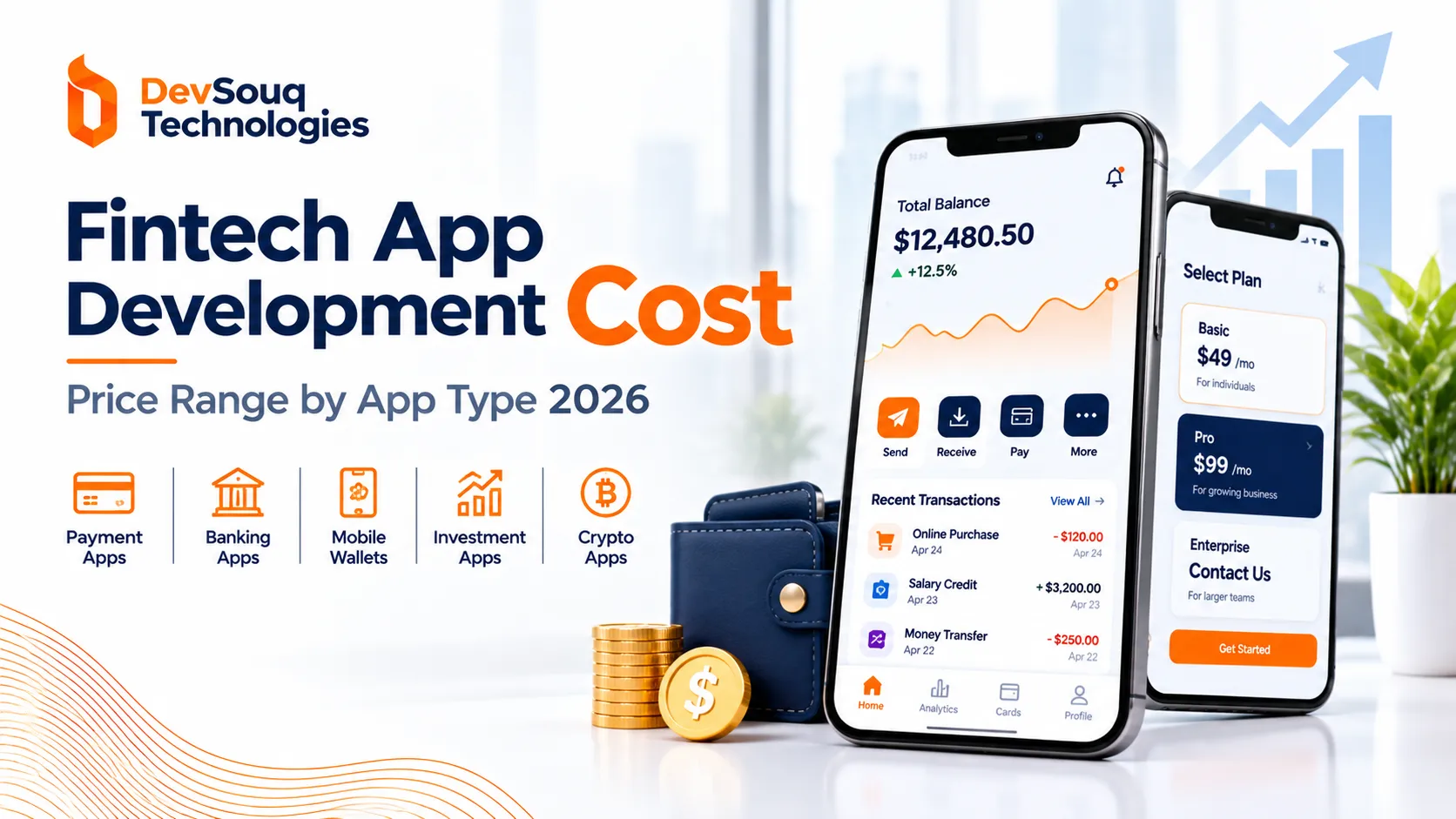
Fintech app development cost ranges from about $30,000 for a read only budgeting app to $500,000 or more for a full digital banking platform. Wallets and payment apps typically fall between $60,000 and $220,000. The biggest factor is whether your app holds or moves customer money, because that adds a ledger, KYC and heavier security. Not sure where your idea sits? DevSouq, a cost efficient custom finance software development company, offers a free scope review to give you a realistic budget and timeline.
Key Takeaways
- Read only apps (budgeting, aggregation) are the cheapest category. Apps that store balances, send payments or issue cards cost several times more.
- The invisible backend (ledger, reconciliation, audit logs, security) usually takes a larger share of the budget than screens and design.
- Team location can change the same scope by 40 to 60 percent, but regulation depends on where your customers are, not where your developers sit.
- Flutter is a practical way to cut mobile cost for a fintech MVP, provided security is engineered properly.
- Budget 15 to 25 percent of the build cost per year for maintenance, plus per use fees from KYC, payment and data providers.
- Every range here is an indicative planning estimate, not a quote. Licensing and the cost of running a regulated business are separate from software cost.
The DevSouq Scope Clarity Session
A free, 30-minute session where you leave knowing the real cost, real timeline, and real risks of your project, whether you ever build with us or not.
Book Your Free Scope Clarity Session →What Is a Fintech App?
A fintech app is software that delivers a financial service through a phone or browser. The word combines financial and technology. Examples include payment wallets, digital banks, lending platforms, investment dashboards, budgeting tools, insurance apps and billing or accounting systems used by businesses.
If you searched for a fintech description, the most useful way to think about it is by what the product does with money:
- Displays money: reads account data and shows spending, balances and insights. No custody of funds.
- Moves money: initiates transfers, stores balances, routes card or bank payments.
- Lends or invests money: decides credit, services loans or places orders on behalf of customers.
- Manages money for a business: billing, accounting, reconciliation and reporting tools.
That last distinction is what the rest of this guide is built around, because each step down the list adds engineering and compliance work.
Fintech App Development Cost by App Type
The table below gives indicative ranges for a build led by an experienced agency team. They exclude licensing, legal fees and operating costs of a financial business.
| App type | What it typically includes | Indicative build cost | Typical timeline |
|---|---|---|---|
| Personal finance or budgeting (MVP) | Account linking, categories, charts, alerts, login | $30,000 to $90,000 | 3 to 5 months |
| Digital wallet or payment app | Stored balance, P2P transfers, history, KYC, ledger | $60,000 to $220,000 | 4 to 9 months |
| Lending or BNPL app | Applications, credit checks, repayment schedules, collections | $60,000 to $200,000 | 5 to 9 months |
| Investment or wealth app | Portfolio views, market data, broker integrations, reporting | $100,000 to $300,000+ | 6 to 12 months |
| Insurtech app | Policy, claims and billing workflows, document handling | $80,000 to $250,000 | 5 to 9 months |
| Digital banking or neobank | Accounts, cards, transfers, KYC and AML, admin console | $150,000 to $500,000+ | 6 to 18 months |
Published guides disagree on these numbers. The budgeting floor ranges from about $25,000 to $80,000 depending on who you ask, and the ceiling for banking platforms ranges from $300,000 to over $1 million. The section on why quotes differ explains the gap.
Where Cost Shifts for Specific Products
- Lending: Origination is the visible part. The expensive part is servicing, covering payment schedules, delinquency, interest accrual and statements. See how custom loan servicing software development separates these concerns.
- Investment: Cost depends on whether you only display holdings or also route orders, calculate performance and handle rebalancing. Custom investment portfolio management software covers those layers in detail.
- Subscriptions and usage based products: Proration, retries, invoicing and revenue recognition add logic that a basic payment gateway does not handle. Custom recurring billing software development explains when that logic needs to be custom.
- Insurance: Premium collection, adjustments and commissions are billing problems first. Insurance billing software development is a useful reference for scoping that part.
How Much Does Fintech Cost? Start With One Question
Before any feature list, answer this: does your app hold, move or transmit customer funds, or does it only display and analyze financial data?
A read only app connects to a user’s existing accounts through an aggregation provider and shows insights. It never takes custody, so it avoids ledgers, settlement and most money transmission rules.
A money moving app adds all of the following:
- A transaction ledger that records every movement
- Idempotent transfers, so a retry never creates a duplicate payment
- Reversal and failure handling when a transfer half completes
- Nightly reconciliation against bank or processor records
- Identity verification (KYC) and screening (AML)
- Fraud rules, limits and monitoring
- A larger security, audit and compliance footprint
This is why a wallet that looks as simple as a budgeting app on screen can cost two to four times more. The cost tracks what happens when a transaction fails, not how many screens exist.
Fintech App Development Cost by Phase
Budgets split roughly as follows for a money moving product. Percentages shift with scope, but this is a useful sanity check against any proposal.
| Phase | Share of budget | What it covers |
|---|---|---|
| Discovery and scoping | 10 to 15% | Flow of funds, MVP definition, compliance questions |
| UI and UX design | 10 to 15% | Journeys, disclosures, error states, design system |
| Frontend and backend development | 40 to 45% | App, APIs, ledger, business logic |
| Integrations | 10 to 15% | Payments, banking, KYC, aggregation |
| QA and security testing | 8 to 12% | Functional tests, penetration testing, remediation |
| DevOps and launch | 3 to 5% | Cloud setup, monitoring, release runbooks |
Two practical notes. First, a thin discovery phase is the most common cause of rework later. Second, if a proposal lists no line for security testing or remediation, it is incomplete.
Fintech App Development Cost by Feature
Feature estimates help build a preliminary budget, but they do not simply add up. Shared infrastructure and architecture choices change the total.
| Feature | Indicative cost |
|---|---|
| Authentication with MFA and biometrics | $5,000 to $15,000 |
| KYC and AML onboarding through a provider | $10,000 to $30,000 |
| Payment gateway or banking API integration | $10,000 to $35,000 per integration |
| Core ledger and transaction engine | $20,000 to $60,000 |
| Fraud detection integration | $8,000 to $30,000 |
| Admin dashboard and back office tools | $5,000 to $20,000 |
| Analytics and reporting dashboards | $10,000 to $30,000 |
| Security hardening and penetration testing | $15,000 to $50,000+ |
The ledger line is the one to protect. A wrong ledger is the most expensive thing to rebuild after launch. If your business needs strong books behind the product, it helps to understand how custom accounting software development handles double entry design, since the same principles apply inside a wallet or lending product.
8 Factors That Drive Fintech App Development Cost
- Money movement complexity. Custody, transfers and card issuing sit at the expensive end. Read only sits at the cheap end.
- Integration count. Every payment, aggregation, KYC or market data provider is both a build cost and a recurring fee.
- Backend architecture. A single well structured service is cheaper to start. Products that need independent scaling, many partners or strict isolation often move toward services based designs. The trade offs are covered in microservices architecture in financial services.
- Security and compliance depth. Encryption, MFA, role based access, audit logging and testing are launch requirements, not upgrades.
- Platform choice. One platform is cheapest. Two native apps cost meaningfully more. A cross platform framework sits between them.
- Number of jurisdictions. Each market adds its own licensing, data rules and payment rails.
- Team location and seniority. Rates differ widely by region, and senior engineers with regulated industry experience command a premium everywhere.
- Timeline pressure. Compressing a schedule needs parallel teams and usually raises total cost.
Fintech App Development Cost in India
India is one of the most developed fintech markets in the world, largely because of public payment infrastructure. The Unified Payments Interface (UPI), run by NPCI, now processes well over 15 billion transactions a month. The Account Aggregator framework allows consented sharing of financial data, and Aadhaar based eKYC speeds up onboarding. A product that plugs into these rails can be cheaper to build than the same product in a market without them.
What affects cost in India:
- Rates. Developer rates in India commonly fall around $20 to $60 per hour, against $100 to $250 in the US and Western Europe.
- Regulator. The Reserve Bank of India governs payment aggregators, prepaid instruments, digital lending and data storage for payment data. Authorisation timelines can be long, so start early.
- Data protection. The Digital Personal Data Protection Act adds consent and handling duties.
- Integrations. UPI, bank APIs, Account Aggregator providers and eKYC vendors each add integration effort.
Indicative cost to build in India (agency team):
| Product | Indicative range |
|---|---|
| Budgeting or finance tracker | $15,000 to $50,000 |
| UPI enabled wallet or payment app | $40,000 to $120,000 |
| Digital lending app | $50,000 to $150,000 |
| Full digital banking layer on a partner bank | $100,000 to $300,000 |
If you searched for fintech programs in India, note that this guide covers software products. Training courses and government schemes are separate topics.
Fintech App Development Cost in the UK
The UK has high engineering rates but a mature regulatory and open banking environment. Open Banking is well established, with more than 10 million active users, and Faster Payments gives instant domestic transfers.
What affects cost in the UK:
- Rates. Agency rates commonly fall roughly between 60 and 150 pounds per hour, with specialist fintech engineers at the top of that range.
- Authorisation. Firms that provide regulated services need Financial Conduct Authority authorisation or must operate under an authorised partner. Payment and e money activity falls under the Payment Services Regulations and Electronic Money Regulations.
- Strong customer authentication. Payments need two factor checks, which affects design and testing.
- Consumer protection. The Consumer Duty and fraud reimbursement rules for authorised push payment scams influence fraud tooling and customer support design.
- Data protection. UK GDPR applies to personal and financial data.
Indicative cost to build with a UK or blended team:
| Product | Indicative range |
|---|---|
| Budgeting app on open banking data | $50,000 to $120,000 |
| Wallet or payment app | $100,000 to $250,000 |
| Digital banking app on a partner | $200,000 to $450,000+ |
Many UK startups use a blended model: product and compliance sensitive work stays onshore, and the rest is delivered by a lower cost team.
Fintech App Development Cost in Pakistan
Searches for fintech app Pakistan usually come from founders building locally or from companies sourcing engineering there. The market has grown quickly around mobile wallets, branchless banking and the State Bank of Pakistan’s instant payment system, Raast, launched in 2021.
What affects cost in Pakistan:
- Rates. Engineering rates commonly fall around $20 to $50 per hour.
- Regulator. The State Bank of Pakistan licenses payment system operators, payment service providers and electronic money institutions. It also runs a regulatory sandbox for early stage products.
- Bank API access. Access to bank connectivity can be the slowest part of a build. Plan time for partner onboarding and certification.
- Local requirements. Local language support, low bandwidth performance and affordable devices affect design and testing.
Indicative cost to build in Pakistan (agency team):
| Product | Indicative range |
|---|---|
| Basic finance app | $12,000 to $35,000 |
| Wallet with KYC and transfers | $40,000 to $100,000 |
| Payment or P2P app | $50,000 to $150,000 |
| Digital bank or neobank layer | $100,000 to $300,000 |
Regional Comparison for the Same Wallet MVP
| Factor | India | UK | Pakistan |
|---|---|---|---|
| Typical hourly rate | $20 to $60 | 60 to 150 pounds | $20 to $50 |
| Indicative MVP cost | $40,000 to $120,000 | $100,000 to $250,000 | $40,000 to $100,000 |
| Main regulator | Reserve Bank of India | Financial Conduct Authority | State Bank of Pakistan |
| Public payment rail | UPI | Faster Payments, Open Banking | Raast |
| Biggest cost risk | Authorisation timelines | Compliance and rates | Bank API access |
Local currency figures move with exchange rates, so convert from the dollar ranges at the rate on the day you budget. Regional ranges are planning estimates, and the rules that apply to you depend on where your customers are.
Fintech in Flutter: Does It Lower Cost?
Flutter is Google’s open source toolkit for building iOS, Android and web apps from one Dart codebase. For fintech it is popular because most of the app is forms, lists, charts and confirmation flows, which a cross platform framework handles well.
Where Flutter saves money:
- One team and one codebase for both mobile platforms, often cutting mobile effort by roughly 30 to 40 percent compared with two native apps
- Consistent interfaces across devices, which reduces design and QA duplication
- Fast iteration, which suits an MVP that will change after user feedback
What still needs care:
- Secure storage. Keep tokens and keys in the platform keystore through a secure storage plugin, never in plain preferences.
- Biometrics. Use the local authentication plugin to tie sensitive actions to Face ID or fingerprint.
- Network security. Add certificate pinning and strict TLS settings.
- Code protection. Use the code obfuscation and split debug information build options for release builds, and add jailbreak or root detection for higher risk products.
- Native modules. Card tap to pay, some device security features or heavy real time charting may need native code.
Flutter or native? Choose Flutter or React Native for most MVPs, wallets and budgeting products. Choose native when you depend on deep device security features, specialist hardware or performance critical trading screens.
Security and Compliance as Engineering Scope
Security is a line in the budget, not a risk you can defer. A typical baseline includes:
- Encryption in transit and at rest
- Multi factor and biometric authentication
- Role based access control for users and staff
- Secure API design and secrets management
- Tamper evident audit logging
- Fraud controls such as velocity checks and limits
- OWASP aligned development practices
- PCI DSS where the app touches card data. The current standard is version 4.0.1, and its earlier future dated requirements are now mandatory
The cost of getting it wrong is high. IBM’s Cost of a Data Breach research puts the global average breach in the region of $4.4 million, and financial services sits above that average. Verify the latest figure before quoting it in your own material.
Two areas deserve special scoping. Fraud and onboarding checks benefit from automation, and intelligent automation in banking shows where it pays off. Monitoring and reporting dashboards need clear requirements early, and business intelligence for finance is a good starting point for deciding what to measure.
Which regulations apply depends on your product, activities, jurisdictions and partners. Treat this list as engineering scope, and confirm legal obligations with qualified counsel.
Hidden and Ongoing Costs
| Cost | What to expect |
|---|---|
| Maintenance | 15 to 25% of build cost per year, higher for money moving products |
| Cloud hosting | Scales with users, data and uptime needs |
| KYC and identity checks | Usage based, often charged per verification |
| Payment processing | A percentage plus a fixed fee per transaction |
| Data aggregation | Per connection or subscription fees |
| Security testing | Annual or release based penetration tests |
| Audits and certifications | PCI DSS, SOC 2 or similar where required |
| Legal and licensing | Separate from software, varies by market |
| Customer support | Disputes, failed payments, account recovery |
Plan these from the first month. Per use fees grow as you succeed, so model them against expected volume and not just launch day.
Why Fintech Cost Estimates Differ So Much
Two quotes for an app that sounds identical can differ by 3x. The usual reasons are:
- Different definitions of MVP. One vendor means a clickable flow. Another means a production ready, audited product.
- Money movement assumed or not. A quote for a read only app and a quote for a wallet are different products.
- Compliance included or excluded. Some proposals leave out KYC, penetration testing and audit logging.
- Build versus buy. Using a banking as a service provider cuts build cost and adds monthly fees.
- Team rates and seniority. Rates differ by region, and so does the amount of senior review.
- Exclusions. Hosting, third party fees, app store costs and maintenance may sit outside the quote.
Ask every vendor to state what is in scope, what is excluded and which assumptions the number depends on.
How to Estimate Your Fintech App Budget
- Define the model. What does the app do and how does it earn?
- Answer the money question. Read only, or holds and moves funds?
- Cut the MVP to one core workflow.
- List users and roles. Customers, agents, admins and auditors each add access logic.
- List integrations. Payments, aggregation, KYC, messaging, bank connections.
- Confirm compliance scope with counsel.
- Pick platforms. One platform, or cross platform for both.
- Set security requirements.
- Choose team composition. In house, partner or blended.
- Plan in phases. Build, maintain and scale, with run costs included.
Illustrative arithmetic (not a quote or client work): suppose a wallet MVP priced at $150,000 with a US or UK agency. Delivering it with a blended team at roughly 60 percent of that rate gives $90,000. Adding 20 percent for hosting, per use fees and testing in the first year brings the planning figure to about $108,000. Treat the result as a starting point to test against detailed proposals.
How to Reduce Fintech App Development Cost Without Cutting Corners
- Ship one workflow first. Each extra product multiplies complexity.
- Use a cross platform framework such as Flutter or React Native for the MVP.
- Buy mature infrastructure for KYC, screening and payments instead of building it.
- Use a blended team so sensitive work stays close while the rest scales.
- Get the ledger right once. This is the one place not to cut.
- Start licensing in parallel. Approvals can take longer than the build.
- Automate testing and deployment early to catch defects while they are cheap.
- Design for dashboards early. Reporting built after launch is slower to retrofit. Reviewing fintech dashboard website examples helps settle layouts before design starts.
Choosing a Fintech Development Partner
A good partner reduces cost mostly by preventing rework. Evaluate:
- Experience with ledgers, reconciliation and payment integrations
- A clear security process and testing plan
- Transparent scope, exclusions and milestones
- Source code ownership and documentation
- Post launch support and maintenance terms
- Willingness to say no to features that do not belong in the MVP
Financial software has a long tail of back office needs, such as accounting, billing, servicing and reporting. DevSouq, a leading custom finance software development company, works across these areas, which is useful when your fintech product has to connect to the systems behind it.
The DevSouq Scope Clarity Session
A free, 30-minute session where you leave knowing the real cost, real timeline, and real risks of your project, whether you ever build with us or not.
Book Your Free Scope Clarity Session →Conclusion
The honest answer to how much does fintech cost is a range, and the range is mostly set by decisions you control: whether your app moves money, how many integrations it needs, how deep your security goes, and which team builds it. Define one core workflow, confirm your compliance scope early, protect the ledger, and budget for running costs from day one. Then compare detailed proposals line by line, so that every number in your fintech app development cost estimate has a reason behind it.
Frequently Asked Questions
How much does it cost to build a fintech app?
Most fintech apps cost $30,000 to $500,000 or more. Read only budgeting apps sit at $30,000 to $90,000, wallets and payment apps at $60,000 to $220,000, and digital banking products at $150,000 to $500,000 or more. These are build estimates and exclude licensing.
What is a fintech app?
A fintech app is software that delivers a financial service, such as payments, lending, investing, budgeting, insurance or banking, through a phone or browser. Some only display data, while others hold or move customer funds, which makes them far more complex and costly.
How much does fintech app development cost in India?
In India, a basic finance app can cost $15,000 to $50,000, a UPI enabled wallet $40,000 to $120,000, and a digital lending app $50,000 to $150,000. Rates are lower than in the US or UK, but regulatory approval still takes time.
How much does fintech app development cost in the UK?
UK builds usually cost more because of higher rates and compliance work. A budgeting app may cost $50,000 to $120,000, a wallet $100,000 to $250,000, and a digital banking app $200,000 or more. Blended teams can reduce these figures.
How much does a fintech app cost in Pakistan?
A basic finance app in Pakistan may cost $12,000 to $35,000, a wallet with KYC and transfers $40,000 to $100,000, and a payment app $50,000 to $150,000. Bank API access and State Bank of Pakistan requirements can affect timelines.
Is Flutter good for fintech apps?
Yes, for most MVPs, wallets and budgeting apps. One codebase serves iOS and Android and can cut mobile cost by around 30 to 40 percent. Security must still be engineered with secure storage, biometrics and certificate pinning. Native suits deep device features.
How much does it cost to maintain a fintech app?
Plan for roughly 15 to 25 percent of the build cost per year. Add hosting, KYC and payment fees, security testing and any audit or recertification costs. Money moving products sit at the higher end.
How long does it take to build a fintech app?
A read only MVP takes about 3 to 5 months. A wallet or payment app takes 4 to 9 months, and a digital bank 6 to 18 months. Licensing and bank partner onboarding can run longer than the software build.