Quick Answer
The best real estate accounting software depends on what you run: landlords do well with rental focused tools like REI Hub, Housters or Prop Pocket, agents with a deal tracker like AgentXpense, and large portfolios with Yardi or MRI. Plot sellers, housing societies and multi entity groups often outgrow packaged tools, which is where a custom build fits best. DevSouq Technologies builds cost efficient custom real estate accounting systems with no monthly software fee, and offers a free scope review to show what your workflow needs. Whichever you choose, test it on your real data and confirm local tax rules first.
Key takeaways
- No single product fits every real estate business. Agents, landlords, developers, housing societies and investors have different accounting problems.
- Of the ten options below, only some are true accounting systems. Others are sales platforms, estate management tools or accounting services, and this guide says so plainly.
- Several listed tools are built around US or UK rules, and some directories list them for those countries only. Buyers in Pakistan and Canada should check tax and trust rules before committing.
- Free plans and trials exist, but cracked free downloads put your financial records at risk.
- Custom software suits businesses with installment plans, society workflows or multi entity structures that off the shelf tools handle awkwardly.
The DevSouq Scope Clarity Session
A free, 30-minute session where you leave knowing the real cost, real timeline, and real risks of your project, whether you ever build with us or not.
Book Your Free Scope Clarity Session →What real estate accounting software actually does
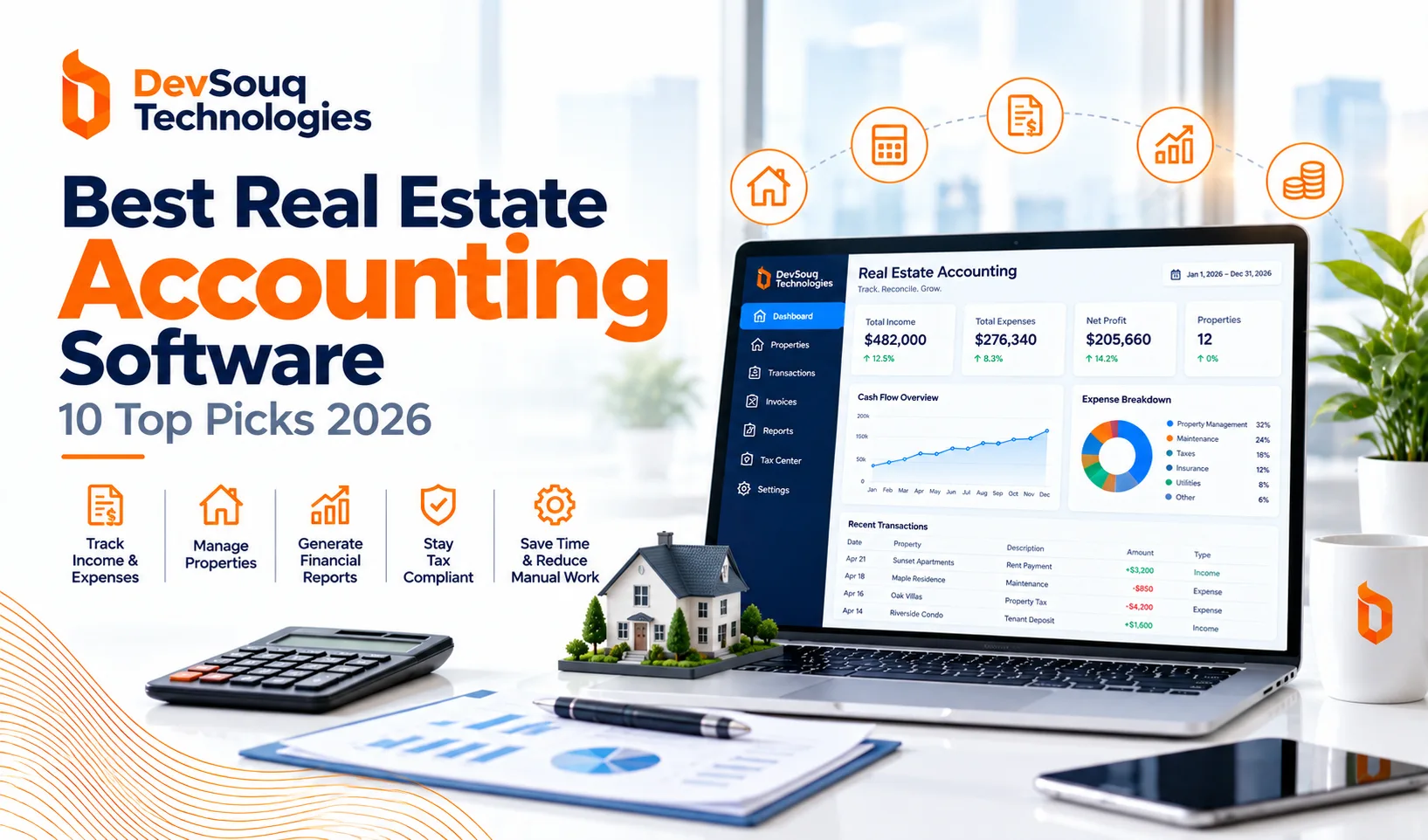
Ordinary accounting software records one company. Real estate accounting software records a collection of assets, tenants, buyers and agents, and reports on each of them separately. The property, project or entity becomes a reporting unit in its own right, not a tag added afterwards.
In practice, the software should help you manage:
- Property sales and purchase records
- Customer and tenant accounts, including outstanding balances
- Rent collection and arrears
- Installment schedules and payment reminders
- Property wise income and expenses
- Commission and brokerage calculations
- Bank and cash books
- Profit and loss statements, balance sheets and cash flow reports
A simple test separates real estate accounting software from a generic bookkeeping tool. Can you produce an accurate profit and loss statement for one building, one project and the whole group without merging spreadsheets? If the answer is no, the tool is approximating real estate accounting rather than doing it.
Accounting software vs property management software
The two categories overlap, which is why buyers often compare the wrong things. Accounting software owns the ledger. Property management software runs the building or the tenancy.
| Job | Accounting system | Property management system |
|---|---|---|
| Ledger and chart of accounts | Core function | Usually built in, sometimes limited |
| Consolidated reporting across entities | Core function | Rare |
| Rent collection and tenancy records | Sometimes | Core function |
| Maintenance and work orders | No | Core function |
| Installment and buyer ledgers | Sometimes | Rare |
| Commission tracking | Sometimes | Rare |
Small landlords can often use one combined tool. Larger groups usually run both and connect them through an integration, so rent charges and maintenance costs flow into the ledger without re entry. Each tool in the comparison below is marked by what it really is.
Which type of business are you?
Name your model first. It narrows the market faster than any feature list.
| Business | Biggest accounting problem | What to prioritise | Options in this guide that lean this way |
|---|---|---|---|
| Real estate agent or dealer | Commissions and splits | Deal level tracking, bank feeds | AgentXpense, DevSouq custom build |
| Housing society or plot seller | Installments, receipts, transfers | Buyer ledgers, payment schedules, late payment handling | DevSouq custom build, Investagon for the sales side |
| Developer or builder | Project costs against sales | Project accounting, sales ledgers | DevSouq custom build, Investagon for sales distribution |
| Landlord or small manager | Rent, expenses, tax reports | Property level profit and loss, bank feeds | Housters, REI Hub, Prop Pocket |
| Property management company | Owner statements and client funds | Trust accounting, owner reporting | RISSOFT, Jupix for UK agencies, Numetix as a service |
| Investor with several entities | Consolidation and investor reports | Multi entity books, capital accounts | DevSouq custom build, enterprise platforms |
| Corporate occupier with many leases | Lease accounting standards | IFRS 16 and FRS 102 calculations | WorkSavi |
Features that matter before you compare
Property level and portfolio reporting
Every asset needs its own income statement showing rent and other income against operating costs, financing and capital spend. Net operating income per property, rolled up into a portfolio view, is the figure lenders and partners ask for first. General tools approximate this with classes or tags. Property native tools treat the property as a first class reporting dimension.
Multi entity accounting
Many property groups hold each asset or project in a separate company or special purpose vehicle. That means a ledger and balance sheet per entity, intercompany balances, and a consolidated group view. If you hold more than a handful of entities, consolidation by spreadsheet becomes the monthly bottleneck, and this is where entry level tools usually stall.
Rent rolls, leases and arrears
Revenue follows leases, not one off invoices. The system should hold the rent roll, bill recurring charges, apply escalations and flag late payments immediately. Commercial landlords also need to reconcile common area maintenance recoveries against actual costs at the close of each period.
Trust and deposit accounting
Managers and brokers who hold other people’s money, such as deposits and client funds, usually must keep it separate from operating cash and reconcile it regularly. Rules vary by country and region, so confirm the requirement in your jurisdiction before choosing a tool.
Installments and commissions
Plot sellers, developers and agencies live on payment schedules and commission splits. A good system calculates the schedule, tracks each receipt against it, applies late payment rules and posts dealer or agent commission automatically. Linking this to a real estate CRM means a lead, a booking and a payment history live in one connected record instead of three disconnected files.
Integrations
Your ledger will not work alone. It needs to receive data from your property management platform, banks, payment gateways and sales tools. Well documented real estate API integrations let these connections be built and maintained without rebuilding them every time a system changes upstream.
Best real estate accounting software: ten options compared
The list below mixes true accounting tools, property management platforms, a sales platform, an estate management system, an accounting service and a custom build option. They are not identical products, so read the column that says what each one is.
| Option | What it is | Best for | Pricing signal | Main limit |
|---|---|---|---|---|
| DevSouq Technologies | Custom software build | Installment, society and multi entity workflows | No monthly software fee, project quote | Needs scoping and build time |
| Housters | Rental management with accounting | Small and medium landlords | Not published on one major directory | Listed for the United States only |
| REI Hub | Rental accounting software | Landlords with US tax needs | From $9 per month, vendor stated | US tax focus |
| Prop Pocket | AI assisted landlord platform | Landlords and letting agents | Free plan and low monthly plans listed | Limited review history |
| Investagon | Investment property sales platform | Developers and sales organisations | From €59 per month, directory listing | Not an accounting system |
| AgentXpense | Commission and expense tracker | Individual agents | Check vendor page | No full financial statements, per a third party comparison |
| RISSOFT | Property management and accounting | Residential and commercial managers | Contact vendor | Built around US style management |
| Jupix | Estate agency and lettings software | UK agencies | Contact vendor | Listed for the United Kingdom only |
| WorkSavi | Estate and lease accounting platform | Multi site occupiers and portfolios | Entry prices listed from £15 per feature or £29 per month | Not for landlord rent accounting |
| Numetix | AI assisted accounting service | Property management firms | Service plans, see vendor | A service, not software |
Pricing and availability change often. Treat the table as a starting point and confirm on each vendor’s own page.
1. DevSouq Technologies
What DevSouq Technologies does
DevSouq Technologies is a custom real estate software development company. Instead of renting a fixed product and bending your business around it, you describe how you actually sell, collect and report, and the system is built around that workflow. It is the only option in this list that starts from your process, not from a feature menu.
Why it is cost efficient
Packaged tools usually charge per user or per unit every month, and the bill grows as your team and portfolio grow. DevSouq positions its custom builds as a cost efficient alternative with no monthly software fee. You pay for the build instead, so over several years the total can compare well against a subscription, especially for larger teams. Scope, hosting, support and timeline are agreed in a project quote, so ask for each in writing.
Workflows a custom build can cover
Scope depends on your business, but typical requirements for this kind of system include:
- Plot and file inventory with booking, allotment and transfer records
- Installment schedules, receipts and late payment rules
- Dealer and agent commission calculation
- Project wise and entity wise books that roll into one group report
- Connections to your CRM, banks and sales tools through an API
Consider a hypothetical scheme selling 300 plots on 36 month plans. That is 10,800 scheduled receipts to track, which is exactly the volume a purpose built system is meant to handle without spreadsheets.
Who it suits
- Developers and housing societies selling on installment plans
- Agencies that need commissions and customer accounts in one place
- Investors with several entities who need consolidated reports
DevSouq publishes guides on custom real estate development software and real estate investment management software, which show the kinds of systems it builds.
Free scope review
Before you commit, DevSouq offers a free scope review. You share how your business runs today, and the review shows what your workflow needs before you spend anything on a build. It is a low risk first step, even if you later choose another option.
Watch out for
A custom build needs clear requirements up front and will not be live the day you sign. If your needs are simple, a rental focused tool will be faster to start.
2. Housters
Housters is rental property management software aimed at small and medium landlords and property managers. Its accounting lets you log rental income and expenses, set up recurring transactions, import bank and credit card activity, reconcile statements and run reports by property and date range. A double entry mode is available for users who want it. The product has an iPhone and Android app.
- Best for: landlords who want rent tracking and basic accounting in one tool.
- Watch out for: one major directory lists availability for the United States only, the public review base is small at five reviews, and it does not target multi entity or installment based businesses.
3. REI Hub
REI Hub is accounting software built specifically for rental property owners. According to its own site, it includes a real estate chart of accounts, double entry bookkeeping, bank feeds, mortgage accounting, mileage logs and reports at unit, property and portfolio level. It also lists asset basis and depreciation tracking and Schedule E style tax reports, and states plans from $9 per month, with an unlimited plan for portfolios of 21 or more units at $48 per month.
- Best for: US landlords who want a purpose built rental ledger without enterprise complexity.
- Watch out for: its tax reporting is shaped around US forms, which will not map directly to other countries.
4. Prop Pocket
Prop Pocket describes itself as AI powered property management software for landlords and letting agents. Directory listings show accounting, rent tracking, expense tracking and overdue payment features, plus tax insights with profit and loss analytics and exports. The AI tax assistant is positioned to help with self assessment. Listings show a free plan and low priced monthly tiers, though currency and plan names vary by listing.
- Best for: small landlords who want an inexpensive, mobile friendly starting point.
- Watch out for: it is a newer product with a limited public review history, so run a trial against your real data before relying on it.
5. Investagon
Investagon is a digital sales platform for investment properties, not an accounting system. It helps developers, banks and sales organisations share property data, commissions and availability with sales partners. Directory listings show a Starter plan from €59 per month, with higher Team and Enterprise tiers.
- Best for: developers and sales organisations distributing investment property through partners.
- Watch out for: you will still need a separate ledger for the money side. Think of it as the sales front end that feeds your accounting.
6. AgentXpense
AgentXpense starts from the deal. For each pending or closed transaction you can record the property or client, closing date, gross commission, brokerage and team splits, referral deductions and net commission, then attach expenses to that deal. A third party comparison notes that it does not include a general ledger, balance sheet, accounts payable or invoicing.
- Best for: individual agents who want to know what each closing actually earned.
- Watch out for: agents who need full financial statements will need an accounting system alongside it.
7. RISSOFT
RISSOFT comes from Realty Information Systems and combines property management with integrated accounting for residential and commercial managers. Directories describe support for condominiums, cooperatives, parking facilities and similar assets. A vendor discussion on G2 states that it allows unlimited companies and properties at no additional cost.
- Best for: property managers who want accounting and management in one established system.
- Watch out for: it is built around US style property management, so check fit for your region and reporting rules.
8. Jupix
Jupix is estate agency and lettings software with an accounting module, contact and document management, and links to property portals. Directories list it for the United Kingdom, and its public rating rests on five reviews at 4.2 out of 5.
- Best for: UK estate and letting agencies that want sales, lettings and accounts in one platform.
- Watch out for: it is a regional tool, so it is a poor fit outside the UK.
9. WorkSavi
WorkSavi is an estate management and operations platform for organisations that own, occupy or manage commercial property across many locations. Its lease accounting module automates IFRS 16 and FRS 102 calculations, including right of use assets, lease liabilities, interest and depreciation journals.
- Best for: retailers, hospitality groups and other multi site occupiers with many leases.
- Watch out for: it is not designed for landlord rent collection or plot and installment accounting.
10. Numetix
Numetix is an AI first accounting firm, not a software product. AI handles routine bookkeeping and reporting while human experts review and close the books. It publishes comparisons of AppFolio, Buildium, Yardi and QuickBooks for property management firms, and serves clients from California.
- Best for: property management firms that want outsourced bookkeeping on top of a platform they already use.
- Watch out for: you are buying a service, so ongoing cost depends on volume and scope.
Yardi and MRI: when you need an enterprise platform
Yardi and MRI Software sit at the enterprise end of the market. Both support multi entity structures, trust accounting, lease administration and consolidated reporting for large residential and commercial portfolios, and both are typically quote based.
An accounting firm that works across these platforms describes Yardi Voyager as the standard for large or complex portfolios, but notes that implementation takes months, licensing costs are significantly higher than mid market tools and dedicated staff or consultants are needed to run it well. MRI is most often chosen by commercial heavy and mixed portfolios that want a configurable ledger.
If you are a developer or investor deciding which assets to buy rather than how to book them, ledger software is only half the picture. Commercial real estate investment analysis software covers the underwriting and deal modelling side that accounting platforms do not.
Real estate accounting software in Pakistan
Pakistan’s property market runs on workflows that many global tools were never designed for. A housing society or plot seller typically needs:
- Plot and file inventory with booking, allotment and transfer records
- Installment schedules, receipts and late payment handling
- Dealer and agent commission calculation
- Separate accounting by project or scheme
- Bank and cash books that match daily operations
- Local currency formats, and bilingual receipts if customers expect them
Here is a hypothetical example, not a real client case. A scheme sells 300 plots at PKR 2,000,000 each, with 20 percent down and the balance over 36 monthly installments. That is PKR 400,000 down and about PKR 44,444 per month per plot, which creates 10,800 scheduled installment receipts over the term. Tracking that in a spreadsheet means manual follow up on every late payer.
Tax treatment of property transactions and withholding changes often and varies by situation, so do not assume any tool applies it correctly by default. Confirm the current rules with a qualified tax adviser, and choose software that lets you configure tax lines rather than hard coding them.
Several tools in this guide are listed for the US or UK only, so they are a weak fit for Pakistani plot and installment businesses. That is why many developers and societies end up choosing local software or a custom build. Real estate development software built around your own sales, installment and project accounting flow is one route, and DevSouq is a practical option to scope if your workflow does not fit packaged tools.
Real estate accounting software in Canada
Canadian buyers should confirm that a tool handles GST or HST, provincial rules for trust accounts and Canadian dollar reporting. Several global products list Canadian availability, but US centred tax reports such as Schedule E do not apply. Ask any vendor to show a real Canadian property and entity in the demo, not a generic sample.
Free real estate accounting software and free downloads
Searches for free real estate accounting software and free downloads are really two different questions.
Free plans and trials are safe to test. Some vendors list a free plan, and free trials are common. Free tiers usually cap properties, users or reports, and they rarely include trust accounting or multi entity consolidation. Use them to test fit, not to run a growing portfolio.
Cracked free downloads are not worth the risk. Pirated accounting software can carry malware, never receives updates or tax rule changes, has no support and leaves you without a legitimate licence. For a system that holds bank details, buyer records and payment histories, that risk outweighs any saving.
Safer ways to cut cost:
- Start with an official free plan or trial from a vendor
- Look at open source ERP options with free community editions, remembering that setup and support still cost money
- Consider a custom build if you want to avoid recurring per user fees, and compare the full cost against a few years of subscriptions
AI real estate accounting software
AI is useful in accounting when it removes repetitive work and a person still reviews the result. Practical uses that exist today include:
- Categorising bank transactions and matching them to invoices
- Reading receipts and extracting vendor, date and amount
- Flagging duplicates, unusual entries and overdue payments
- Summarising profit and loss movements in plain language
- Reading lease documents to track renewal dates and rent reviews
Treat claims that AI will run your finance function without supervision with caution. Ask whether every automated posting leaves an audit trail, whether a person reviews exceptions, and how the system behaves when it is wrong. For ideas on where AI fits across the property lifecycle, see these AI use cases in real estate development and the wider real estate technology trends.
When to move off spreadsheets and how to choose
A spreadsheet works for one property. It strains at three and becomes a liability when several people edit it. Signs you have outgrown it:
- Month end close depends on one person who understands the workbook
- You merge several files to see a group view
- Late installments or rent are discovered weeks after they are due
- Commission disputes take days to resolve
- Lenders or partners wait for reports
Use this process to choose:
- Name your model. Agent, landlord, manager, developer, society or investor.
- Count your entities and properties. This decides how much consolidation you need.
- List your must have workflows. Installments, commissions, trust funds, leases.
- Check regional fit. Tax rules, currency and local compliance.
- Test with real data. Ask for a demo on one of your actual properties.
- Compare total cost. Include setup, migration, support and growth, not just the subscription.
- Check references. Speak to a business with a similar model and size.
Common mistakes to avoid
- Buying for today’s size. A tool that works at ten properties may need manual workarounds at fifty.
- Confusing categories. A sales platform or property management tool is not automatically a ledger.
- Ignoring regional rules. US and UK tools may not match your tax and trust requirements.
- Skipping the migration plan. Moving historical data is often the hardest part.
- Choosing on price alone. Hours lost to reconciliation usually cost more than the subscription.
- Using unofficial downloads. The risk to your financial records is not worth the saving.
The DevSouq Scope Clarity Session
A free, 30-minute session where you leave knowing the real cost, real timeline, and real risks of your project, whether you ever build with us or not.
Book Your Free Scope Clarity Session →Final thoughts
The best real estate accounting software is the one that matches how your business earns and spends money, and that still fits when your portfolio doubles. Landlords will find a good starting point among the rental focused tools above. Agents should look at deal level trackers. Large groups should evaluate enterprise platforms, and businesses with installment plans, society workflows or several entities should weigh a custom build.
If packaged tools keep forcing workarounds, DevSouq Technologies can help you scope a custom real estate accounting system with no monthly software fee. Request a scope review to see what your workflow would need before you commit to any platform.
Frequently asked questions
What is real estate accounting software?
It records income, expenses, rent, installments and commissions by property, then produces profit and loss statements, balance sheets and cash flow reports. Unlike generic bookkeeping tools, it treats each property, project or entity as a reporting unit, so owners and lenders see performance without merging spreadsheets.
Is there free real estate accounting software?
Yes, some tools list free plans, and free trials are common. Free tiers usually limit properties, users or reports. Avoid free downloads from unofficial sites, because cracked software can carry malware, receives no updates and puts financial records at risk. Test official free plans or trials first.
Do I need both accounting and property management software?
Often yes. Property management software runs tenancies, maintenance and rent collection, while accounting software owns the ledger, consolidation and reporting. Small landlords can use one combined tool. Growing groups usually connect two systems through an integration so data moves without re entry.
What suits a housing society or plot seller in Pakistan?
Look for plot inventory, installment schedules, buyer ledgers, late payment handling, dealer commissions and project wise reports. Many global tools lack these workflows, so businesses often choose local software or a custom build. Confirm tax treatment with a qualified adviser rather than relying on software defaults.
Are Yardi and MRI worth it?
They suit large residential or commercial portfolios with complex leases, multiple entities and dedicated finance staff. Implementation takes time and licensing is quote based. Smaller businesses usually get better value from lighter tools or a custom system scoped to their actual workflow.
How much does real estate accounting software cost?
Costs range from free plans to low monthly subscriptions for landlords, per unit pricing for managers, and quote based pricing for enterprise or custom systems. Compare total cost, including setup, migration, support and growth, not only the subscription. Custom software moves cost to the build rather than a monthly fee.