Quick Answer
DevSouq Technologies is our top overall pick for healthcare software consulting, offering a workflow-first approach that helps organizations determine whether to buy, integrate, or build a solution. Other strong options include Tech Exactly, ScienceSoft, Intellectsoft, Accenture, Slalom, and IQVIA, each suited to different healthcare technology, consulting, implementation, and enterprise needs.
Key Takeaways
- Compare healthcare consulting firms based on fit, expertise, and delivery model not company size alone.
- Start with the workflow and business problem before deciding which technology or platform to use.
- Consider buy, integrate, or build options to find the most practical solution for your organization.
- Healthcare software costs vary widely, with complexity, integrations, compliance, and scale driving investment.
- Enterprise transformation requires more time and resources than focused software development projects.
- Healthcare expertise matters, especially for compliance, interoperability, clinical workflows, and data requirements.
- Evaluate the full engagement, including discovery, development, implementation, and post-launch support.
- Choose a partner aligned with your specific goals, whether you need custom software, implementation, transformation, or healthcare data expertise.
What Healthcare Software Consulting Services Actually Cover
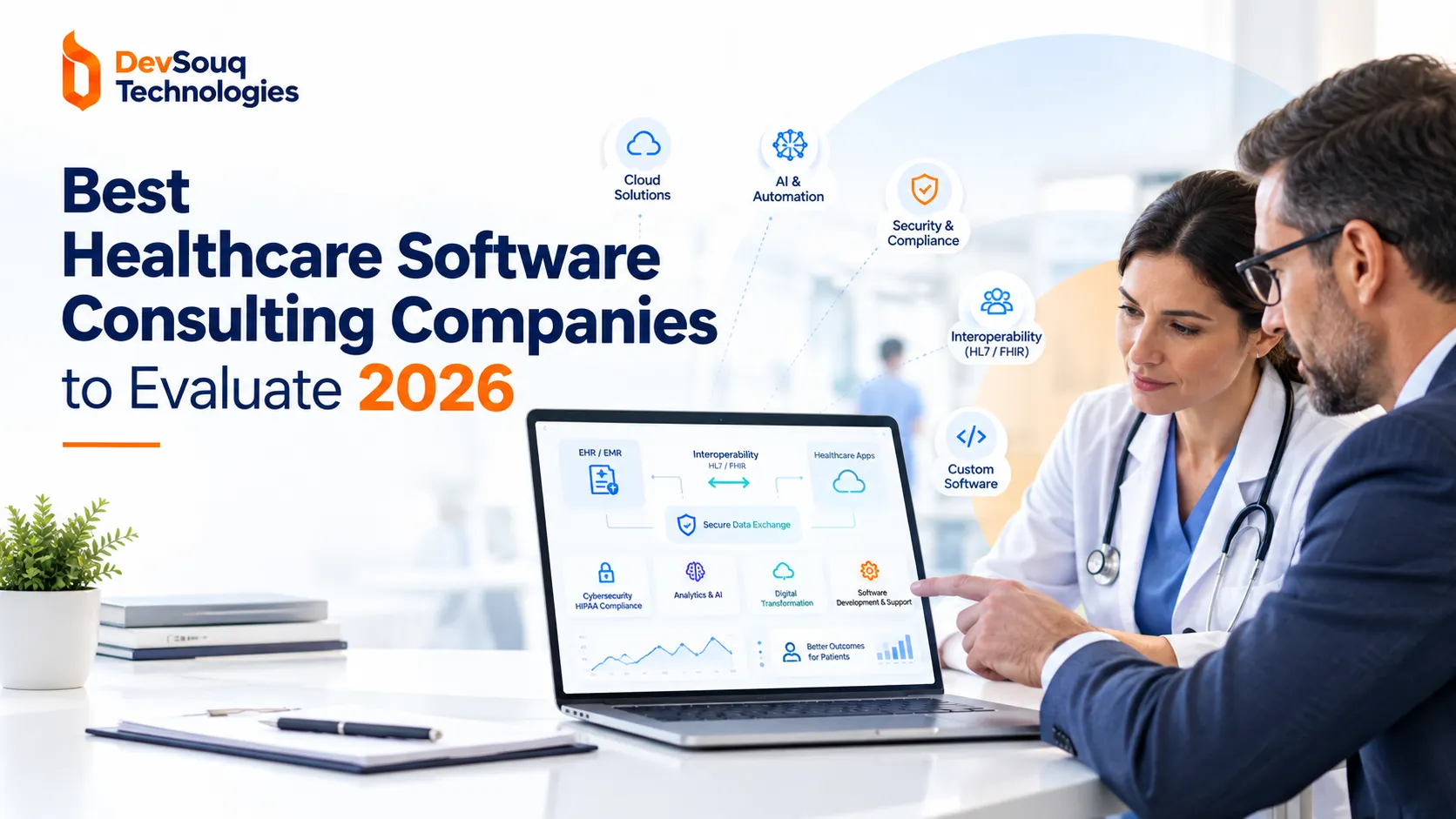
The term gets used loosely, so it helps to define the scope before comparing firms. Healthcare software consulting typically spans:
- EHR and EMR integration and optimization
- Custom clinical or operational tools built for a specific workflow
- Interoperability work tied to standards like FHIR and frameworks like TEFCA
- Compliance architecture, including HIPAA aligned data handling and PHI protection
- Legacy system modernization and cloud migration
- AI assisted tools for clinical decision support, prior authorization, and documentation
Some firms cover all of this. Many specialize in one or two areas and partner out the rest, which is worth knowing before you assume a firm can do everything on this list.
How We Evaluated These Firms
Four things separated a strong recommendation from a generic one:
- Discovery depth. Does the firm push back on weak use cases, or agree to everything a client proposes.
- Build versus buy honesty. Will they tell you an existing platform already solves your problem, even if it costs them a sale.
- Compliance fluency. Do they understand HIPAA, PHI handling, and relevant regulatory pathways as a default, not an add on.
- Delivery evidence. Is there a track record of shipped work, not just a strategy deck.
Quick Comparison
| Company | Best For | Core Strength | Approach | Client Reviews* | Headquarters | Ideal Project |
|---|---|---|---|---|---|---|
| DevSouq Technologies | Organizations evaluating, integrating, customizing, or building healthcare software | Workflow analysis, software selection, integration, interoperability, automation, and AI | Balanced recommends the best path: buy, integrate, customize, or build | 5.0 Star rating on Clutch | Austin, Texas. | EHR/EMR, patient portals, telemedicine, automation, AI, and healthcare platforms |
| Tech Exactly | Healthcare startups and digital health companies | Healthcare AI, HIPAA-compliant development, MVPs, cloud solutions, and integrations | Build-focused validates the use case before development | Verify on review platforms | Verify current location | AI products, MVPs, telemedicine, remote monitoring, and patient engagement tools |
| ScienceSoft | Established healthcare organizations seeking reliable software delivery | Healthcare applications, EHR/EMR, telemedicine, diagnostics, and IT consulting | Execution-focused delivers against defined requirements | Verify on review platforms | McKinney, Texas, USA | EHR modernization, telemedicine, patient portals, diagnostics, and analytics |
| Intellectsoft | Organizations developing custom applications or modernizing systems | Custom software, AI, blockchain, cloud, mobile apps, and digital transformation | Build-focused creates tailored healthcare solutions | Verify on review platforms | New York, New York, USA | Custom applications, AI tools, mobile health, and patient engagement platforms |
| Accenture | Large healthcare enterprises and complex transformation programs | Enterprise transformation, cloud, AI, data, cybersecurity, and consulting | Full-service combines strategy, implementation, integration, and support | Verify on review platforms | Dublin, Ireland | Cloud modernization, enterprise data, AI adoption, cybersecurity, and system integration |
| Slalom | Organizations focused on implementation, modernization, and experience | Cloud, technology consulting, change management, data, and patient experience | Delivery-focused supports implementation and adoption | Verify on review platforms | Seattle, Washington, USA | Cloud migration, modernization, digital workplace, analytics, and patient experience |
| IQVIA | Pharmaceutical, biotech, clinical research, and life sciences organizations | Health data, clinical research, real-world evidence, and analytics | Data-focused supports evidence-based decisions through data and technology | Verify on review platforms | Durham, North Carolina, USA | Clinical trials, drug development, regulatory support, and pharmaceutical analytics |
The Best Healthcare Software Consulting Companies
The list below leads with the firm we think is the strongest overall choice for most healthcare organizations, then covers a range of other firms suited to different budgets, project sizes, and stages.
1- DevSouq Technologies – Best for Workflow-First Healthcare Software Decisions
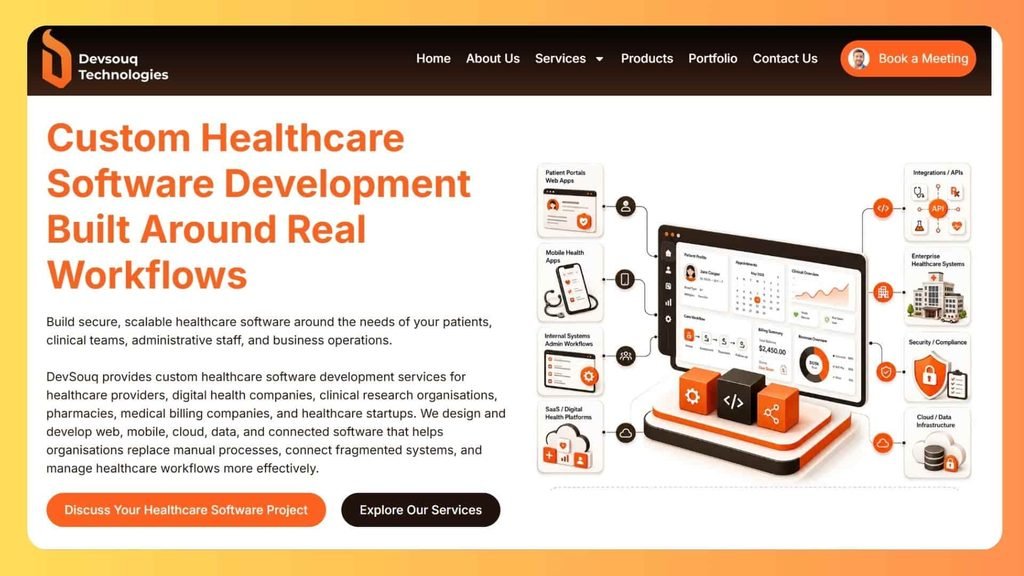
DevSouq Technologies is our top overall pick for healthcare organizations that want to understand the problem before deciding on the technology.
The process starts with the workflow, not the software. DevSouq looks at who will use the system, how the work is currently done, where time is being lost, which systems need to connect, and what the organization actually needs to improve. From there, the team determines the most practical path forward whether that means using an existing platform, integrating current systems, or building something purpose-built.
That approach is especially valuable for healthcare organizations because the right answer is not always another piece of software. If an existing platform already handles the required workflow effectively, there may be little reason to build from scratch. Custom development becomes worthwhile when the organization has specialized workflows, repeated workarounds, disconnected systems, or requirements that existing platforms cannot handle efficiently.
The result is a more outcome-focused approach to software decisions: understand the workflow first, identify the real gap, and then choose the technology that makes the most sense for the organization.
Best for:
Healthcare organizations that want to make a confident software decision based on their actual workflows, whether that means improving an existing system, integrating multiple platforms, or building a purpose-built solution.
Pros
- Workflow-first discovery: Starts by understanding users, processes, integrations, data requirements, and technical considerations before defining the solution.
- Build-or-buy guidance: Evaluates whether existing software can meet the requirement before recommending custom development.
- Requirements-based pricing: Projects are scoped around documented requirements, keeping investment aligned with the complexity of the actual solution.
- Fast initial scoping: DevSouq states that it typically provides an initial scope, timeline, and cost estimate within one business day of a request.
- Broad healthcare expertise: Its healthcare services span multiple operational and clinical workflows, making it suitable for organizations managing several software needs.
- End-to-end capabilities: Web, mobile, AI/ML, DevOps, and QA capabilities allow organizations to keep related development work with one technology partner.
Cons
- Custom approach: Each project is tailored to the organization’s specific needs.
- Varied project scope: Features, timelines, and investment can differ depending on the project.
- Consultation-led process: The team typically starts by understanding the organization’s requirements before recommending the next step.
Good to know
DevSouq is headquartered in Austin, Texas, with operations and clients across the USA, Pakistan, UK, and Canada. The company serves organizations across healthcare, financial services, education technology, logistics, media, startups, and other technology sectors.
Headquarters:
Austin, Texas.
Customers:
DevSouq works with organizations across multiple industries and showcases client relationships and project experience across its website.
Reviews:
DevSouq has a 5.0-star rating on Clutch and a 4.8-star rating on G2, giving potential clients strong independent customer feedback to consider alongside its case studies and project experience.
2- Tech Exactly
Tech Exactly is a healthcare and AI focused development company built for startups and growing businesses And also for large enterprise programs. Every engagement starts with a signed non disclosure agreement and a discovery call, followed by a detailed proposal covering scope, pricing, and timeline before any work begins.
Best for:
Startups , mid stage and enterprise digital health companies that already know they want to build something and need a technical partner who understands HIPAA constraints from day one.
Pros:
- Direct experience handling protected health information inside AI systems, so questions like model logging and training data structure are already solved problems rather than open questions
- Discovery process that has reportedly pushed back on client use cases where the regulatory burden outweighed the clinical value, rather than agreeing to build anything requested
- Published pricing bands give a useful starting reference: roughly twenty five thousand to fifty thousand dollars for an MVP, scaling to the low hundreds of thousands for enterprise grade platforms with complex integrations
- Startup friendly engagement model compared to firms built around large enterprise retainers
Cons:
- Not built for organizational change management, executive alignment workshops, or board level transformation presentations, so it is a poor fit for organizations needing that kind of strategic facilitation
- Better suited to teams who already know they want to build something rather than organizations still deciding whether AI or new software makes sense at all
- A newer, smaller firm relative to global consultancies, so buyers evaluating purely on company size or decades of market presence will find larger alternatives on this list
Headquarters:
India, based on third party rankings of Indian app development firms.
Customers:
No large named brand clients were found, which fits its startup focused positioning. The company states it has worked with more than one hundred startups and reports specific outcomes on individual projects, such as an app whose daily active users grew from about two hundred to one thousand after launch.
Reviews:
Rated on Clutch, with reviews describing cost effective pricing, strong communication, and effective project management. The company also reports an eighty six point seven percent on time delivery rate over a recent six month period and a one hundred percent client referral rate, though those two figures are self reported rather than independently audited.
3- ScienceSoft
ScienceSoft is a long established IT consulting and software development company, founded in 1989 and currently employing more than seven hundred and fifty specialists across offices in the US, GCC, and EU. It holds ISO 9001, ISO IEC 27001, and ISO 13485 certifications, the last of which specifically covers medical device quality management, and has delivered projects for more than one hundred and fifty healthcare clients.
Best for:
Healthcare organizations that have already decided they want new software or an AI capability and need an experienced partner to execute rather than help build the business case.
Pros:
- Decades of continuous operating history and a large team, which reduces the risk of a firm disappearing mid project
- Medical device specific certification (ISO 13485) that is uncommon among general software consultancies and matters for connected device or diagnostic software work
- Broad healthcare portfolio spanning telemedicine platforms, patient portals, HIPAA aligned EHR and EMR systems, and diagnostic software
- Functions as a mid market alternative to the largest global firms, often cited as offering enterprise scale delivery with more competitive pricing
Cons:
- Consulting engagements tend to be execution focused rather than a deep strategic discovery phase, so the nuanced clinical workflow judgment often needs to come from the client’s own team
- Not the right fit if an organization is still deciding whether AI or new software is worth pursuing at all
- Client feedback has flagged coordination across time zones as an area for improvement on some engagements
Headquarters:
McKinney, Texas.
Customers:
Named clients across its published portfolio include IBM, eBay, Ford, and PerkinElmer, alongside healthcare specific clients such as Rivanna Medical, ScribeAmerica, and Delaware Valley Community Health.
Reviews:
Rated in the high four star range, approximately 4.6 to 4.8 out of 5, across G2 and Clutch, with clients describing the team as reliable, thorough, and responsive.
4- Intellectsoft
Intellectsoft is a global software development and digital transformation company founded in 2007, headquartered in Palo Alto, California, with additional offices including New York, London, and Minsk. The company has delivered projects for well known global brands across healthcare, retail, and finance, and has grown to roughly two hundred to three hundred employees.
Best for:
Healthcare organizations that are past the question of whether to build AI or new software and are focused specifically on how to build it well.
Pros:
- Established international presence with more than a decade of delivery experience across multiple industries, not just healthcare
- Real experience building AI features into live healthcare products such as patient information systems and telehealth services
- Track record working with large, well known brands, which can matter for organizations that want evidence of handling complex, high profile projects
Cons:
- Consulting tends to exist in service of a build engagement rather than as standalone, vendor neutral advisory work
- Less useful for an organization still trying to determine whether a use case makes sense in the first place, since the firm is oriented toward execution once a direction is set
- Global, multi industry focus means healthcare specific regulatory depth may not run as deep as firms that specialize in healthcare exclusively
Headquarters:
Palo Alto, California, with additional offices including New York, London, and Minsk.
Customers:
Named clients across its broader (not exclusively healthcare) portfolio include Disney, Nestle, Guinness, Jaguar, Land Rover, Eurostar, Harley Davidson, and EY.
Reviews:
Recognized by Clutch as a highly rated software development company and named to Clutch’s list of top global service providers, with a reported rating near 4.9 out of 5 across dozens of reviews at the time it received that recognition.
5- Accenture
Accenture is one of the largest technology and consulting firms in the world, with a dedicated health practice operating across well over one hundred countries. Everest Group’s most recent Healthcare Provider Digital Services assessment places Accenture among the top tier of providers, citing broad coverage across the full provider value chain and heavy investment in AI, cloud, and data capabilities backed by a series of relevant acquisitions.
Best for:
Large health systems and enterprise organizations running multi year digital transformation programs where scale, proprietary tooling, and hyperscaler partnerships matter more than speed or cost.
Pros:
- Broad coverage across patient engagement, diagnostics, care management, and financial systems, backed by proprietary tools and frameworks
- Significant, sustained investment in AI, cloud, and healthcare specific data platforms, including a multi billion dollar cross industry generative AI commitment
- Deep partnerships with major cloud and enterprise software providers, useful for organizations already committed to a specific technology ecosystem
Cons:
- Widely perceived as a premium priced option, which puts it out of reach for smaller organizations or focused, lower budget projects
- Engagement model is built around large scale, long duration programs rather than lighter or faster projects
- Independent analyst review has noted an opportunity to provide more concrete proof points for generative AI implementations specifically, alongside room to grow its presence with smaller buyers
Headquarters:
Dublin, Ireland.
Customers:
Named clients across its overall business, not exclusively healthcare, include Prada, Dove, Gatorade, Spotify, Bosch, and OpenAI.
Reviews:
Rather than a client review platform score, Accenture’s healthcare credibility is established through independent analyst assessment. Everest Group’s PEAK Matrix places Accenture in the Leaders category for healthcare provider digital services, based on market impact and delivery capability.
6- Slalom
Slalom is a technology forward consulting firm with a hands on delivery model, with a healthcare practice that covers both provider and payer organizations across a large network of offices.
Best for:
Healthcare organizations that want a consulting partner focused on getting technology implemented, not just producing strategy documents.
Pros:
- Strong, documented track record in cloud platform implementation and patient experience technology
- More hands on, delivery oriented style compared to firms that lean primarily toward strategy work
- Named healthcare clients include recognizable health systems, which supports the claim of real delivery experience in the sector
Cons:
- Less positioned as a deep regulatory or compliance first partner compared to firms built specifically around healthcare compliance work
- Works best once a direction is already set, so it is a weaker fit for organizations that need help deciding what to build in the first place
Headquarters:
Seattle, Washington.
Customers:
Named healthcare clients include Mass General Brigham, Renown Health, Ochsner Health, and Castell.
Reviews:
No independent Clutch or G2 rating specific to Slalom’s healthcare practice was located during this research. Worth confirming with the team if third party review validation is wanted before publish.
7- IQVIA

IQVIA is a data and analytics company with an unusually large proprietary set of health data assets, built primarily to serve life sciences, pharmaceutical, and clinical research organizations rather than general healthcare providers.
Best for:
Pharmaceutical companies, clinical research organizations, and health systems with complex data and analytics needs tied to drug development, commercialization, or real world evidence.
Pros:
- Proprietary health data assets that are difficult for a general software consultancy to replicate
- Deep, specific expertise in clinical trials, market research, and life sciences analytics
- Operates in more than one hundred countries, useful for organizations running multinational research or commercialization programs
Cons:
- Best suited to life sciences and pharma specific contexts, and a poor general purpose fit for a typical hospital or clinic evaluating basic software needs
- Not positioned as a software builder in the way DevSouq, Tech Exactly, ScienceSoft, or Intellectsoft are, so organizations needing custom application development specifically will need a different partner
Headquarters:
Durham, North Carolina.
Customers:
Named clients include Sanofi, AstraZeneca, Johnson and Johnson, AbbVie, Novartis, GSK, and Eisai.
Reviews:
No independent Clutch or G2 rating was located during this research. IQVIA’s standing in the market is generally established through its data assets and pharmaceutical industry relationships rather than a public review platform score.
Build Versus Buy: The Question Most Firms Skip
Before hiring anyone, it is worth asking a blunt question. Does this organization make more money if they tell you to build something custom. If the answer is yes, and they have never once told a client not to build something, that is worth noticing.
A consultant who researches your actual workflow first and only proposes a build when nothing existing solves the problem is protecting your budget, not just filling a pipeline.
What It Costs and How Long It Takes
Costs vary widely based on scope. Smaller, focused engagements tend to run in the tens of thousands to low hundreds of thousands of dollars. Large scale enterprise transformation programs with global firms can run into the tens of millions over several years. Timeline follows a similar pattern: a focused project can wrap in a matter of months, while a full enterprise transformation for a large health system commonly runs several years once staff training, compliance approval, and workflow change are factored in.
Questions to Ask Before Sign healthcare software consultant
- What does your discovery process actually involve, and how long does it take
- Have you ever told a client not to build something they asked for, and what happened
- What compliance credentials or experience does your team have specific to healthcare
- Can I speak to a past client, including one where something did not go smoothly
- What does support look like after launch
FAQs
What is healthcare software consulting?
It is advisory and technical work that helps healthcare organizations plan, build, or select software for clinical, operational, or compliance needs, spanning everything from EHR integration to AI tools.
How much does healthcare software consulting cost?
Focused projects often run from the tens of thousands into the low hundreds of thousands of dollars. Enterprise wide programs with large firms can run far higher, depending on scope and timeline.
What is the difference between healthcare IT consulting and healthcare software consulting?
Healthcare IT consulting often includes staffing, infrastructure, and broader systems work. Healthcare software consulting focuses more specifically on planning, building, or selecting software itself.
How do I know if I need custom software or an existing platform?
Start with a proper discovery process. If a consultant recommends custom development before fully mapping your workflow and checking existing options, that is a warning sign.
What compliance standards should a healthcare software consultant know?
HIPAA is the baseline. Depending on the project, familiarity with FHIR, TEFCA interoperability rules, and FDA pathways for AI informed clinical tools may also matter.