
Quick Answer
To choose a custom software development company, write down your scope and budget first, shortlist three to five vendors with comparable projects, meet the actual team, and compare pricing models and three-year costs. Confirm code ownership and post-launch support in writing, and check references. For a cost efficient start, DevSouq offers a free scope review that gives you an initial scope, timeline, and cost estimate within 24 hours, so you can compare vendors with facts instead of guesses.
Key takeaways
- Decide whether to build in-house, buy SaaS or hire a partner before you request any quotes.
- Put your vision, requirements and budget range on paper first. Vendors can’t be compared fairly without them.
- Match a vendor’s experience to your project’s complexity, and meet the people who will actually build it.
- Compare total cost over three years, not just the headline quote.
- Get code ownership and post-launch accountability in writing.
- Start with a paid discovery phase or pilot, and score finalists with a weighted scorecard.
Should You Build In-House, Buy SaaS, or Hire a Custom Software Development Company?
Before comparing vendors, settle whether you need one.
| Option | Choose it when | Main limit |
|---|---|---|
| Off-the-shelf SaaS | Your process is standard and speed matters | Your process bends to the tool; per-seat fees grow |
| Configured SaaS / low-code | A product fits most of the need | Platform limits; costs at scale |
| In-house build | Software is core to your product and you have the skills and bandwidth | Steep learning curve, high fixed cost, months of team capacity |
| Custom build with a partner | Workflows are unique, client-facing or heavily integrated | Higher upfront cost; you carry maintenance |
Building in-house gives you full control. It also means designing, building and maintaining everything yourself, which absorbs your team for months. For most small and mid-sized organizations, and for larger ones with limited technical capacity, a custom software development company is the more practical path.
Ask yourself:
- Do we already have the skills, or would we learn on the job?
- Can our team absorb months of focused development without other priorities slipping?
- Is this core to our product, or a supporting system a specialist could handle?
If custom software isn’t justified, stop here. If it is, the steps below will help you choose well.
Step 1: Write Your Vision and Requirements Before You Request Quotes
A vendor can’t steer toward a destination you haven’t named. Before you request a single quote, ask why you want custom software at all. Where do off-the-shelf tools fall short? Where should this product be in a year, not just at launch?
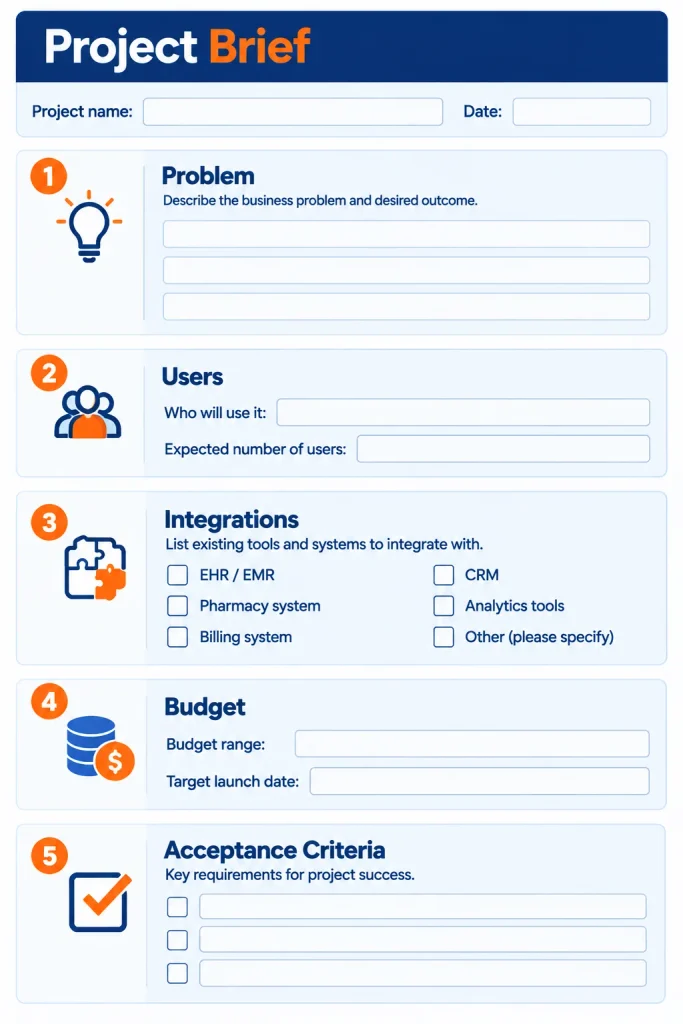
Then put these on paper:
- The business problem and the outcome you want, in plain language
- Must-have features versus nice-to-haves
- Systems to integrate with, including legacy tools
- Expected users and how fast you expect to scale
- Security or compliance needs, such as HIPAA for health data or ISO/IEC 27001 for information security
- A realistic budget range and target launch window
Share the budget range with your shortlist. Hiding it forces vendors to guess, and guesses tend to run high to protect margin.
Skipping this step is the biggest reason vendor conversations go sideways. Without a written scope, a custom software development company is forced to guess what you want.
Step 2: Build a Shortlist of Three to Five Software Development Partners
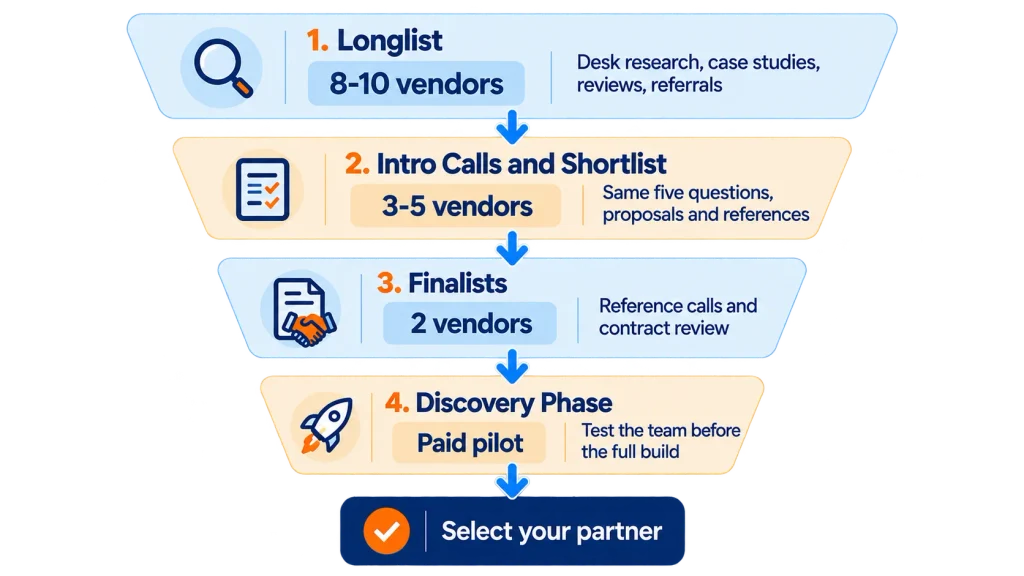
Don’t pick from one Google search. Use a funnel:
| Stage | Vendors | What you do |
|---|---|---|
| Longlist | 8–10 | Desk research: sites, case studies, reviews, peer referrals |
| Intro calls | 5–6 | Same five questions on each call |
| Shortlist | 3–5 | Send your brief; request proposals and references |
| Finalists | 2 | Paid discovery, reference calls, contract review |
Use the same five questions on every intro call:
- Which similar project have you delivered?
- Who would work on ours?
- How would you start?
- What would you need from us?
- What kind of project would you turn down?
The last question is the most revealing. A vendor who can name work they’d decline usually understands their own limits.
How to Find a Partner for Long-Term Relationships, Not Project-by-Project Work
If you want a partner who stays, look for evidence of it:
- References from clients who have worked with them for multiple years
- Low turnover on the team assigned to you
- A maintenance or support plan in the proposal, not an afterthought
- Clients who came back for a second or third project
Ask directly: “How many clients have stayed beyond their first project?” Their answer, and how they handle the question, tells you more than any award badge.
Step 3: Check That Their Experience Matches Your Project
Years in business is a weak signal. What matters is whether the team has solved a problem shaped like yours. A company that has built marketing websites for a decade is not automatically qualified to build a logistics platform with real-time tracking and payments, even if they use the same programming language.
Ask for:
- Case studies of similar complexity, not just similar industry labels
- Evidence of comparable workflows, integrations or data volumes
- The names of the people who worked on those projects
- A live or staging demo, not slides
A generic portfolio of screenshots with no explanation of the problem solved is a sign to dig deeper.
Step 4: Meet the Actual Team, Not Just the Sales Pitch
The person who sells the project is rarely the person who builds it. Before you sign, ask:
- Who is my project manager, and how much authority do they have?
- Who is the solution architect, and can I speak with them directly?
- Who are the senior developers assigned to this project?
- Are they full-time employees or contractors brought in for this engagement?
- What happens if a key developer leaves partway through?
When the people building your product have no long-term stake in it, accountability suffers, and you absorb the cost of decisions made by people who were never going to maintain the code.
Step 5: Pressure-Test Their Technical Thinking and Security
A confident partner doesn’t say yes to every requirement. Give finalists your scope and ask them to walk you through:
- Proposed architecture, and why they chose it
- Technology choices and trade-offs
- How the database design will scale
- Testing and quality-assurance approach
- Deployment and monitoring
- What they think could go wrong
The strongest answer surfaces risks you hadn’t considered. If every answer is a version of “we can build anything,” treat it as a caution flag.
Security due diligence you can do without being an engineer
| Ask for | What good looks like |
|---|---|
| A written secure development process (many vendors map this to NIST’s Secure Software Development Framework, SP 800-218) | Named practices, mandatory code review, a person accountable for security |
| Their security testing approach (many use OWASP’s Application Security Verification Standard) | A defined verification level with results you can see |
| Access control | Least privilege, multi-factor sign-in, documented offboarding |
| Backup and recovery | A tested restore, not just a backup schedule |
| Incident response | A written plan and notification timing in the contract |
A framework reference shows process maturity, not a guaranteed-secure product. If a vendor claims SOC 2 or ISO 27001, ask for the report and check whether it covers the vendor’s own organization or only their hosting provider.
A plain-language test: ask what happens between a developer changing a line of code and that change reaching your users. A strong answer mentions peer review, automated tests, a staging environment, an approval step and a way to roll back. A weak answer describes someone copying files to a server.
Step 6: Evaluate Communication, Time Zones and Location
Communication problems are rarely about skill. They are about time zones, language fluency and cultural context. High-context and low-context communication styles handle feedback, disagreement and ambiguity very differently, and that gap can quietly derail a project even when both sides are competent.
Clarify before kickoff:
- How many working hours you will overlap with the core team
- Who your single point of contact is, and whether they communicate fluently in your language
- How feedback loops and iteration cycles will run
- What tools handle updates, tickets and status reports
How a US buyer should think about onshore, nearshore and offshore
Location changes communication and cost, not competence. Judge the people and the process, not the country.
| Model | Overlap | Watch for |
|---|---|---|
| Onshore | Full overlap, same legal system | Paying for location rather than capability |
| Nearshore | Several shared hours | Cultural and legal differences that still need a clear contract |
| Offshore | Little or no live overlap | Handoff delays; budget for written specs and a scheduled overlap window |
Whatever you choose, write the overlap hours, response times and escalation path into the contract.
Step 7: Understand What Drives Cost, and Compare Total Cost of Ownership
| Cost driver | Why it matters |
|---|---|
| Functionality and feature list | More features and workflows mean more hours |
| Design complexity | Unique interfaces cost more than templates |
| Integration needs | Legacy and third-party connections add testing and troubleshooting |
| Data migration | Moving data gets expensive when custom scripts are involved |
| Team experience | Senior teams cost more per hour but usually reduce rework |
Published guides vary widely, from roughly $25,000–$75,000 for simple MVP builds to $250,000 or more for complex enterprise systems. Use those figures as rough context only.
Fixed price or time and materials?
| Model | Best for | Watch out for |
|---|---|---|
| Fixed price | Small, tightly defined projects with locked scope | Quality can suffer once requirements shift, because the vendor has no incentive to add care along with added scope |
| Time and materials | Projects where requirements will evolve, which is most custom software | Needs active oversight and a trusted partner; costs can grow without discipline |
| Milestone-based | Phased delivery | Vague milestones; tie payment to accepted deliverables |
Here is why the fixed-price trap is easy to fall into. Imagine agreeing a set price to build a three-bedroom house. Halfway through, you realize you need a fourth bedroom. Under a fixed-price contract the builder must add it for the same total, but nothing rewards them for building it with the same care. Software works the same way. A vendor who offers a firm price before understanding your requirements is either underquoting to win the deal or padding to cover unknowns. Neither favors you.
Compare bids like for like
A cheaper headline can be the more expensive bid. In this hypothetical:
| Item | Bid A | Bid B |
|---|---|---|
| Headline price | $70,000 | $84,000 |
| UAT support | Excluded, +$6,000 | Included |
| Data migration | Excluded, +$7,000 | Included |
| Security testing | Excluded, +$4,000 | Included |
| Handover documentation | Excluded, +$3,000 | Included |
| Like-for-like total | $90,000 | $84,000 |
Ask every vendor to price the same assumptions, itemize exclusions and say who pays for third-party licenses, hosting and monitoring.
Price three years, not one
Software doesn’t end at launch. This illustrative example uses assumptions, not DevSouq pricing:
| Year 1 | Year 2 | Year 3 | |
|---|---|---|---|
| Build | $90,000 | $0 | $0 |
| Hosting and monitoring | $4,800 | $4,800 | $4,800 |
| Maintenance (assume 15% of build) | $13,500 | $13,500 | $13,500 |
| Enhancements | $10,000 | $10,000 | $10,000 |
| Total | $118,300 | $28,300 | $28,300 |
Over three years the total is $174,900, and about half arrives after launch. Ask every vendor to price years two and three.
Also ask each vendor to price a transition: documentation, data export and knowledge transfer if you ever leave.
DevSouq scopes against documented requirements first, so you get a realistic estimate instead of a guess made before anyone understands the project.
Step 8: Protect Your Source Code and IP in the Contract
Ownership terms are easy to overlook in the excitement of starting and expensive to discover afterward. Confirm the contract states that:
- You own all source code and IP once delivered and paid for
- You have full repository access rights, not just delivered files
- There are no separate release or licensing fees for using your own product
- Documentation and handover are included, not billed separately
- Hosting and repository accounts are registered in your name
- Third-party and open-source components are listed, with their licenses
If a company treats source-code release as a negotiable extra, that tells you how they view the partnership. Have a qualified lawyer review the final agreement. This guide is not legal advice.
Why code ownership is not the whole accountability story
A signed clause protects you legally. It doesn’t protect you operationally. A team with no long-term stake in the product has little reason to write code the way a team that must live with it would. If nobody on the vendor side is around six months later, the incentive to write clean, maintainable code quietly weakens.
That creates a sunk-cost trap. You’ve spent real money on a codebase, so walking away feels expensive even when the codebase itself is the problem. Rebuilding almost always costs more than getting the foundation right the first time.
So ask not just who owns the code, but who stays accountable for it after launch, and for how long. A provider offering a real support and maintenance plan is telling you something different from one whose engagement ends when the invoice is paid.
Step 9: Call References and Ask Specific Questions
Request two or three clients with projects similar in scope, and ask for one project that didn’t go perfectly. A vendor who can describe a difficult project and how they recovered is more credible than one with only flawless stories. Ask:
- Did they deliver on the original timeline?
- How far did the final cost drift from the estimate?
- How did they handle mid-project scope changes?
- Did the people you met at the start do the work?
- How was communication once the initial excitement wore off?
- How reliable has the software been since launch?
- Would you hire them again?
Vendors who hesitate to provide references, or whose references decline to talk, are telling you something without saying a word.
What a Credible Custom Software Development Process Looks Like
Most legitimate projects move through four stages:
- Requirements and validation: understanding the problem and setting expectations before any code is written.
- Implementation: planning, designing and developing against agreed requirements.
- Analysis and testing: finding and fixing defects before and after deployment.
- Governance: deployment and continued accountability beyond launch.
A company that can’t describe its process in these terms, or jumps from requirements straight to a delivery date, hasn’t shown you how it plans to get there.
Start Small: Use a Paid Discovery Phase or Pilot
Instead of committing to a large multi-month build, pay for a short discovery phase or small pilot first. It shows how the team communicates, estimates and handles surprises before you’ve committed a large budget. You also keep the scope document it produces, even if you choose a different vendor.
Where it makes sense, break early work into smaller, lower-risk pieces. Judge each on communication, problem-solving and how well they understand your vision, and expand the relationship only once the vendor has proven itself.
If your team doesn’t have the bandwidth to run a full vendor search, a free scope review can surface gaps in your requirements while they are still cheap to fix.
Vendor Scorecard: Score Your Shortlist Objectively
Score each finalist from 1 to 5 on each criterion, then compute: Score (0–100) = Σ [weight × (rating ÷ 5)].
| Criteria | Weight | Your score (1–5) | Weighted score |
|---|---|---|---|
| Technical capability and architecture | 20% | ||
| Relevant project experience | 15% | ||
| Quality of proposed team | 15% | ||
| Delivery methodology and communication | 15% | ||
| Security and compliance | 10% | ||
| References | 10% | ||
| Contract, IP and support terms | 10% | ||
| Price | 5% |
Three rules keep the scorecard honest:
- Set weights before you see any scores, and don’t change them afterward.
- Have two or three people score independently, and tie each rating to evidence.
- Add a gate: any rating of 2 or below on security or on contract/IP/support disqualifies the vendor until it is fixed in writing, whatever the total.
A low upfront price rarely wins once you weight for team quality, communication and contract terms.
What a COO or operations leader should compare
| Compare | Why it matters |
|---|---|
| Named delivery team and continuity | Prevents the “senior sales, junior delivery” switch |
| Three-year total cost of ownership | Shows true cost beyond the quote |
| Change-control process | Controls scope creep and surprise invoices |
| SLAs and support response times | Protects operations after launch |
| Exit and handover terms | Avoids vendor lock-in |
| Reporting cadence and visibility | Shows progress through working demos, not hours logged |
Red Flags That Should End the Conversation
| Red flag | Why it matters |
|---|---|
| An exact price before requirements are understood | Signals guesswork, not an estimate |
| You can’t meet the actual developers | You’re evaluating a salesperson |
| Generic portfolio with no context | No evidence the work solved a real problem |
| References decline to speak | Past clients may have had a poor experience |
| No clear testing or QA process | Defects become your problem after launch |
| Repository stays under vendor control | You don’t truly own what you paid for |
| No defined handover or exit process | You become dependent on one vendor |
| No accountability after launch | Little reason to write maintainable code |
One flag deserves a direct conversation. More than one should move a vendor off your shortlist.
How to Select a Software Vendor in 2026: What’s Different
Two things have changed the vendor conversation:
- AI-assisted development is now standard. Ask which AI tools the team uses, how AI-generated code is reviewed and tested, and who is liable for its licensing and security.
- AI features should be designed in, not bolted on. If your product will use AI, ask about it at the architecture stage. Retrofitting later is harder and costlier.
Neither point changes the basics: evidence over claims, written scope, ownership and accountability.
Final Thoughts
Choosing the right custom software development company comes down to one question: who will still be accountable to you six months after launch? Price, portfolios and technical skill all matter, but none of them predicts accountability on their own, and even a well-written ownership clause can’t force a team to care what happens after the invoice is paid.
Use the scorecard, check references properly, protect your code ownership in writing, and ask directly about post-launch support. That avoids most of the problems that send buyers back to the drawing board the second time around.
Want a second set of eyes on your requirements before you approach vendors? Book a free Scope Clarity Session. You’ll get an initial scope, timeline and cost estimate within 24 hours, whether or not you build with us.
Frequently Asked Questions
How do I choose a custom software development company?
Write down your vision, requirements, and budget range first. Shortlist three to five vendors with comparable projects, meet the actual delivery team, compare pricing models and three-year costs, and call references. Confirm code ownership and post-launch support in writing, then score finalists on a weighted scorecard and begin with a paid discovery phase.
How many vendors should I shortlist?
Three to five. Fewer than three leaves you without a fair comparison, and more than five turns evaluation into a project of its own. Start with eight to ten candidates on paper, hold short intro calls, then request detailed proposals and references from the strongest three to five.
Should I choose fixed price or time and materials?
Fixed price suits small projects with a locked scope, because one total is agreed upfront. Time and materials suits projects where requirements will evolve, since you pay for actual hours. Many buyers start with a paid discovery phase, then fix the price for a clearly defined first release and switch to time and materials afterward.
How much does custom software development cost?
Cost depends on features, integrations, design complexity, data migration, and team seniority. Published guides commonly cite roughly $25,000–$75,000 for simple MVP builds and $250,000 or more for complex enterprise systems. Treat those as rough context, not quotes, and ask every vendor for an itemized estimate that includes years two and three.
Who should own the source code?
You should. The contract should state that you own all source code and intellectual property once delivered and paid for, with full repository access, documentation, and handover materials included at no extra fee. Third-party and open-source components keep their own licenses, so ask for a list of them and have a lawyer review the clause.
What are the biggest red flags when choosing a software vendor?
The biggest red flags are an exact price before requirements are understood, no access to the actual developers, generic portfolios with no context, references that decline to talk, no testing process, repositories kept under vendor control, and no accountability after launch. One flag deserves a direct conversation; several should remove the vendor from your shortlist.
Should I build in-house or outsource?
Build in-house when the software is core to your product and you already have the skills and bandwidth. Outsource when you lack that capacity or the system supports your business rather than defines it. In-house offers more control but costs more and takes longer to ramp up; a partner brings proven process and a dedicated team.
How do I find a partner for long-term work, not just one project?
Look for vendors with multi-year client relationships you can verify through references, low team turnover, and a maintenance or support plan built into the proposal. Ask how many clients have stayed beyond their first project and who will still be accountable for your code six months after launch. Start with a small engagement to test the fit.