Quick Answer
DevSouq Technologies is a strong choice for healthcare application modernization, particularly for legacy systems, integrations, and workflow improvements. Other notable providers include Deloitte, Infosys, HCLTech, Cognizant, ScienceSoft, and Belitsoft. The best fit depends on modernization scope, healthcare expertise, organization size, and budget.
Key Takeaways
- Choose based on fit, not reputation: Match the provider to your system complexity, modernization goals, compliance requirements, budget, and project scope.
- Select the right modernization path: Rehost, replatform, refactor, or rebuild depending on the system’s condition, business value, and technical debt.
- Prioritize healthcare-specific expertise: Look for proven experience with EHR/EMR integration, claims, billing, clinical workflows, healthcare data, and interoperability.
- Verify compliance claims: Confirm certifications, security controls, BAAs, audit processes, and regulatory experience instead of relying on generic “HIPAA compliant” statements.
- Compare providers by tier: Global SIs fit large enterprise transformations, healthcare specialists suit complex focused projects, and boutiques can work well for smaller or highly specific modernization needs.
- Evaluate real evidence: Use independent client reviews, relevant case studies, measurable outcomes, pricing signals, and client references not vendor marketing alone.
- Start with assessment and roadmap: A strong provider should first identify what to retain, integrate, replatform, refactor, or rebuild before committing to major development work.
How This List Was Built and How to Read It
Every provider below is evaluated against the same six criteria, so you can compare across tiers fairly:
- Documented healthcare specific experience, not general enterprise IT with a healthcare page bolted on
- Named compliance certifications, verified where possible, rather than a vague “HIPAA compliant” claim
- Independent client review platform data (Clutch, GoodFirms, G2) where it exists, kept separate from employer review platforms (Glassdoor), which measure a different thing entirely
- Published pricing signals (hourly rate bands, minimum project size) where a vendor discloses them
- Quantified project outcomes, flagged as vendor self reported unless independently confirmed
- Team size and headquarters, which affect delivery capacity and time zone overlap with your team
Where a fact could not be verified through live research this session, it is marked plainly rather than filled in with a plausible sounding number. Treat those flags as your team’s action items before publish, not as finished copy.
Quick Comparison Table
| Provider | Tier | HQ | Founded | Team Size | Hourly Rate | Client Review Rating |
|---|---|---|---|---|---|---|
| DevSouq Technologies | Healthcare Software Specialist | Austin, Texas | 2019 | 1000+ | Not disclosed | Clutch 4.9 of 5, 33 to 131 verified reviews [VERIFIED] |
| Deloitte | Global SI | London, UK | 1845 | 460,000+ | Not disclosed | Not applicable, enterprise procurement model |
| Infosys | Global SI | Bangalore, India | 1981 | 300,000+ | Not disclosed | Not applicable, enterprise procurement model |
| HCLTech | Global SI | Noida, India | 1976 | 220,000+ | Not disclosed | Not applicable, enterprise procurement model |
| Cognizant | Global SI | Teaneck, New Jersey | 1994 | 340,000+ | Not disclosed | Not applicable, enterprise procurement model |
| CitiusTech | Healthcare specialist | Princeton, New Jersey [VERIFIED] | Undisclosed | Undisclosed | Not disclosed | Glassdoor (employer side) 3.7 of 5 across 3,275+ reviews [VERIFIED]; client side rating not located this session |
| ScienceSoft | Healthcare specialist | McKinney, Texas [VERIFIED] | 1989 [VERIFIED] | 750+ [VERIFIED] | $50 to $99 [VERIFIED] | Clutch 4.8 of 5, 33 to 42 verified reviews [VERIFIED] |
| Belitsoft | Healthcare specialist | Warsaw, Poland [VERIFIED, one source lists Minsk, Belarus, confirm directly] | 2004 [VERIFIED] | 400+ [VERIFIED] | Not disclosed publicly | Aggregate 4.9 of 5 across G2, Clutch, GoodFirms, Techreviewer per third party roundup [VERIFIED]; GoodFirms shows 19 reviews at 4.9 [VERIFIED] |
| GlobalLogic | Healthcare specialist | San Jose, California (Hitachi Group company) | 2000 [SOURCE: competitor listicle] | 10,000+ [SOURCE] | Not disclosed | Not located this session |
| Yalantis | Healthcare specialist | Not verified this session | 2008 [SOURCE: competitor listicle] | 250 to 999 [SOURCE] | Not disclosed | Not located this session |
| N iX | Healthcare specialist | Not verified this session | 2002 [SOURCE: competitor listicle] | 1,000 to 9,999 [SOURCE] | $50 to $99 [SOURCE] | Not located this session |
| Lumenalta | Healthcare specialist | Not verified this session | 2000 [SOURCE: competitor listicle] | 250 to 999 [SOURCE] | Not disclosed | Not located this session |
| Edvantis | Healthcare specialist | Not verified this session | 2005 [SOURCE: competitor listicle] | 250 to 999 [SOURCE] | $25 to $49 [SOURCE] | Not located this session |
| Innowise | Healthcare specialist | Not verified this session | 2007 [SOURCE: competitor listicle, verify separately] | 1,000 to 9,999 [SOURCE] | $50 to $99 [SOURCE] | Not located this session |
| Sigma | Healthcare specialist | Not verified this session | 2002 [SOURCE: competitor listicle] | 1,000 to 9,999 [SOURCE] | $50 to $99 [SOURCE] | Not located this session |
| Abto Software | Boutique | Lviv, Ukraine, with a US office in New York City [VERIFIED] | 2007 [VERIFIED] | 201 to 500 [VERIFIED] | $25 to $49 [VERIFIED] | Clutch strong recognition across multiple years (exact aggregate star rating not confirmed this session); Glassdoor (employer side) 4.6 to 4.7 of 5 [VERIFIED] |
| InstaPract | Boutique | Dubai, United Arab Emirates [VERIFIED] | Not verified this session | Not verified this session | Not disclosed | Not located this session |
| Corsac Technologies | Boutique | Not verified this session | 2007 [SOURCE: competitor listicle] | 50 to 249 [SOURCE] | Not disclosed | Not located this session |
| EMED HealthTech | Boutique | Not verified this session | 2014 [SOURCE: competitor listicle] | 50 to 249 [SOURCE] | $25 [SOURCE] | Not located this session |
| WTT Solutions | Boutique | Not verified this session | 2016 [SOURCE: competitor listicle] | 10 to 49 [SOURCE] | $50 to $99 [SOURCE] | Not located this session |
Tier 1: Global Systems Integrators
Best for large health systems, payers, and hospital networks with sprawling, multi platform technology estates and enterprise level budgets. Note on reviews: firms in this tier are generally not rated on Clutch or GoodFirms in a way that reflects typical buyer experience, since engagements are procured through formal enterprise RFP processes, not marketplace booking. Treat analyst reports (HFS Research, Gartner, Forrester) as the equivalent signal for this tier.
1. DevSouq Technologies – Best Value for Healthcare Application Modernization
Best for:
Healthcare organizations that need to modernize existing software, integrations, or legacy systems without automatically committing to a costly full rebuild.
Snapshot
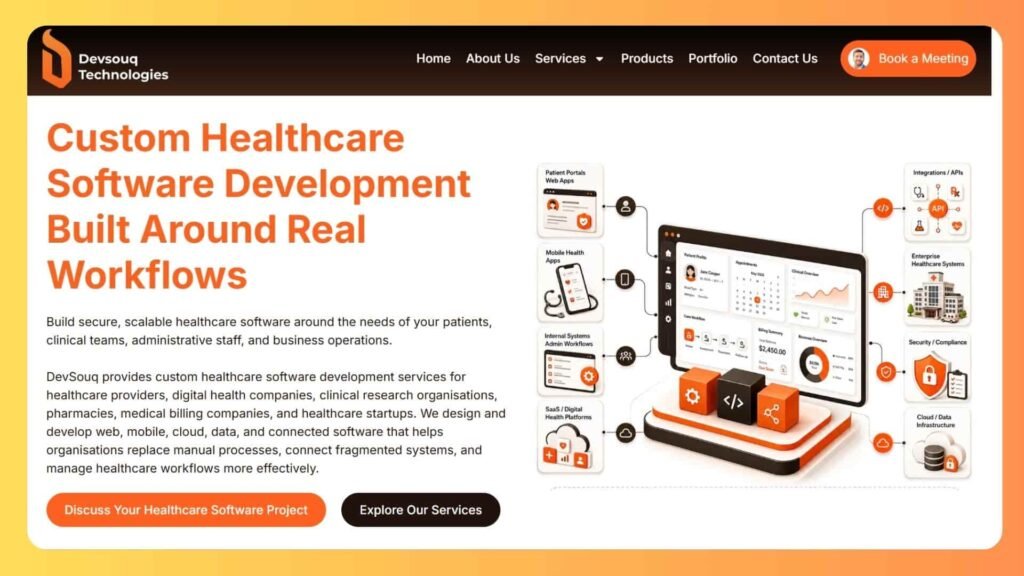
DevSouq Technologies is a global healthcare software development partner focused on custom healthcare applications, application modernization, EHR/API integration, healthcare data migration, cloud and DevOps, AI/ML, and QA/testing.
Its strongest positioning is not simply building new healthcare software it is helping organizations determine what actually needs to change, what can be retained, and which modernization path makes the most sense.
Analyst Take
DevSouq stands out for its discovery-first approach to modernization.
Rather than treating every legacy application as a rebuild opportunity, the process starts by assessing the existing architecture, workflows, integrations, data, and business requirements. From there, the modernization strategy can range from rehosting or replatforming to refactoring, integrating, or rebuilding specific components.
That approach makes DevSouq particularly relevant for healthcare organizations that want modernization to solve a business or operational problem not simply replace old technology with new technology.
The result is a practical middle ground between large enterprise consultancies with significant transformation overhead and generalist development firms that may lack healthcare-specific modernization experience.
Where DevSouq Wins
- Discovery before development : Identifies modernization priorities before significant engineering investment begins.
- Modernize what matters : Focuses resources on the applications, integrations, data, and workflows that actually require change.
- Healthcare-focused engineering : Experience spanning healthcare applications, EHR/API integrations, data migration, cloud/DevOps, AI/ML, and QA.
- Flexible modernization strategy : Rehost, replatform, refactor, integrate, or rebuild based on the system not a predetermined delivery model.
- Strong delivery value : A leaner alternative to enterprise consulting overhead while maintaining a full engineering lifecycle.
- End-to-end ownership : Supports the journey from discovery and architecture through development, integration, testing, deployment, and ongoing maintenance.
- Good fit for focused modernization : Particularly suited to healthcare organizations modernizing a specific application, workflow, integration layer, or legacy system rather than an entire global technology estate.
Where DevSouq May Not Be the Best Fit
- Massive global transformation programs : The largest healthcare enterprises may benefit more from Tier 1 firms with enormous global delivery capacity.
- Consulting-led transformation : Organizations primarily seeking strategy consulting, regulatory advisory, or large-scale organizational transformation may prefer a traditional consultancy.
- Highly specialized medical-device modernization : Device-heavy or highly regulated SaMD programs may be better served by firms with deeper specialized device engineering and regulatory track records.
Ideal Client Profile
DevSouq is best suited to healthcare providers, healthtech companies, clinics, and growing healthcare organizations that already have software in place but need to modernize it.
Typical projects include:
- Replacing or modernizing legacy healthcare applications
- Improving aging application architecture
- Connecting EHRs and third-party systems through APIs
- Migrating healthcare data
- Moving applications toward modern cloud infrastructure
- Modernizing specific clinical or administrative workflows
- Adding AI/ML capabilities to existing healthcare software
- Improving application performance, maintainability, and scalability
Bottom Line
DevSouq is a strong #1 choice for healthcare organizations that want to modernize intelligently not simply modernize expensively.
Its strongest differentiator is the combination of healthcare-focused engineering, discovery-led planning, flexible modernization strategies, and end-to-end delivery.
For organizations that don’t need a massive consulting machine but still need a capable healthcare technology partner to make complex modernization decisions and execute them properly
DevSouq offers a compelling balance of expertise, flexibility, and delivery value.
2. Deloitte
Snapshot:
Headquartered in London, founded in 1845 as a professional services firm, workforce above 460,000 globally.
Analyst take:
Deloitte’s healthcare practice centers on EHR transformation, implementation, optimization, and ongoing managed application services, which makes it a common choice for provider organizations mid transition between EHR platforms rather than organizations starting a modernization roadmap from zero.
Where they win:
- Deep regulatory and advisory bench alongside delivery capability, useful when modernization intersects with compliance strategy
- Established managed services offering for the post go live period, when many other vendors hand off and step back
- Strong existing relationships inside large health systems, often already engaged for audit or advisory work
Where they fall short:
- Best suited to organizations already committed to a specific EHR platform change, less of a fit for exploratory modernization strategy work
- Enterprise scale pricing and timelines, similar constraints to Accenture
- Heavier advisory orientation can mean more documentation and governance overhead relative to smaller, delivery focused firms
Ideal client profile:
A hospital network or health system already committed to an EHR platform transition that needs both advisory and delivery support under one contract.
3. Infosys
Snapshot:
Headquartered in Bangalore, founded in 1981, workforce above 300,000 globally.
Analyst take:
Infosys focuses on refactoring, componentization, and application rationalization for large healthcare portfolios moving to the cloud, and appears among HFS Research’s leading healthcare provider service providers, reflecting consistent recognition at the analyst level rather than a single strong year.
Where they win:
- Strong track record specifically in application rationalization at scale, useful when an organization has dozens of overlapping legacy systems to sort through before deciding what to modernize
- Global delivery footprint supports round the clock engineering coverage across time zones
- Established cloud partnerships across AWS, Azure, and Google Cloud reduce platform lock in risk
Where they fall short:
- Healthcare specific clinical workflow nuance is less differentiated in public materials compared to healthcare only firms like CitiusTech or ScienceSoft
- Large scale engagement model, a poor fit for a single, narrowly scoped application project
- As with other Tier 1 firms, expect a formal procurement process rather than a fast turnaround quote
Ideal client profile:
A large healthcare enterprise with a fragmented application portfolio that needs rationalization before a full modernization roadmap can even be planned.
4. HCLTech
Snapshot:
Headquartered in Noida, founded in 1976, workforce above 220,000 globally.
Analyst take:
HCLTech combines large scale legacy application transformation with broader cloud and digital engineering services, and appears in HFS Research’s healthcare provider leader group for 2026, though its healthcare specific case study visibility is thinner in public materials than some of its direct Tier 1 competitors.
Where they win:
- Strong legacy and mainframe transformation engineering depth
- Broad cloud and digital engineering capability packaged under a single vendor relationship
- Competitive positioning on cost relative to some other Tier 1 firms for comparable scope
Where they fall short:
- Publicly available healthcare specific case studies are thinner than competitors, request healthcare specific references directly during evaluation
- Best suited to large, multi year transformation programs rather than a single application project
- Less visible in independent healthcare specific analyst coverage compared to Accenture or Deloitte
Ideal client profile:
A large health system prioritizing cost competitive legacy and mainframe transformation as part of a broader multi year digital engineering program.
5. Cognizant
Snapshot:
Headquartered in Teaneck, New Jersey, founded in 1994, workforce above 340,000 globally.
Analyst take:
Cognizant applies AI led application modernization and cloud migration specifically to provider and payer environments, positioning itself around enterprise application and infrastructure modernization work rather than narrow point solutions.
Where they win:
- Strong integration of AI and automation directly into the modernization process itself, not just as an add on service
- Experience spanning both payer and provider environments under one roof
- US headquartered, which can simplify contracting and data residency conversations for US based health systems
Where they fall short:
- Enterprise pricing and scale, similar constraints to other Tier 1 firms
- Requires clear internal ownership on the client side to manage a program of this size effectively
- AI forward positioning means some engagements lean toward newer, less proven tooling, worth probing during vendor evaluation
Ideal client profile:
A payer or provider organization that wants AI and automation built directly into its modernization roadmap rather than bolted on afterward.
Tier 2: Healthcare Specialized Modernization Firms
Best for hospitals, payer organizations, and mid sized health networks that want deep healthcare domain expertise without the largest global consultancy price tag. This is where independent client review platform data starts to matter, and where it exists, we have included it.
6. CitiusTech
Snapshot:
Headquartered at 5 Independence Way, Princeton, New Jersey. Founding year and current team size were not independently confirmed this session, request both directly. Glassdoor shows an employer side rating of 3.7 of 5 across more than 3,275 reviews, with 72 percent of employees saying they would recommend working there, and Great Place to Work data showing 82 percent of employees rate it a great place to work, compared with 57 percent at a typical US based company. Note this is employee sentiment, not client satisfaction data, and should not be read as a proxy for delivery quality.
Analyst take:
CitiusTech is a healthcare only systems integrator with unusually well documented, quantified project outcomes, which is rare in this market. In one published case, the firm reports saving 2 million dollars in licensing costs while improving application performance by 60 percent for a health plan. In another, migrating a claims collections management system to Azure using microservices and AKS produced a reported 30 percent increase in revenue realization and scaling capacity. A separate project modernized five legacy scheduling, registration, billing, and therapy management applications onto Google Cloud Platform microservices, consolidating more than 1,500 databases into a single cloud data warehouse across more than 3,000 clinics. These are vendor self reported figures and should be verified through reference calls, but the specificity itself is a positive signal, most competitors publish only vague outcome language.
Where they win:
- Rare among vendors in this space for publishing specific, numeric project outcomes rather than vague claims
- 100 percent healthcare focused, spanning payer, provider, medtech, and life sciences work under one roof
- Named an analyst rated leader across multiple healthcare and technology research firms
- Named partnerships with over 50 healthcare organizations, according to company materials
Where they fall short:
- Team size and founding year not independently confirmed this session, a basic transparency gap worth raising directly in evaluation
- Case studies are self reported by the vendor, treat them as a starting point for reference calls, not as independently audited results
- Employee review data on Indeed shows meaningfully more mixed sentiment than Glassdoor’s headline number, worth noting as a signal of variability across teams or regions, though this reflects internal culture rather than client delivery quality
- No independent client side review platform rating (Clutch or GoodFirms) was located this session, which is unusual for a firm this large and worth asking about directly
Ideal client profile:
A payer or provider organization that wants measurable, ROI driven modernization outcomes and is comfortable requesting reference calls to verify published case study figures.
7. ScienceSoft
Snapshot:
Headquartered in McKinney, Texas, founded in 1989, with 750+ technology professionals and clients across 70+ countries and 30+ industries. Hourly rate of $50 to $99, minimum project size around $10,000, and Clutch shows a 4.8 of 5 rating across 33 to 42 verified reviews depending on the snapshot date, alongside recognition in the Clutch Top 1000 B2B providers list, the Global Outsourcing 100 by IAOP, and Financial Times’ Fastest Growing Companies in the Americas. ISO 9001, ISO 27001, and ISO 13485 certified.
Analyst take:
ScienceSoft brings more than three and a half decades of IT experience and the broadest documented compliance coverage of any vendor researched for this list, spanning HIPAA, GDPR, FDA, the 21st Century Cures Act, GCP, GMP, GLP, NCPDP, MDR, IVDR, SAMHSA, and MOHAP requirements. It was named Number 1 in Healthcare Advisors for Predictive Analytics, AI and Internet of Medical Things, and in the Healthcare Software Development and Testing Consultant Firm category, according to the Black Book 2023 market survey, which analyzed client satisfaction among more than 1,400 current clients. An independent third party review platform (SectorPunk) rated ScienceSoft 7.5 of 10 overall, describing the firm as a broad generalist with competitive pricing but noting that its marketing heavy approach can create a gap between online presence and perceived technical specialization, a fair counterpoint worth weighing against its strong Clutch numbers.
Where they win:
- Broadest documented compliance coverage of any vendor on this list, spanning far more than HIPAA alone
- Long, consistent healthcare specific track record spanning more than three decades
- Strong, verifiable Clutch rating (4.8 of 5) backed by dozens of named reviews, not just marketing claims
- Named enterprise clients (IBM, Ford, eBay, Walmart, NASA per company materials) suggest capacity for demanding, high stakes engagements
- Transparent pricing bands and minimum project size published, easier to budget against early
Where they fall short:
- An independent reviewer flagged a possible gap between marketing presence and specialized technical depth, worth probing with technical reference questions during evaluation, not just business ones
- As a broad generalist across 30+ industries, healthcare depth may be less concentrated than a healthcare only firm like CitiusTech
- Some Clutch reviews note time zone coordination challenges given delivery teams spanning the US, EU, and GCC regions
Ideal client profile:
An organization that needs the broadest possible compliance coverage across multiple regulatory frameworks (not just HIPAA) and values a long, independently verified track record over a narrower healthcare only specialization.
8. Belitsoft
Snapshot:
Headquartered in Warsaw, Poland, with team members distributed across Poland, Latvia, and Georgia (one source lists an original base in Minsk, Belarus, worth confirming directly). Founded in 2004, team above 400. A third party roundup cites an aggregate 4.9 of 5 rating across G2, Clutch, GoodFirms, and Techreviewer, and GoodFirms shows 19 reviews averaging 4.9 of 5 directly. Reported 90 percent customer retention following MVP delivery and roughly a third of new clients arriving through referrals, according to third party coverage.
Analyst take:
Belitsoft is a full cycle systems integrator with hands on multi cloud experience across AWS, Azure, and Google Cloud Platform, including serverless architectures using AWS Lambda and container orchestration with Kubernetes. Its modernization approach explicitly targets breaking apart legacy monoliths built around scheduling, billing, and inpatient documentation into microservices, a concrete architectural stance rather than generic “we modernize your systems” language. A named GoodFirms review specifically describes a .NET Core migration project for a healthcare client, a useful, directly relevant data point rather than an unrelated industry example.
Where they win:
- Genuine multi cloud experience rather than being tied to a single cloud provider
- Clear, published architectural approach to monolith decomposition into microservices
- Strong, consistent aggregate review scores across four independent platforms, not just one
- Active EHR migration and integration practice, including HL7, medical claims, and healthcare payment integration work
- Reported cost advantage (roughly 40 to 50 percent lower than US based rates, per company and third party sources) worth verifying with a direct quote
Where they fall short:
- Headquarters location is inconsistently reported across sources (Warsaw versus Minsk), a basic detail worth clarifying before you rely on it for contracting or data residency purposes
- Named compliance certifications beyond HIPAA are not clearly published, ask directly during evaluation, especially for ISO or SOC 2 status
- Hourly rate is not publicly disclosed, request a quote early since pricing structure complexity was flagged as a minor concern in third party reviews of similar firms in this tier
Ideal client profile:
An organization planning a genuine architectural rebuild (monolith to microservices) rather than a simple lift and shift, particularly one open to nearshore or offshore delivery from Central or Eastern Europe.
9. GlobalLogic

Snapshot:
A Hitachi Group company, generally associated with a Silicon Valley presence; founded in 2000 with a team above 10,000, per the competitor listicle supplied for this project. Independent client review data was not located this session.
Analyst take:
GlobalLogic’s public materials emphasize Software as a Medical Device (SaMD) work, embedded device software, and broader MedTech, Bio and Pharma, and HealthTech positioning, making it more differentiated for device adjacent modernization than for pure administrative or back office system work. Its acquisition by Hitachi gives it access to hardware and industrial engineering capability that pure software vendors cannot match, relevant if your modernization project touches connected medical devices.
Where they win:
- Strong fit specifically for medical device and embedded software modernization, a narrower and more technical niche than most competitors on this list cover
- Large team supports bigger, longer running engagements without the smallest vendor’s capacity constraints
- Hitachi Group backing brings hardware and industrial engineering depth that software only firms cannot offer
Where they fall short:
- Facts sourced secondhand this session, confirm current compliance certifications, headquarters, and team size directly on GlobalLogic’s own site
- No independent client review platform data located this session, unusual for a firm this size, worth asking about directly
- Less clearly differentiated for pure administrative or back office system modernization compared to its device engineering strength
Ideal client profile:
A medical device manufacturer or hospital system with connected device infrastructure that needs modernization touching both software and hardware layers.
10. Yalantis
Snapshot:
Founded in 2008, team between 250 and 999, per the competitor listicle supplied for this project. Headquarters and independent client review data were not verified this session.
Analyst take:
Yalantis reports ISO 13485 certification and more than 50 FDA and CE approved products delivered, positioning it toward smart hospital and medical device engineering rather than general administrative system modernization.
Where they win:
- Regulatory approved product delivery track record (FDA and CE), a meaningful signal for device adjacent work specifically
- Focused specialty in smart hospital and medical device engineering rather than trying to cover every healthcare system type
Where they fall short:
- Source data not independently reverified this session, confirm founding year, team size, and current certifications directly
- Narrower specialty (devices and SaMD) may be a mismatch if your primary need is administrative system modernization like billing or scheduling
- No independent client review platform data located this session
Ideal client profile:
A medical device company or smart hospital initiative needing FDA or CE regulatory experience specifically, rather than general purpose administrative modernization.
11. N iX
Snapshot:
Founded in 2002, team between 1,000 and 9,999, hourly rate $50 to $99, per the competitor listicle supplied for this project. Headquarters and independent client review data were not verified this session.
Analyst take:
N iX positions itself around full cycle service, from consulting and design through modernization and integration, operating across multiple European countries according to the source material.
Where they win:
- Full lifecycle coverage from strategy through delivery under one vendor relationship
- Operates across multiple countries, useful for organizations wanting distributed team coverage across time zones
- Published hourly rate band gives an early budgeting reference point
Where they fall short:
- Specific healthcare compliance certifications were not listed in the source material, confirm directly before shortlisting
- Facts not independently reverified this session
- No independent client review platform data located this session, request references directly
Ideal client profile:
A mid sized health organization wanting a full lifecycle partner with distributed European delivery coverage.
12. Lumenalta
Snapshot:
Founded in 2000, team between 250 and 999, per the competitor listicle supplied for this project. Headquarters and independent client review data were not verified this session.
Analyst take:
Lumenalta’s positioning centers on AI and machine learning, cloud modernization, and HL7 FHIR interoperability specifically, with named services spanning ambient clinical documentation, care coordination, discharge optimization, and claims automation, a more clinically workflow oriented pitch than most Tier 2 competitors.
Where they win:
- Clear focus on AI enabled clinical workflow tools, not just infrastructure migration
- HL7 FHIR interoperability named explicitly as a core capability rather than a footnote
- Named clinical workflow specialties (ambient documentation, discharge optimization) suggest genuine product thinking, not generic staffing
Where they fall short:
- Facts not independently reverified this session
- Midsized team (250 to 999 per source), confirm current capacity if you are planning a larger, multi system program
- No independent client review platform data located this session
Ideal client profile:
A provider organization prioritizing AI enabled clinical workflow tools and interoperability alongside its infrastructure modernization work.
13. Edvantis

Snapshot:
Founded in 2005, team between 250 and 999, hourly rate $25 to $49, per the competitor listicle supplied for this project. Headquarters and independent client review data were not verified this session.
Analyst take:
Edvantis focuses on healthcare mobile app development and the Internet of Medical Things (IoMT), a specialty positioning rather than broad enterprise modernization coverage.
Where they win:
- Specific strength in mobile and connected device work
- Mid sized team offers more direct access to senior engineers than a global systems integrator
- Published hourly rate at the lower end of this tier, potentially more accessible for mid sized budgets
Where they fall short:
- Compliance certification list not clearly published in the source material, confirm directly
- Facts not independently reverified this session
- Narrower specialty (mobile and IoMT) may not cover a full back office modernization need on its own
Ideal client profile:
A healthcare organization prioritizing mobile patient engagement or connected device projects over back office system modernization.
14. Innowise
Snapshot:
Founded in 2007, team between 1,000 and 9,999, hourly rate $50 to $99, per the competitor listicle supplied for this project.
Analyst take:
Innowise is positioned around data interoperability and legacy modernization work. Important caveat: the source document listed identical service and focus area text for Innowise and a separate vendor (Corsac Technologies), which reads like a copy paste error on the original page rather than two firms genuinely sharing an identical offering. This entry should be treated as needing full reverification before it goes anywhere near a published page.
Where they win:
- Large team size suggests capacity for bigger, multi system programs
- Interoperability named as a specific specialty rather than a generic add on
Where they fall short:
- Source data quality issue identified directly (see caveat above), this is the single highest priority verification item on this entire list
- Specific healthcare compliance certifications unclear from available source material
- No independent client review platform data located this session
Ideal client profile:
Undetermined until the data quality issue above is resolved, do not publish this entry as is without direct verification.
15. Sigma
Snapshot:
Founded in 2002, team between 1,000 and 9,999, hourly rate $50 to $99, per the competitor listicle supplied for this project.
Analyst take:
Sigma reports more than two decades of healthcare product development experience, spanning telehealth platforms, EHRs, EMS dispatching, and clinical decision tools, with HIPAA, FDA, HHS, and DEA compliance named specifically, a narrower and more specific compliance list than most competitors in this tier who cite HIPAA alone.
Where they win:
- Long, specific track record in telehealth and EMS dispatch systems, a narrower niche than most competitors cover in depth
- Names FDA, HHS, and DEA compliance specifically, not just HIPAA, relevant for organizations handling controlled substance data or emergency dispatch workflows
- Large team size range suggests meaningful delivery capacity
Where they fall short:
- Facts not independently reverified this session
- Broad team size range (1,000 to 9,999) makes it hard to gauge actual dedicated healthcare team capacity versus total company headcount
- No independent client review platform data located this session
Ideal client profile:
An organization with EMS dispatch, telehealth, or DEA regulated workflow needs specifically, where the narrower named compliance list is a direct fit.
Tier 3: Boutique and Specialist Vendors
Best for clinics, single system modernization projects, startups, and organizations with smaller budgets that still need genuine healthcare compliance experience rather than a generalist agency.
16. Abto Software
Snapshot:
Registered headquarters in Lviv, Ukraine, with a US office at 303 Fifth Avenue, New York City. Founded in 2007, team between 201 and 500. Hourly rate $25 to $49, project costs ranging from $25,000 to over $1.25 million, with project teams typically comprising 2 to 10 people. Recognized multiple years running as a Top Artificial Intelligence Developer and Top 5 .NET Developer on Clutch, plus a GoodFirms Top AI Companies recognition. Glassdoor (employer side) shows 4.6 to 4.7 of 5 across roughly 20 reviews, with 100 percent of respondents saying they would recommend working there, a strong internal stability signal, though again, this measures employee sentiment rather than client outcomes.
Analyst take:
Abto Software is a Microsoft Gold Certified Partner with more than 70 healthcare projects delivered, spanning EHR and EMR systems, telemedicine platforms, and pharmacy and medication management systems. It also operates one of the larger computer vision AI departments in Eastern Europe, which is relevant if your modernization project includes an AI or diagnostic imaging component alongside standard application work. Abto publishes a genuinely useful data point for internal “why modernize” conversations: a HIMSS 2021 cybersecurity survey found that more than 73 percent of surveyed healthcare organizations still had legacy operating systems in place, a strong, citable statistic for building an internal business case.
Where they win:
- Strong combination of modernization work with applied AI and computer vision capability, a genuine differentiator versus generalist boutiques
- Microsoft Gold Certified Partner status, relevant if your stack is .NET based
- Transparent about team size, project count, and pricing, easier to evaluate fit before the first call
- Multi year, repeated Clutch recognition rather than a single good year
Where they fall short:
- Smaller team than Tier 2 firms, less suited to very large, multi system programs running concurrently
- Compliance certifications published are narrower (primarily HIPAA) than the deepest Tier 2 options like ScienceSoft
- Public review presence is concentrated mainly on Clutch, with fewer references on broader platforms like G2, according to one independent reviewer, meaning additional direct reference checking is worthwhile
Ideal client profile:
A startup or mid sized healthcare organization that wants modernization paired with genuine applied AI or computer vision capability, on a .NET based stack, at a boutique price point.
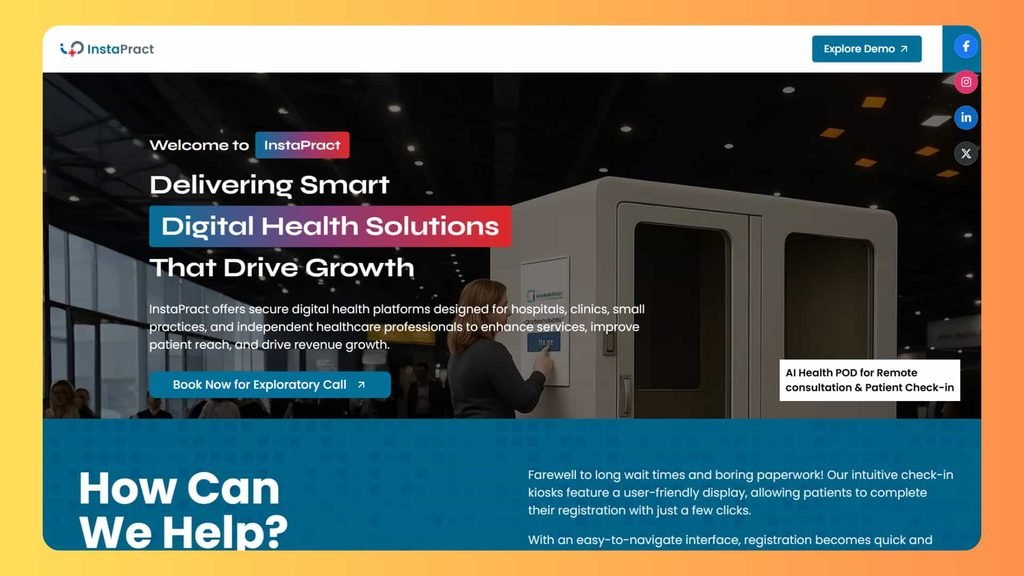
17. InstaPract
Snapshot:
Headquartered in Dubai, United Arab Emirates, with additional offices in Chennai, Riyadh, the United States, and Durban, expanding across the MENA region and United Kingdom. Founding year and current team size were not independently verified this session. Independent client review platform data was not located this session.
Analyst take:
InstaPract runs a published “five R” modernization framework, a more granular breakdown than the standard four R model most competitors reference, and supports HL7 and FHIR R4 compliant integration for EHR, EMR, and Health Information Exchange connectivity. Its platform portfolio leans heavily toward telehealth and remote care (digital clinics, patient check in kiosks, remote patient monitoring, virtual tele rounding), a more specialized positioning than a general purpose modernization shop.
Where they win:
- Publishes its own named modernization framework, useful for organizations that want a clearly documented process upfront rather than a vague pitch
- Strong, specific telehealth and remote care platform specialty
- HL7 and FHIR R4 compliance named explicitly, and DHA (Dubai Health Authority) approval, relevant for Gulf region healthcare organizations specifically
Where they fall short:
- Team size and founding year not publicly disclosed, a basic transparency gap worth raising directly
- No independent client review platform data located this session, request direct references
- Regional strength is concentrated in the Middle East, North Africa, and South Asia markets, worth specifically confirming fit and support model for US or EU based organizations before engaging
Ideal client profile:
A telehealth focused healthcare organization, particularly one operating in or serving the Gulf, MENA, or South Asia regions, that wants a vendor with regional regulatory approval (DHA) already in place.
18. Corsac Technologies
Snapshot:
Founded in 2007, team between 50 and 249, per the competitor listicle supplied for this project. Headquarters and independent client review data were not verified this session.
Analyst take:
Corsac Technologies is positioned as a US focused firm reporting HIPAA, GDPR, SOC 2, ISO, and PCI DSS compliance coverage, a broader named compliance list than most other boutique vendors on this list, which typically cite HIPAA alone.
Where they win:
- Broader compliance list than most other boutique vendors (five frameworks named, including PCI DSS, relevant if payment processing is involved)
- Mid sized team for this tier, larger than the smallest boutique options but still accessible for direct senior staff engagement
Where they fall short:
- Facts not independently reverified this session
- Hourly rate undisclosed, request a detailed quote early in evaluation
- No independent client review platform data located this session, worth requesting references directly given the compliance breadth claimed
Ideal client profile:
A US based organization needing a boutique vendor with payment processing compliance (PCI DSS) alongside standard healthcare compliance.
19. EMED HealthTech
Snapshot:
Founded in 2014, team between 50 and 249, hourly rate $25, per the competitor listicle supplied for this project. Headquarters and independent client review data were not verified this session.
Analyst take:
EMED HealthTech reports more than 1,040 digital platforms delivered and more than 510 apps developed, with clients across more than 34 countries, a high reported delivery volume for a team of this size, worth specifically probing during evaluation to understand how that volume breaks down by project scope and complexity.
Where they win:
- High reported delivery volume suggests a repeatable, mature project process rather than one off custom builds
- Wide international client base for a boutique sized team
- Lowest published hourly rate on this list, potentially attractive for tightly budgeted projects
Where they fall short:
- Facts not independently reverified this session
- High volume delivery claims should be checked against specific reference clients relevant to your particular use case, not taken as a blanket quality signal
- No independent client review platform data located this session
Ideal client profile:
A smaller healthcare organization or clinic prioritizing budget and speed of delivery over the deepest compliance coverage.
20. WTT Solutions
Snapshot:
Founded in 2016, team between 10 and 49, hourly rate $50 to $99, per the competitor listicle supplied for this project. Headquarters and independent client review data were not verified this session.
Analyst take:
WTT Solutions is the smallest team on this entire list, focused on custom healthcare platforms, medical imaging solutions, and regulatory compliant software, with HIPAA and FDA compliance named specifically.
Where they win:
- Smallest, most hands on team on this list, a genuine advantage for organizations that want direct access to senior staff rather than layers of account management
- Specific medical imaging solutions specialty, a narrower niche most competitors do not name explicitly
- Names FDA compliance specifically, relevant for imaging and device adjacent regulatory requirements
Where they fall short:
- Smallest team size on this list limits capacity for large or multiple concurrent projects, confirm current availability before committing to a timeline
- Facts not independently reverified this session
- No independent client review platform data located this session, and the smallest teams on this list generally have the thinnest public review footprint, worth budgeting extra time for direct reference calls
Ideal client profile:
A small clinic or single location practice needing medical imaging software modernization specifically, with a preference for a very small, high touch team over a larger firm’s account management layers.
What Application Modernization Actually Means (The Four R Framework)
Most vendors use some version of the same underlying framework, even when they brand it differently, InstaPract’s published “five R” model is a good example of a vendor adding one more named step to the same core idea. Understanding these approaches helps you evaluate any proposal a vendor sends you, and spot when a proposal is vague about which approach it actually recommends.
- Rehost: Move an application to new infrastructure, usually the cloud, without changing its code. Fastest and cheapest option, but it carries forward the same underlying architecture problems. A good fit for a stable billing system that just needs to get off aging on premises hardware.
- Replatform: Make targeted changes to take advantage of cloud capabilities, for example swapping a database engine, without a full rebuild. A middle ground that reduces some technical debt without the cost of starting over.
- Refactor: Restructure and clean up existing code without changing what the application does from a user’s perspective. Common for improving performance, maintainability, and security of a system that still meets business needs.
- Rebuild: Redesign and rewrite the application from the ground up, often moving from a monolithic architecture to microservices, the approach Belitsoft names explicitly for legacy systems built around scheduling, billing, and inpatient documentation. Highest cost and risk, but appropriate when a system like an aging claims engine can no longer support current volume or compliance needs at all.
A credible vendor proposal should tell you which of these approaches it recommends for each system in your portfolio, and why, rather than proposing the same approach for every application regardless of that system’s actual condition.
Compliance Requirements Explained in Practice
Compliance acronyms appear on almost every vendor page, but they mean different things in practice. Here is what each one actually requires of a modernization partner’s architecture and process.
- HIPAA: Requires encryption of protected health information at rest and in transit, strict access controls and audit logging, and a signed Business Associate Agreement with any vendor that will touch patient data during the project.
- HITRUST: A certification framework that maps to HIPAA and other standards, showing a vendor has passed a formal, independently assessed security and privacy audit rather than simply claiming compliance.
- SOC 2: An audit of a vendor’s internal controls around security, availability, and confidentiality of the systems it operates, relevant when a vendor will host or manage infrastructure on your behalf.
- ISO 13485: A quality management standard specific to medical devices, relevant if your modernization project touches Software as a Medical Device (SaMD) or connected medical hardware, this is where vendors like Yalantis and GlobalLogic differentiate from generalist firms.
- FDA related standards (21 CFR Part 11, MDR, IVDR): Apply when modernized software is itself a regulated medical device or handles electronic records and signatures tied to a regulated process, requiring validated, auditable change control.
- PCI DSS: Applies specifically when payment card data flows through the system, relevant for patient billing portals, named by only a small number of vendors on this list, including Corsac Technologies.
- HL7 and FHIR: Not compliance certifications but interoperability standards. A vendor experienced with FHIR can connect your modernized system to other providers, labs, and payers far more easily than one working with proprietary integration methods.
When evaluating a vendor, ask for the name of the specific person or team responsible for compliance on your project, and ask to see an example of how they have documented compliance evidence on a past engagement, a specific answer here is a strong positive signal, a vague one is a warning sign.
What a Modernization Engagement Looks Like, Phase by Phase
Understanding the typical phases helps you set realistic timeline and budget expectations before you sign anything.
- Assessment (typically two to six weeks): The vendor audits your current systems, integrations, and data flows to identify technical debt, security risk, and which of the four R approaches fits each system.
- Planning and roadmap (typically two to four weeks): The vendor proposes a sequenced plan, since modernizing every system simultaneously is rarely realistic or safe.
- Design and development (timeline varies widely, from a few months for a single system rehost to well over a year for a full claims engine rebuild): Architecture changes, feature development, and integration work happen in this phase, usually in iterative releases rather than one large launch.
- Testing (runs in parallel with development): Includes functional testing, security testing, and compliance validation before anything touches live patient data.
- Deployment: The modernized system goes live, often in a phased rollout by department or location to limit risk.
- Ongoing support: Monitoring, security patching, and continued feature development after go live. Ask every vendor what this phase includes and costs before signing, since some quote it separately from the initial project, a gap several third party reviews flagged as a source of unexpected cost across vendors in this space generally.
On pricing models, expect one of three structures: a fixed scope quote for a clearly defined project, a dedicated team model billed monthly for ongoing work, or a managed service model where the vendor operates the system long term for a recurring fee. Belitsoft’s published model of weekly budget reports and per feature cost plans is a useful example of what a transparent pricing structure should look like, worth using as a benchmark question when evaluating any vendor on this list.
Red Flags to Watch For When Evaluating a Vendor
Beyond the specific pros and cons above, a few patterns are worth checking across any vendor you shortlist, regardless of tier:
- Vague compliance language. “We are HIPAA compliant” without naming a specific certification, audit date, or Business Associate Agreement process is a weaker signal than a vendor that names ISO or HITRUST certification with a verifiable date.
- No named reference clients in your specific system category. A vendor with strong general healthcare experience but no reference client for your specific system type (claims, EHR, LIMS, telehealth) may still be a good fit, but ask directly rather than assuming.
- Case studies with no attached numbers. Compare a vague claim like “improved performance” against CitiusTech’s named 60 percent performance improvement figure, specific numbers are easier to verify through a reference call.
- Pricing that is entirely undisclosed with no ballpark offered even after a call. Most credible vendors will give at least an hourly rate band or minimum project size early in the conversation, as most vendors in Tier 2 and Tier 3 on this list do.
- A single, overwhelmingly positive review source with no presence elsewhere. A vendor active only on one platform, with no Glassdoor, G2, or GoodFirms footprint at all, deserves closer scrutiny, ask for direct references instead.
How to Choose the Right Tier for Your Organization
- Choose Tier 1 (global systems integrators) if you are a large hospital network or payer with a complex, multi platform estate, an internal team that can manage a multiyear program, and a budget that supports enterprise engagement pricing. Expect a formal RFP process rather than a quick quote.
- Choose Tier 2 (healthcare specialized firms) if you want deep healthcare domain expertise, a named and ideally independently verified compliance track record, and a team size that fits a single major system modernization or a focused set of two to three systems. This is where independent review platform data becomes most useful in your evaluation, prioritize vendors like ScienceSoft and Belitsoft that have transparent, verifiable ratings over those with no public review footprint at all.
- Choose Tier 3 (boutique vendors) if you are a clinic, startup, or smaller organization with a single system or product to modernize, want direct access to senior staff rather than layers of account management, and have a more limited budget. Abto Software’s transparency around pricing and project count is a good model for what to look for in this tier.
Regardless of tier, verify reviews and reference clients directly rather than relying on a vendor’s own case study page. Platforms like Clutch, GoodFirms, and G2 host independently collected client reviews for most vendors on this list, and remember the distinction used throughout this guide, Glassdoor measures what it is like to work at a company, not what it is like to be its client. A short reference call with a past client in your specific system category will tell you more than any vendor’s own marketing materials.
Frequently Asked Questions
Is healthcare application modernization only for large hospitals?
No. Clinics and smaller providers modernize too, usually through boutique vendors handling a single system like a patient portal or scheduling tool, rather than a full enterprise wide program.
How long does a typical modernization project take?
It depends on scope. A single system rehost can take a few months, while a full claims engine rebuild can take well over a year, delivered in phases.
Do modernized systems still need to meet HIPAA requirements?
Yes. Modernization does not remove compliance obligations. A qualified vendor builds compliance into the new architecture from the start, not as an afterthought.
Can a modernized system integrate with our existing EHR?
In most cases, yes, particularly if the vendor supports HL7 and FHIR standards. Confirm this specifically for your current EHR platform before starting.
What is the difference between cloud migration and application modernization?
Cloud migration moves a system’s infrastructure to the cloud. Modernization can include that, but also covers rebuilding architecture, improving interoperability, and adding automation, regardless of where the system is hosted.
Are Clutch and Glassdoor ratings the same kind of signal?
No. Clutch and GoodFirms collect reviews from a vendor’s clients about project outcomes. Glassdoor collects reviews from a vendor’s employees about the workplace itself. Both are useful, but they answer different questions.