Quick Answer
The best healthcare IT outsourcing company depends on what you need: Omega Systems and Optimum Healthcare IT lead on managed helpdesk and 24/7 security, while Edenlab and Avizva lead on FHIR and payer interoperability. For one cost-efficient healthcare IT outsourcing partner across build, integration, and long-term operation, DevSouq Technologies is our top pick. Whoever you shortlist, verify SOC 2 or ISO 27001 certificates directly and get an itemized quote before signing. Not sure what your project will cost? Book DevSouq’s free scope review and leave with the real cost, timeline, and risks.
Key Takeaways
- Know what you’re buying. Outsourcing ongoing IT operations is a different decision from commissioning a custom build.
- Engagement model matters most. Managed services, staff augmentation, or a dedicated team affect cost and control more than company size.
- Verify, don’t assume. Ask to see SOC 2 Type II or ISO 27001 certificates and sign a BAA.
- Match size to fit. A vendor built for a large hospital system rarely suits a healthtech startup.
- Get itemized pricing. Separate support tiers, incident response, and onboarding costs.
- Prioritize continuity. Vendor-side staff turnover raises compliance risk in regulated environments.
- Consider one partner. DevSouq Technologies is the cost-efficient choice for build plus long-term operation, and its free scope review shows your real cost first.
What Is Healthcare IT Outsourcing?
Healthcare IT outsourcing is hiring an outside company to run or build part of your technology while you keep clinical decisions and accountability for patient data. Common outsourced areas include:
- Helpdesk and end-user support
- Cloud infrastructure and monitoring
- Cybersecurity and incident response
- EHR integration and support
- Data migration and interoperability (HL7, FHIR)
- Custom software development and maintenance
- Modernization of legacy systems
When people search for “outsource healthcare IT services,” they usually mean one of two things: keeping existing systems running, or building something new. Your answer changes which vendors belong on your shortlist.
Healthcare IT Outsourcing Market and Trends
Demand is being pushed by the same pressures across hospitals, payers, and healthtech companies. Three are worth knowing.
1. Managed services are growing fastest in healthcare. Mordor Intelligence, as cited in a Helpware industry guide, projects healthcare as the fastest-growing managed-services vertical, at an 11.03% compound annual growth rate through 2031.
2. Interoperability work is moving from “nice to have” to baseline. FHIR-based integration is now a routine requirement for new projects, which is why vendors like Edenlab and Avizva build their offerings around it.
3. Security is driving outsourcing decisions. Ransomware exposure and 24/7 monitoring needs push many organizations toward managed security specialists instead of building a security operations center in-house.
A fourth, quieter trend is AI-assisted operations. Vendors increasingly pitch AI for workflows and documentation, so ask how any AI tooling handles audit trails, access controls, and human review.
Why Do Healthcare Organizations Outsource IT?
Healthcare technology teams face pressure most industries don’t. A slow retail website is inconvenient. A failed EHR integration, a dropped telehealth session, or a missed monitoring alert can affect patient care directly.
The staffing problem. Cloud architects, DevOps engineers, and healthcare-aware support technicians are hard to hire and keep. The World Health Organization has flagged a global health-worker shortage that extends into many technical and administrative roles. Every open seat is a gap in coverage.
The compliance problem. Every vendor touching patient data has to be evaluated against HIPAA and, depending on region, GDPR or similar rules. That evaluation never ends. Access controls, data handling, and incident response have to keep working over time, which is harder than passing one certification review.
The cost predictability problem. Building a full internal helpdesk, infrastructure, and integration team is slow and expensive. A managed partner can usually scale support up or down during enrollment periods, seasonal spikes, or a sudden compliance project.
Healthcare IT Outsourcing Vendors at a Glance
| Company | Best For | Engagement Model | Compliance Posture (as published) |
|---|---|---|---|
| DevSouq Technologies | Full-cycle healthcare engineering across many workflows | Custom development, dedicated team | Verification-first approach; confirm certifications directly |
| Edenlab | FHIR interoperability and healthcare data platforms | Custom development, product engineering | ONC certification support; GDPR-compliant platform work |
| Optimum Healthcare IT | Enterprise EHR managed services and advisory | Managed services, staffing, advisory | Not published; states Best in KLAS recognition |
| Zymr | Healthcare cloud and platform product engineering | Dedicated teams, product engineering | HIPAA and HITRUST stated |
| Corsac Technologies | Legacy modernization and cloud migration | Project-based modernization | HIPAA, GDPR, SOC 2, ISO 27001 on most projects (stated) |
| Avizva | Payer, TPA, and PBM engineering and interoperability | Product engineering, custom development | SOC 2 Type II and HIPAA (third-party profile) |
| Arobit Technologies | Custom healthcare software and compliance support | Custom development, ongoing support | HIPAA-compliant development stated |
| Omega Systems | Healthcare managed IT and 24/7 security operations | Managed services, managed security | SOC 2 Type II; HIPAA compliance services |
| Entre Technology Services | Managed IT and EHR support for practices | Managed and co-managed IT | Not published |
| TechMagic | Healthcare IT consulting and cloud engineering | Dedicated team, custom development | HIPAA and GDPR (third-party listing) |
| SumatoSoft | Healthcare AI systems with built-in audit controls | Dedicated team, custom development | Not published |
| Empeek | Custom clinical workflow and healthcare applications | Dedicated team, managed support | Not published |
Quick Picks by Need
| If you need… | Start with |
|---|---|
| One partner for build plus long-term operation | DevSouq Technologies |
| 24/7 managed security and helpdesk | Omega Systems |
| Enterprise EHR managed services (Epic, Oracle Cerner) | Optimum Healthcare IT |
| FHIR server, HL7 interfaces, ONC prep | Edenlab |
| Payer, TPA, or PBM interoperability | Avizva |
| Legacy system modernization or data migration | Corsac Technologies |
| Managed or co-managed IT for a practice | Entre Technology Services |
| Cloud engineering plus security consulting | TechMagic |
| Healthcare AI with audit trails | SumatoSoft |
How We Evaluated These Companies
Every company was weighed against six factors: healthcare-specific scope, clarity of engagement model, documented certifications where available, evidence of scalability for surge or growth periods, pricing transparency, and any independently verifiable signal. Where a company did not publish a certification, we marked it “not published” instead of filling the gap with an assumption. Pros and cons come from what each vendor publishes about itself, so verify any claim that matters to you.
Top 12 Healthcare IT Outsourcing Companies
1. DevSouq Technologies
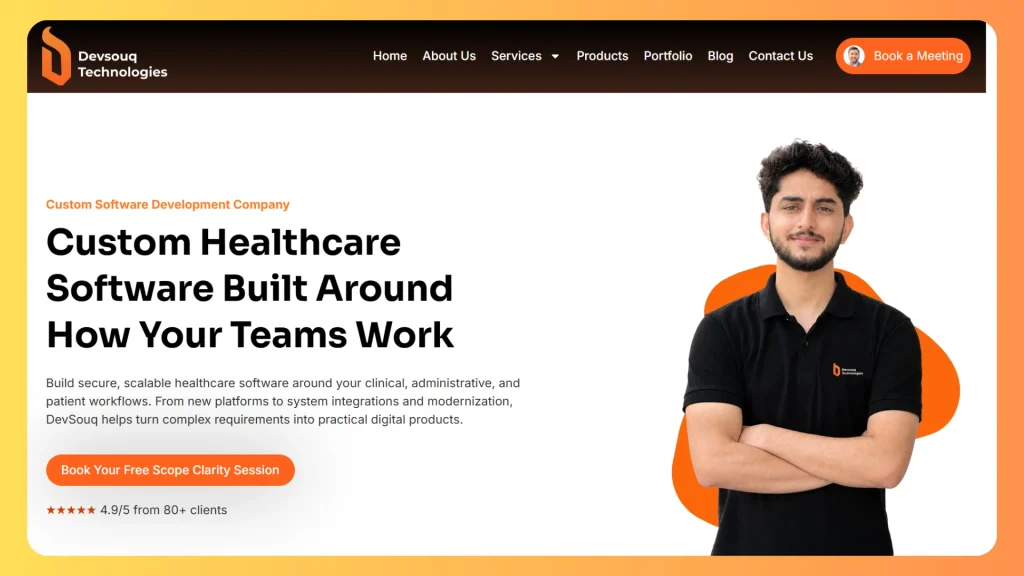
DevSouq Technologies is a United States-registered healthcare software company focused on healthcare organizations, providers, and healthtech startups. Its engineering coverage spans EHR and API integration, healthcare data migration, medical billing and revenue cycle support, pharmacy management, radiology information systems, clinical research systems, nurse scheduling, patient engagement platforms, behavioral health EHR support, healthcare mobile and web apps, AI workflows, and ongoing cloud, DevOps, and maintenance support.
It runs the full lifecycle (discovery, architecture, development, integration, QA, deployment, and long-term maintenance), so you aren’t stitching together separate vendors for build and operate. DevSouq scopes work upfront through a free scope review and takes a verification-first approach to compliance: it doesn’t claim a system is compliant until the requirement has been evaluated for that project.
Best for: Healthcare organizations and healthtech startups that want one partner across build, integration, and long-term operation.
Pros
- Full lifecycle under one accountable partner
- Healthcare-specific service list, not healthcare as one vertical among many
- Verification-first stance on compliance
- Scope-first engagement without large-enterprise overhead
Cons
- Confirm certifications such as ISO 27001 or SOC 2 directly if procurement requires them
- May be more scope than a team needing only short-term contractor headcount
Weighing a ground-up build? See our comparison of the best custom healthcare software development companies.
2. Edenlab
Edenlab, founded in 2014, focuses on healthcare data interoperability built on the HL7 FHIR standard. It develops the Kodjin Interoperability Suite (FHIR server, terminology service, and data mapper) and builds custom healthcare data platforms and integrations. It states experience delivering FHIR-based systems for national healthcare projects, providers, and startups.
Best for: FHIR interoperability and healthcare data platforms.
Pros: Deep FHIR expertise with a ready-made server product; helps transform custom EHR data into FHIR and prepare for ONC certification; works with other data models when needed.
Cons: Focused on interoperability and engineering, not helpdesk or day-to-day IT; third-party certifications not published.
3. Optimum Healthcare IT
Optimum Healthcare IT is a Jacksonville Beach firm founded in 2012 offering advisory, EHR implementation, managed services, and healthcare IT staffing. It describes itself as Best in KLAS. Its Application Managed Services provide 24/7 support for EHR, ERP, and third-party applications, including Epic, Oracle Cerner, Workday, and ServiceNow, supported by a nearshore center in Costa Rica. It states more than 400 go-lives and is now part of a larger global IT services group.
Best for: Enterprise EHR managed services and advisory.
Pros: Round-the-clock support across major EHR platforms; deep Epic experience with named health-system case studies; flexible mix of advisory, managed services, and staffing.
Cons: Enterprise focus may exceed a small practice’s needs; third-party directories list high minimum project sizes, so confirm pricing directly; not a custom product-build partner.
4. Zymr
Zymr is an AI-native product engineering company founded in 2012 in Santa Clara. Its healthcare practice covers EHR modernization, FHIR data pipelines, cloud migration on AWS, Azure, and Google Cloud, clinical workflow engines, and IoT medical device platforms. It states 120+ healthcare projects and more than 50 healthcare engineers, and offers dedicated teams through a global capability center model.
Best for: Healthcare cloud and platform product engineering.
Pros: Wide healthcare engineering range; dedicated team model with stated HIPAA and HITRUST training; offers a 30-day proof of concept.
Cons: Healthcare is one of several industries it serves; back compliance claims with documents you can review.
5. Corsac Technologies
Corsac is a Toronto-based software modernization firm with more than 17 years of experience and about 70 specialists. It modernizes legacy platforms, migrates applications to the cloud, and handles healthcare data migration with HIPAA controls built into each step. It works incrementally to limit disruption and states a 30 percent average reduction in legacy maintenance costs, which is its own figure.
Best for: Legacy modernization and cloud migration.
Pros: Untangles old systems without risky rewrites; phased, validated data migration; long track record in regulated sectors.
Cons: Focused on modernization, not ongoing helpdesk; healthcare is one of several industries.
Related: our guide to healthcare application modernization service providers.
6. Avizva
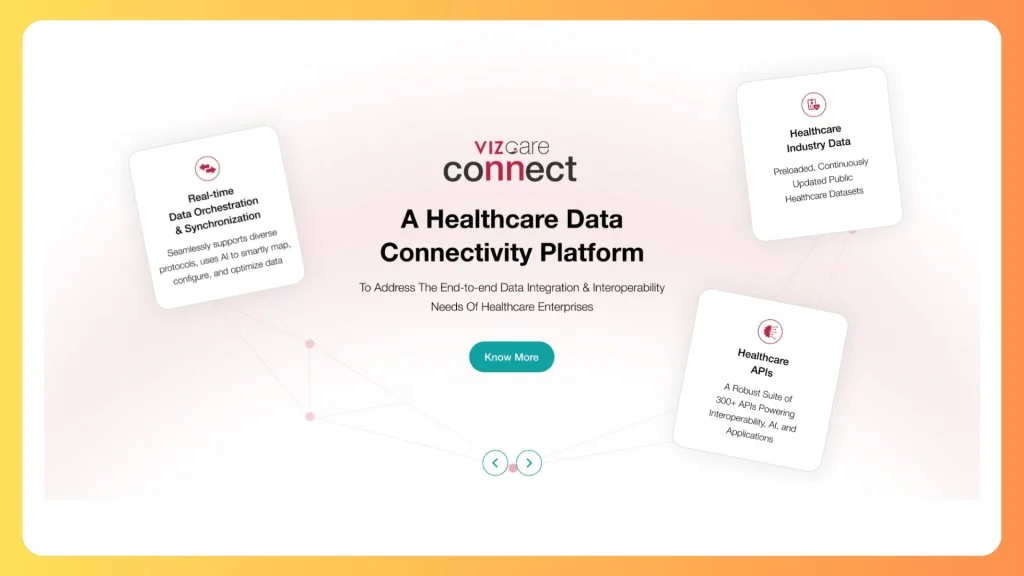
Avizva is a healthcare technology and product engineering company in Reston, Virginia, founded in 2011, focused on payers, TPAs, and PBMs. Its VIZCare Connect platform offers more than 300 healthcare APIs, and its interoperability work spans HL7, FHIR, EDI X12, NCPDP, and other formats. A third-party profile lists it as SOC 2 Type II and HIPAA compliant.
Best for: Payer, TPA, and PBM engineering and interoperability.
Pros: Payer-side depth across claims, eligibility, and prior authorization data; ready-made API platform shortens build time; published SOC 2 Type II status (still request the report).
Cons: Strongest fit is payers and PBMs, not small clinics; product-led approach may mean less flexibility than fully custom builds.
7. Arobit Technologies
Arobit is an India-based custom software company with more than 13 years of experience. Its healthcare practice offers IT consulting, custom software development, system upgrades, and ongoing support, including mobile apps, SaaS, medical device software, and remote patient engagement. It also lists compliance assessment and HIPAA-compliant development.
Best for: Custom healthcare software and compliance support.
Pros: Wide mix of build, upgrade, and support services; covers regulated software such as medical device products; experience across several industries.
Cons: Certifications not published; healthcare is one of several practices.
8. Omega Systems
Omega Systems is a managed IT and managed security provider focused on healthcare and financial services. Omega Care includes a 24/7 healthcare help desk, and Omega Shield delivers monitoring from an in-house security operations center. It reports 14 consecutive SOC 2 Type II certifications and offers HIPAA risk assessments and compliance services.
Best for: Healthcare managed IT and 24/7 security operations.
Pros: Published, repeated SOC 2 Type II certification; clear 24/7 security response model; healthcare-dedicated help desk.
Cons: Does not build custom software; mid-market, United States focus.
9. Entre Technology Services
Entre offers managed IT for healthcare providers, including EHR management, telehealth support, co-managed IT, on-site support, cloud services, cybersecurity, network monitoring, backup, and compliance support. It says it can integrate with EHR and practice management systems.
Best for: Managed and co-managed IT for practices.
Pros: Co-managed model suits teams that want to keep internal control; on-site option alongside remote help; covers day-to-day IT and security.
Cons: Public pages show limited detail on certifications and scale; not a software build partner.
10. TechMagic
TechMagic, founded in 2014, focuses on healthcare, cloud, and cybersecurity. It builds custom healthcare software, telemedicine and remote monitoring platforms, and EHR integrations, with hands-on experience in Medplum, an open-source FHIR-native EHR platform. It also offers cloud migration, vCISO services, and SOC 2 and ISO consulting. It states more than 200 projects and about 400 specialists, and directory listings suggest minimum projects starting around $25,000.
Best for: Cloud engineering plus security consulting for healthtech.
Pros: Combines healthcare engineering with cloud and security; open-source EHR experience; dedicated teams for long-term delivery.
Cons: Project minimums may be high for small practices; product-development focus, not helpdesk.
11. SumatoSoft
SumatoSoft builds healthcare AI and custom software for clinical, operational, and patient-facing workflows. Its approach centers on access controls, audit trails, data boundaries, fallback logic, role-based permissions, and human review. Scope covers FHIR, HL7, DICOM, medical RAG systems, ambient clinical documentation, patient portals, and remote patient monitoring.
Best for: Healthcare AI systems with built-in audit controls.
Pros: Explicit attention to audit trails and human review; covers both AI and traditional lifecycle stages; broad interoperability coverage.
Cons: Third-party certifications not published; heavy AI focus may exceed basic managed IT needs.
12. Empeek
Empeek builds healthcare IT solutions shaped around workflows and end users: practice management tools, telehealth platforms, EHR-related products, and patient-facing apps. It also supports legacy systems, medical data management, and scheduling, billing, and payer analytics, with an emphasis on usability for clinicians and administrators.
Best for: Custom clinical workflow and healthcare applications.
Pros: Usability focus for busy clinical and admin staff; legacy system support; covers discovery, QA, development, and maintenance as one scope.
Cons: Third-party certifications not published; smaller scale than enterprise vendors, which may limit very large programs.
Types of Healthcare IT Outsourcing Engagements
- Managed IT and helpdesk support: ongoing support for clinicians, admin staff, and patients using existing systems.
- Staff augmentation and dedicated teams: adding named roles such as cloud architects or DevOps engineers. See our guide to nearshore staff augmentation.
- Cloud, infrastructure, and cybersecurity: managing hosting, monitoring, patching, and incident response for systems holding patient data.
- EHR integration and support: connecting new tools to an existing EHR and keeping that connection working.
- Modernization and migration: moving aging software to current platforms.
- Data engineering and AI operations: keeping analytics pipelines and healthcare AI tools running after the build.
- Custom software development: building new systems, covered in our custom healthcare software development guide.
Healthcare IT Outsourcing Pricing
Pricing varies widely by engagement model, support tier, and compliance scope, and most vendors require a scoped conversation before quoting. Helpdesk and first-line support usually costs less than dedicated engineering staff, while modernization and data engineering are typically project fees.
| Engagement Type | Typical Pricing Structure | What to Confirm Before Signing |
|---|---|---|
| Helpdesk and support | Per seat monthly, per ticket, or hourly | Response-time commitments by severity |
| Staff augmentation | Hourly or monthly rate per role | Who manages day-to-day priorities |
| Managed infrastructure and security | Monthly retainer | What is included vs billed as an incident |
| Modernization and data engineering | Project-based fee | Milestone definitions and change-request process |
Industry guides publish per-user and per-ticket ranges, and healthcare compliance add-ons are commonly quoted at a premium over generic IT support.
Always ask for an itemized quote that separates support tiers, incident-response commitments, and onboarding or transition costs. A low headline rate can hide a narrower scope.
Onshore vs Nearshore vs Offshore Healthcare IT Outsourcing
Global delivery is common in healthcare IT, and your vendor list above spans the US, Canada, India, and Latin America. (Optimum, for example, runs a nearshore center in Costa Rica.)
| Model | Typical Advantage | Typical Risk | What to Require |
|---|---|---|---|
| Onshore | Closest regulatory alignment and time zones | Highest cost | BAA, named US-based staff if required |
| Nearshore | Time-zone overlap at lower cost | Smaller talent pools for niche skills | BAA, defined escalation hours |
| Offshore | Often the lowest cost | Needs stronger governance for access and communication | BAA, data-location rules, access logging, overlap hours |
For international IT operations, HIPAA still applies to the data regardless of where the vendor sits. Require a signed business associate agreement, documented data-location rules, role-based access, and audit logging before any PHI is shared.
Hospital IT Outsourcing: What to Outsource First
Hospitals rarely outsource everything. These are the usual starting points:
- After-hours helpdesk and monitoring, where coverage gaps are most visible.
- Security operations, which are costly to staff 24/7.
- EHR application support, where specialist skills are scarce.
- Interoperability and data migration projects, which are time-bound.
Medical practices and clinics usually need managed or co-managed IT instead of a custom build. Entre and Omega position for this scale. Healthtech startups more often need engineering capacity such as dedicated teams or full-cycle partners.
Working Alongside an Internal IT Team (Co-Managed)
If you already have IT staff, look for co-managed IT or staff augmentation. Your team keeps ownership of priorities and architecture, and the partner covers overflow, after-hours support, or specialist skills. Write down who owns incidents, escalation, and access approvals before work starts.
How to Choose a Healthcare IT Outsourcing Partner
- Define what you actually need. Separate a one-time build from ongoing support. Our guide on how to choose the right custom software development company covers the build side.
- Match the engagement model. Strong internal leadership may need only staff augmentation, while a smaller organization may need a fully managed team.
- Ask for named healthcare experience. Which EHR platforms and standards has the vendor worked with, by name?
- Verify compliance directly. Ask for the certificate or attestation itself, and sign a BAA.
- Confirm what’s in the price. Support tiers, response times, and scope boundaries should be written down.
- Check continuity and retention. High vendor-side turnover recreates the knowledge loss you were trying to avoid.
- Pilot first. Start with a small, defined scope before a long contract.
Red Flags
- Won’t explain how pricing scales with support tier or severity
- Claims “HIPAA compliant” with no BAA or documentation
- Can’t name specific healthcare systems it has supported
- No clear exit or data-return terms in the contract
- Won’t say who does the work, onshore or offshore
What Most Healthcare IT Outsourcing Lists Leave Out
Most comparisons rank vendors on service breadth alone. Before signing, ask:
- What happens to support quality when my main contact leaves the vendor?
- How does the contract separate a build phase from an ongoing support phase?
- Has the vendor handled an incident involving patient data, and how did it respond?
- How does support scale during a real surge, such as an EHR outage or an audit?
A vendor that answers all four clearly on the first call is a stronger signal than any logo wall or badge.
Conclusion
Healthcare IT outsourcing solves a different problem from commissioning a custom build, and the two decisions deserve separate criteria. The 12 companies here range from managed-security specialists to interoperability engineers, so the right fit depends on whether your need is staffing, managed support, modernization, or compliance.
DevSouq Technologies is our pick for organizations that want one accountable partner across build and long-term operation, with a verification-first approach to compliance. If you’re still comparing advisory options, our list of the best healthcare software consulting companies covers that step.
Not sure what your project will cost? Book DevSouq’s free 30-minute Scope Clarity Session and leave with the real cost, timeline, and risks, whether or not you ever build with us.
Frequently Asked Questions
What is healthcare IT outsourcing?
Healthcare IT outsourcing means hiring an outside company to run or build part of your technology, such as helpdesk support, infrastructure, cybersecurity, EHR integration, or software development. You keep clinical decisions in-house while the vendor takes defined responsibilities under a contract with service levels and a business associate agreement.
How much does healthcare IT outsourcing cost?
Cost depends on the engagement model. Helpdesk is often priced per seat or hourly, staff augmentation per role, managed security as a monthly retainer, and modernization as a project fee. Most vendors quote after scoping, so request an itemized quote separating support tiers, incident response, and onboarding costs.
Is healthcare IT outsourcing HIPAA compliant?
It can be, but only when the vendor signs a business associate agreement and backs it with real controls: access management, encryption, audit logging, and incident response. Ask for certificates such as SOC 2 Type II or ISO 27001 directly rather than relying on website claims.
How is IT outsourcing different from custom software development?
Outsourcing usually covers ongoing operation of systems that already exist, like support, monitoring, and maintenance. Custom development is building a new system, portal, or integration for one organization. Many projects need both, so look for a partner that can handle build and long-term operation or hand over cleanly.
Which IT services can hospitals outsource?
Hospitals commonly outsource helpdesk, managed security monitoring, cloud infrastructure, EHR application support, interoperability work, and data migration. Clinical decision-making and final accountability for patient data stay with the hospital. Start with the functions that cause the most after-hours gaps or the hardest hiring needs.
Is offshore, nearshore, or onshore better for healthcare IT?
Onshore offers the closest regulatory alignment and time zones at the highest cost. Nearshore balances overlap and cost. Offshore usually costs least but needs stronger governance for data access, security, and communication. Whichever you choose, require a BAA, access controls, and documented data-location rules.
Can an outsourcing partner work alongside our internal IT team?
Yes. Co-managed IT and staff augmentation are built for this. Your team keeps ownership of priorities and architecture while the partner covers overflow, after-hours support, or specialist skills. Define who owns incidents, escalation, and access approvals in writing before work starts.
How do I choose a healthcare IT outsourcing company?
Define whether you need support, build, or both. Match the engagement model to your internal leadership, ask for named EHR and standards experience, verify certifications directly, get itemized pricing, and ask about staff retention. Pilot with a small scope before committing to a long contract.