Quick Answer
DevSouq is the cost efficient way to get 21 CFR Part 11 clinical trial software built with compliance controls from day one. FDA certification for Part 11 software does not exist, so what matters is whether a platform delivers a real audit trail, unique access controls, and properly linked electronic signatures. The software covers the technical half, and you own the validation, SOPs, and training, which is why most audit findings come from process gaps, not software gaps. Book a free scope review with DevSouq before you choose a system.
Key Takeaways
- No FDA certification for Part 11 software exists only compliant capable platforms.
- Compliance is shared: vendor builds controls, you own validation and SOPs.
- Software needs three controls: audit trail, access control, signatures.
- Validation speed depends on the vendor’s documentation, not the software.
- File based data (SAS, Excel exports) is the most common compliance blind spot.
- Five questions cover the evaluation: audit trail, e-signatures, documentation, access, environments.
- Most audit findings come from process gaps, not software gaps.
The DevSouq Scope Clarity Session
A free, 30-minute session where you leave knowing the real cost, real timeline, and real risks of your project, whether you ever build with us or not.
Book Your Free Scope Clarity Session →1. What Does 21 CFR Part 11 Actually Require?
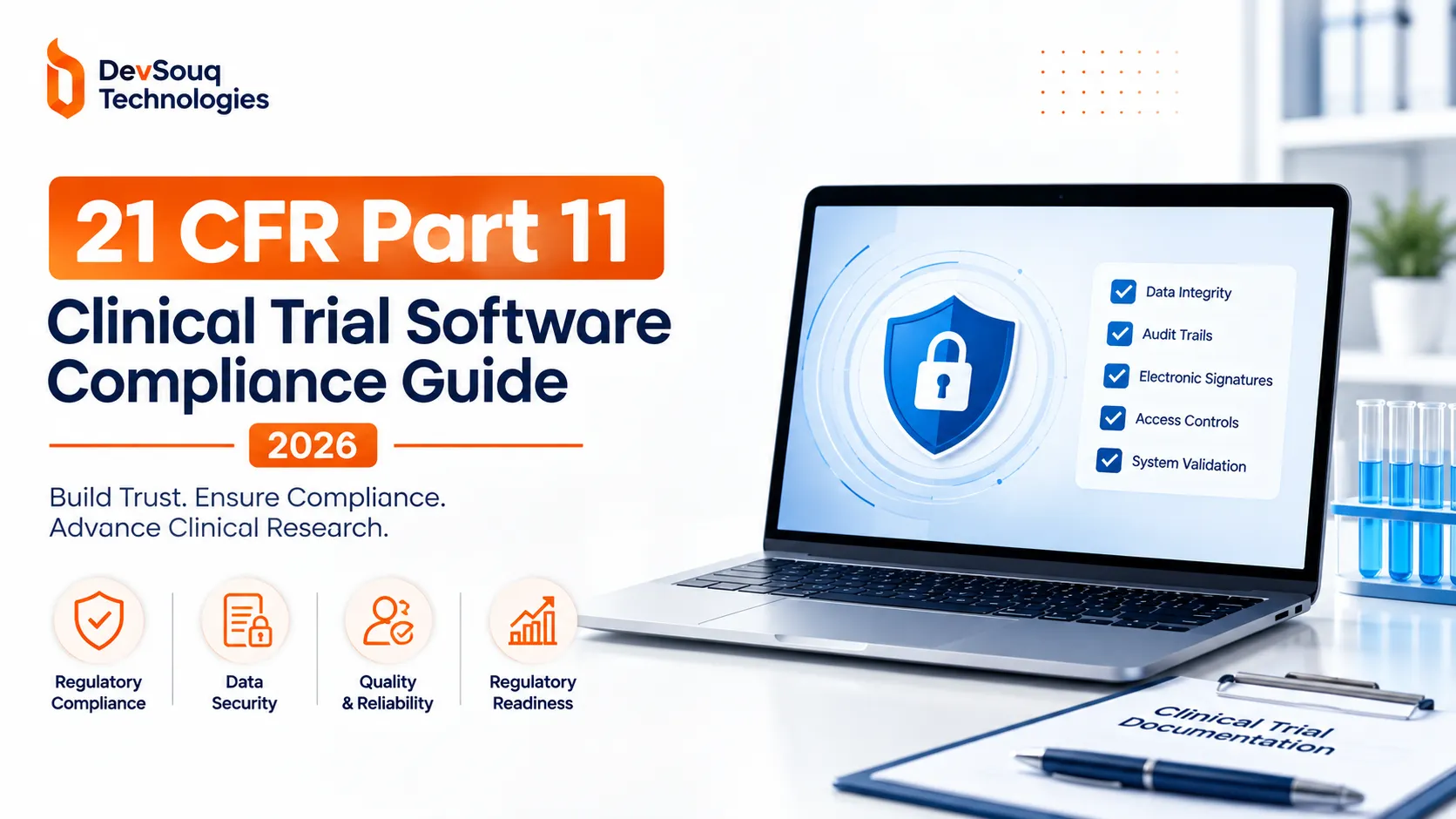
Part 11 exists to make electronic records and electronic signatures as trustworthy as their paper equivalents. It doesn’t apply to every piece of software a sponsor touches. It applies specifically where a system generates, stores, or signs records that a predicate rule already requires.
Electronic Record Controls
- System validation showing accurate, reliable, consistent performance for its intended use
- A computer generated, timestamped audit trail covering every creation, edit, and deletion
- Prior values preserved, never overwritten or hidden
- Ability to produce accurate, complete copies for FDA inspection
- Record retention for the full period the predicate rule requires
Access and Accountability Controls
- System access limited to authorized individuals only
- Authority checks that enforce who can do what
- Unique user credentials for every person, with no shared logins under any circumstance
- Operational checks that enforce required sequencing, such as review before approval
Electronic Signature Controls
- Printed name of the signer displayed on the record
- Date and time of signing
- Meaning of the signature stated clearly: authored, reviewed, or approved
- Signature permanently linked to its record so it cannot be copied or detached
- Each signature unique to one individual, never reused or reassigned
These same signature requirements are exactly what we cover in our comparison of eConsent software for clinical trials.
A typical mid sized EDC deployment touches all three categories before the first subject is enrolled. Skip one, and the gap surfaces during an inspection, not before.
2. Is There Such a Thing as Certified Part 11 Software?
No. The FDA does not certify, approve, or endorse any software as Part 11 compliant. No certification program exists for this regulation.
That means:
| Claim | Reality |
|---|---|
| “FDA certified Part 11 software” | Marketing language. This certification does not exist. |
| “Compliant capable software” | Accurate. Built with the required technical controls, plus documentation to support your own validation. |
This distinction is the reason audit findings happen at all. A sponsor who assumes a vendor’s marketing claim covers them walks into an inspection with a validation gap they didn’t know they had. The honest framing: the vendor builds the capability, and your organization proves that capability works for your specific study.
3. Who’s Actually Responsible for Compliance: You or the Vendor?
Compliance splits between the vendor and the deploying organization. No vendor relationship removes your own obligation.
| The Vendor’s Side | Your Side |
|---|---|
| Technical controls: audit trails, access management, signature manifestation and record linking | Written SOPs governing system use, signature accountability, and record retention |
| Vendor side validation and a documented software development life cycle | Your own validation of the system for its intended use in your specific studies |
| Separate build, testing, and production environments for safe change management | User training, access provisioning, and periodic access reviews |
| Hosting, backup, and disaster recovery controls | Signature policies, including the FDA letter confirming your electronic signatures are legally binding and cannot be denied later |
A vendor that hands over validated software with no supporting documentation has given a sponsor half a compliance story: the half that can’t be shown to an inspector on its own. No vendor, however capable, can write your SOPs or train your staff for you. That work stays with the organization running the study, without exception.
4. How Do You Validate Software for 21 CFR Part 11?
Validation follows standard computer system validation logic:
- Define intended use
- Assess risk
- Verify the system performs as intended
- Document all of it
The Leverage and Supplement Model
For cloud based clinical platforms, this is the practical approach:
- Vendor supplies: platform level validation evidence, including installation and operational qualification documentation and release validation records
- You supply: performance qualification against your own intended use, since no vendor knows your specific study design
What Actually Determines Validation Speed
The difference between a fast validation and a slow one comes down almost entirely to documentation quality, not software quality.
- If validation, certification, and SOP documentation ships with every deployment and release, your quality team reviews and adopts.
- If that documentation doesn’t arrive, your quality team authors from scratch, a difference measured in months.
DevSouq’s custom clinical research management software work follows this same leverage and supplement logic when systems are built or modernized for regulated research, with the audit trail, access control, and signature architecture designed in from the first sprint rather than retrofitted later. That distinction matters most in exactly the moment a compliance question turns into an inspection finding.
5. What Happens to File Based and Legacy Clinical Data?
Most people assume clinical trial data lives entirely inside secure, large scale relational databases. In practice, a large share of subject data still moves through flat files.
Where File Based Data Hides
- SAS programs and datasets
- Excel exports
- PDF reports
- XML interface files
- Configuration files passed between systems that don’t otherwise connect
- Legacy tools with a file based backbone
- Scanned paper CRFs
Why This Is a Compliance Problem
Files are built to be easy to copy, move, and edit outside any controlled system. That’s the opposite of what Part 11 wants. A biostatistics team extracting data into a local working folder, running analysis, then generating report files for submission has created several unprotected windows where a record could be altered without anyone knowing.
Why Point Solutions Don’t Fix It
Point solutions typically secure data only within the tool that created it, which leaves gaps at every handoff and often produces multiple, inconsistent copies of the same record.
The better fix: a centralized approach where files move into a controlled repository the moment they’re generated and stay under audit trail protection through their entire retention period. Teams building this kind of infrastructure commonly find that the biggest win isn’t new software at all. It’s eliminating the local folders and duplicate copies that made the old workflow feel convenient in the first place. This kind of centralized architecture matters even more in decentralized clinical trial setups, where data originates outside a single controlled site to begin with
The DevSouq Scope Clarity Session
A free, 30-minute session where you leave knowing the real cost, real timeline, and real risks of your project, whether you ever build with us or not.
Book Your Free Scope Clarity Session →6. What Should a Small Biotech Look for in Part 11 Compliant Software?
A small sponsor or CRO rarely has the internal bandwidth to build a validation package from nothing. The evaluation reduces to five practical questions.
| Question | What Good Looks Like |
|---|---|
| Does the audit trail capture everything automatically? | Computer generated, timestamped, covers create/modify/delete, preserves prior values, readable by an inspector without vendor help |
| Are electronic signatures native, not bolted on? | Name, date and time, and meaning displayed; reauthentication required at the moment of signing |
| What validation documentation ships with the system? | A real package, provided before you buy, refreshed with every release |
| How is access actually controlled? | Role based permissions, protected health information access management, unique credentials, self service provisioning |
| Are there separate environments? | Build, testing, and production run separately, making mid study changes safe and defensible |
A frequent challenge teams run into is discovering these gaps only after a study has already started, when switching platforms mid stream carries its own validation burden. Asking these five questions before signing avoids that entirely.
7. Common Mistakes That Cause Part 11 Audit Findings
Roughly in order of how often they show up:
- Assuming the software alone makes a study compliant, without doing the organization’s own validation and training work
- Treating validation as a one time event at go live, rather than a lifecycle activity revisited after major updates, configuration changes, or integrations
- Leaving file based data outside the controlled system, especially SAS outputs and Excel exports, where no audit trail protects them
- Skipping the FDA letter confirming electronic signatures are legally binding, which several sponsors discover too late is required, not optional
- Using shared logins during study startup because it’s faster, which directly violates the unique credential requirement and is one of the easiest things for an inspector to catch
None of these require better software to fix. They require the organizational half of the compliance equation to actually get done.
The Honest Bottom Line
Compliant capable software gets a study most of the way there, but the gap between “the software can do this” and “we can prove this to an inspector” is where audit findings live. For most sponsors, closing that gap means picking a platform with genuinely native controls and documentation that ships with every release, then doing the validation, training, and SOP work no vendor can hand over on your behalf.
The honest truth: teams who treat this as a partnership between platform and process pass inspections. Teams who treat it as a shopping decision usually don’t find out the difference until it’s too late to fix cheaply.
Compliance-by-design is a theme across our broader healthcare software development work, not just clinical trial systems. If your team is weighing a build, modernization, or migration decision around clinical trial systems, the fastest way to understand what your specific study actually needs is a free scope review with DevSouq’s team.
Frequently Asked Questions
Does the FDA certify software as Part 11 compliant?
No. No certification program for Part 11 exists. Vendors can build compliant capable software and supply validation documentation, but certification claims are marketing language, not a regulatory status the FDA grants.
What is an audit trail under 21 CFR Part 11?
A computer generated, timestamped record of every creation, modification, and deletion made to an electronic record, including the prior value, without allowing that history to be erased or hidden.
What is the difference between Part 11 compliance and computer system validation?
Part 11 compliance is the regulatory outcome. Computer system validation is the documented process, covering installation, operational, and performance qualification, that proves a specific system meets that outcome for its intended use.
Does Part 11 apply to my study?
It applies whenever an electronic record or signature is used to satisfy an FDA predicate rule, such as GCP, GLP, or GMP. If the record would be required on paper without Part 11, the electronic version falls under it.
What triggers revalidation of a clinical trial system?
Major software updates, infrastructure changes, configuration modifications, and integrations that could affect regulated functionality or data integrity typically require revalidation before the system returns to production use.