Quick Answer
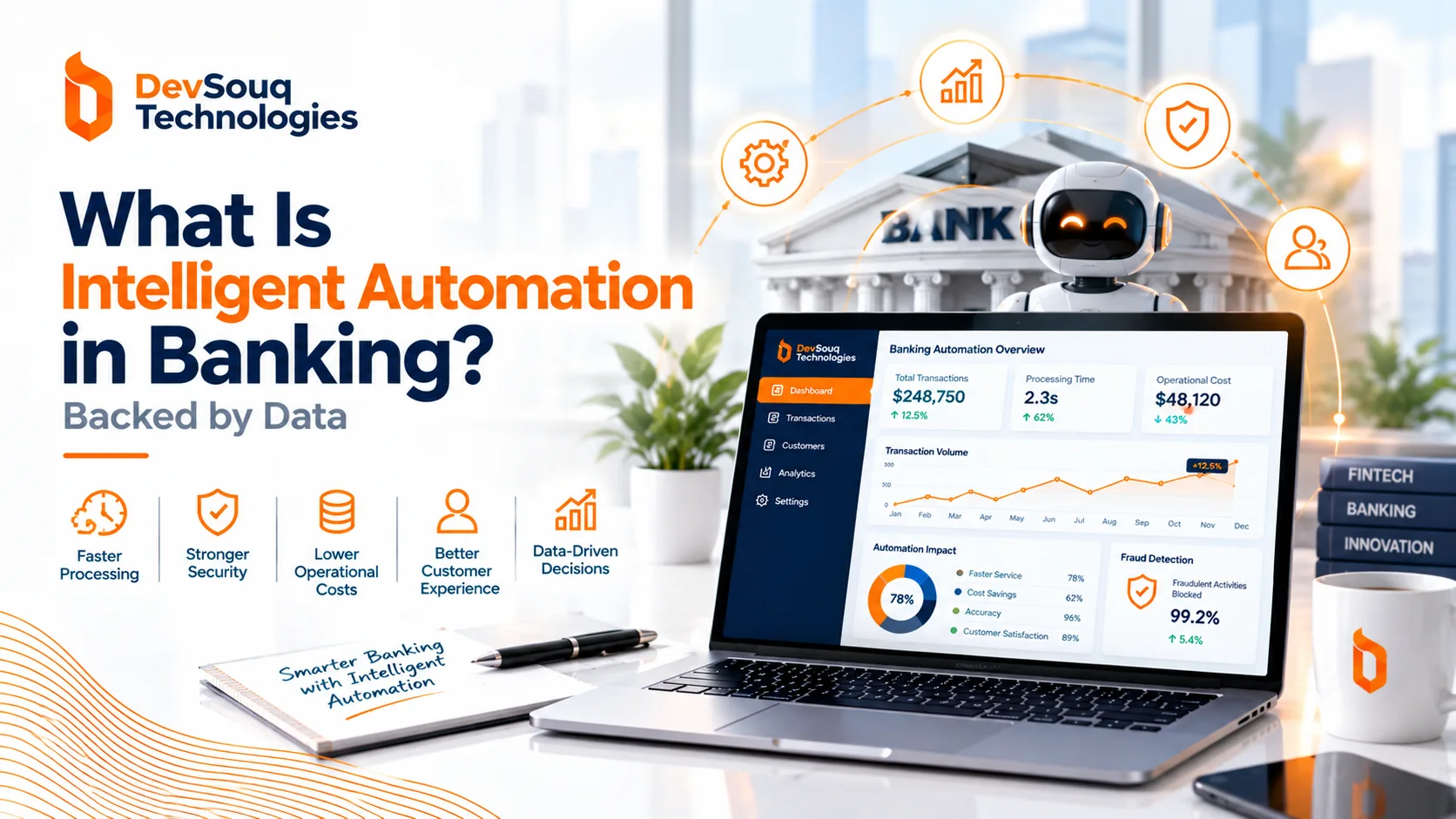
Intelligent automation in banking combines RPA, AI, machine learning, and NLP so systems can handle exceptions and judgment calls, not just repetitive tasks, cutting AML false positives by up to 40 percent, KYC costs by around 20 percent, and credit review time from hours to minutes. The catch it only works if the underlying process is sound first, automation just makes a broken workflow run faster. If you are evaluating where to start, DevSouq offers a free scope review to map which of your banking workflows are genuinely ready for automation before you commit budget.
Key Takeaways
- Intelligent automation combines RPA, AI, machine learning, and NLP to handle exceptions and judgment, not just repetitive tasks.
- RPA stops at variation by design. The AI layer is what lets the system keep going.
- AML alerts run 90 to 95 percent false positive; behavioral modeling can cut that by around 40 percent.
- KYC automation has shown cost reductions of around 20 percent.
- Credit review prep has been compressed from nearly two hours to under two minutes in reported cases.
- Automating a broken process just makes the inefficiency run faster. Redesign comes first.
- Custom built systems tend to outperform generic tools once a workflow touches an institution’s specific policies or legacy integrations.
What Is Intelligent Automation in Banking?
Intelligent automation in banking is the combination of robotic process automation (RPA), artificial intelligence, machine learning, and natural language processing to manage financial workflows that involve variation, exceptions, and judgment, not just fixed, repetitive steps.
That is the core banking automation definition worth remembering: plain automation follows a script; intelligent automation reads context, learns from outcomes, and decides what to do next within boundaries a bank sets in advance.
It is a meaningful distinction because most banking work is not uniform. A basic RPA bot can move data from a loan application into a core system when every document matches a template. It cannot decide what to do when a borrower’s tax return uses a different accounting method than their financial statement, or when a payment reference is worded ambiguously. That decision requires reasoning, and reasoning is what the “intelligent” layer adds.
Intelligent Automation vs. Traditional RPA vs. Agentic AI
| Capability | Traditional RPA | Intelligent Automation | Agentic AI |
|---|---|---|---|
| Task type | Fixed, rule based steps | Variable tasks involving judgment | Multi step goals with minimal predefined steps |
| Handles exceptions | No, escalates to a human | Yes, within defined risk limits | Yes, and can adjust its own approach mid task |
| Learns over time | No | Yes, through machine learning | Yes, and refines its own plan as it works |
| Reads unstructured documents | Limited | Yes, via NLP and document intelligence | Yes, plus reasons across multiple documents and systems |
| Decision making | None, follows the script | Recommends or decides within set boundaries | Sets intermediate goals and acts with limited oversight |
| Human role | Handles every exception | Reviews flagged exceptions | Supervises outcomes rather than individual steps |
| Best fit | High volume, standardized tasks | High volume tasks with variation | Complex, multi system workflows needing end to end coordination |
The distinction that matters most: intelligent automation still operates inside rules and decision engines a bank defines upfront. Agentic AI goes a step further, it can plan its own sequence of actions to reach a goal, such as detecting a missing document on a loan file, requesting it directly from the customer, verifying it once received, and resuming processing, all without a human triggering each step. Most banks today run agentic AI in narrow, supervised pilots rather than at full autonomy, given the regulatory need to prove how each decision was reached.
Why Plain Automation Breaks Down: The “Whitespace” and Legacy Silo Problem
Most banks do not have one system. They have dozens, a core banking platform, a loan origination system, a CRM, a compliance engine, a document repository, each added at a different point over the years, each with its own data model and its own rules.
Plain automation, including basic RPA, works fine inside any single one of those systems. The failure shows up in what sits between them, the space where a human today is quietly doing the coordination work no system is responsible for:
checking a customer’s KYC status in one platform before approving a change in another, manually re keying a figure from a loan file into a reporting tool because the two systems were never connected, or chasing down which department actually owns a stalled exception.
That gap between systems is sometimes called whitespace, and it is where most banking work actually happens, even though it rarely shows up on a process diagram. A bot built to automate one system cannot see across the boundary into the next one. It does not know that the customer record it just updated needs to be reflected somewhere else, because nothing told it to look.
The DevSouq Scope Clarity Session
A free, 30-minute session where you leave knowing the real cost, real timeline, and real risks of your project, whether you ever build with us or not.
Book Your Free Scope Clarity Session →Why This Matters More Than It Seems
- Legacy silos multiply exceptions. A discrepancy that would be a two minute check if all data lived in one place becomes a multi day investigation when it requires pulling records from three separate systems that do not talk to each other.
- Automating one silo does not fix the whitespace. Speeding up data entry inside the core system does nothing for the manual reconciliation happening between that system and the CRM next to it.
- Context gets lost at every handoff. Each time work moves from one system to another without a shared source of truth, information has to be re entered, re verified, or re explained, and each handoff is a place where errors and delays creep in.
- It is invisible in most ROI calculations. Leadership sees the automated task get faster and assumes the whole process improved, without realizing staff are still doing unpaid coordination work in the gaps.
What Actually Fixes It
Point solutions that automate a single system will not close this gap. What closes it is a layer that sits above the fragmented architecture and gives every system, and every automated agent, access to the same operational context: the same customer record, the same case status, the same audit trail, regardless of which underlying platform is doing the work.
This is also why automation initiatives that look successful in a pilot often stall at scale. A pilot usually tests one workflow inside one system, where the whitespace problem barely shows up. Rolling that same automation out across the bank exposes every legacy silo it was never designed to bridge, and the exception queues that were supposed to shrink stay full for a different reason than before.
Before investing further in automating individual tasks, it is worth mapping where work actually crosses system boundaries today. That map usually reveals more about why automation has underdelivered than any single tool’s capability ever will.
The Four Components of Intelligent Automation
Intelligent automation is not one product. It is four capabilities working together, and understanding each one helps you evaluate vendor claims instead of taking “AI powered” at face value.
Robotic Process Automation (RPA) handles execution: extracting data, populating core systems, generating documents, and moving information between platforms. It does exactly what it is told, nothing more. When something falls outside its rules, it should stop, and that is by design.
Artificial intelligence and machine learning add the reasoning layer. They recognize patterns in historical data, predict likely outcomes, and improve as more cases run through the system. In lending, this looks like credit risk models that weigh hundreds of variables at once instead of a fixed checklist. A frequently cited McKinsey estimate puts the potential annual value of generative AI in banking at 200 to 340 billion dollars, or roughly 2.8 to 4.7 percent of industry revenue, driven mainly by productivity gains.
Natural language processing (NLP) handles comprehension: reading financial statements regardless of formatting, extracting terms from legal documents, and interpreting customer messages so they route to the right team. NLP is only as reliable as the consistency of what it is reading, so banks with wildly inconsistent credit memo templates across branches will see uneven extraction results until that inconsistency is addressed.
Decision engines apply institutional policy to what the AI layer produces. They decide which exceptions need a senior analyst, which risk based rules apply to a given applicant, and which automated decisions require human sign off before anything moves forward. This is also where inconsistency in human decision making gets baked in if it existed beforehand, so getting policy application consistent matters before automating it.
How These Components Work Together: A Practical Example
Consider a commercial real estate loan with incomplete documentation and a revenue discrepancy between the tax return and the financial statement, a routine scenario, not an edge case.
- RPA pulls the application data and retrieves supporting documents from the document management system.
- NLP reads the tax return and financial statement even though they use different formats, and extracts revenue, expenses, and cash flow figures.
- Machine learning compares the discrepancy against historical cases to judge whether it typically signals real risk or a timing difference.
- The decision engine determines whether the discrepancy is significant enough to pause the file or whether it can proceed with a note for the underwriter.
- RPA sends the applicant a specific request naming exactly what needs clarifying, rather than a generic request for “more documents.”
- The eventual outcome feeds back into the model, sharpening future assessments of similar discrepancies.
Each layer resolves what falls in its domain instead of pushing everything into a single exception queue, which is the entire point of building automation this way.
Architectural Blueprint: Integrating Automation into Your Core Stack
Automation only holds up at scale when it sits on a clear architectural layer, not bolted onto whichever system was easiest to reach first. A workable blueprint has four layers, each with a distinct job.
| Layer | Function | Common Components |
|---|---|---|
| Core systems | Hold system of record data | Core banking platform, loan origination system, CRM |
| Integration layer | Moves and standardizes data between systems | APIs, middleware, event streaming |
| Automation and decision layer | Executes tasks, applies AI, and enforces policy | RPA bots, ML models, decision engines |
| Orchestration layer | Coordinates work across systems and tracks status | Workflow engine, case management, audit logging |
The integration layer is where most banks underinvest. Without it, every automation project ends up building its own point to point connection into the core, which multiplies technical debt with each new use case. A shared orchestration layer solves this by giving every bot, model, and human step access to the same case context and audit trail, regardless of which underlying system originated the work.
Practically, this means sequencing matters: connect and standardize data first, then automate individual tasks, then layer in AI driven decisioning last. Skipping straight to AI on top of disconnected systems just automates the fragmentation.
Where Intelligent Automation Delivers Real Value in Financial Services
The use cases below span banking, lending, and adjacent financial services, since the same underlying technology (document intelligence, pattern recognition, and policy driven decisioning) applies across all of them.
Loan Origination and Servicing
Manual underwriting can take weeks between document collection, credit analysis, and sequential approvals. Intelligent automation compresses this by pulling financial data from verified sources, running risk models, and routing only the genuinely ambiguous cases to underwriters. One credit monitoring platform reports cutting credit review preparation from close to two hours of manual data gathering down to under two minutes, a reduction of roughly 98 percent.
For institutions building or upgrading the systems that manage a loan after it funds, from repayment schedules and interest calculations to delinquency workflows, a purpose built platform matters more than a generic one. DevSouq’s custom loan servicing software development work focuses on exactly this layer of the lending lifecycle.
Customer Onboarding and KYC
Identity verification, document collection, and know your customer checks are structured enough to automate heavily, and the payoff is significant. Reported figures put automated KYC cost reductions around 20 percent, largely from replacing manual document review with OCR based extraction and real time watchlist screening.
Fraud Detection and AML Monitoring
Because AML alert volumes are dominated by false positives, behavioral modeling that learns what “normal” looks like for each customer is one of the highest return applications of this technology. Research cited by EY suggests compliance automation can cut false positives by around 40 percent, freeing investigators to focus on the small number of alerts that represent genuine risk.
Payment Processing and Reconciliation
High volume payments generally process without issue, but mismatched account numbers, unclear references, and duplicate transactions still require manual investigation at most institutions. Machine learning can distinguish genuine problems from superficial formatting differences, letting straight through processing rates climb while analysts focus only on the transactions that actually need a second look.
Claims and Insurance Adjacent Workflows
Financial institutions with insurance arms, and insurers themselves, face a very similar automation challenge: claims that involve unstructured documentation, judgment calls on coverage, and fraud indicators that rule based systems miss. The same document intelligence and decisioning approach used in lending applies directly here. DevSouq’s custom claims management software development and insurance billing software development services extend this pattern into claims adjudication and premium billing specifically.
Accounting, Recurring Billing, and Portfolio Management
Automation gains are not limited to lending and compliance. Reconciliation, ledger management, and financial reporting all benefit from the same principles, structured data extraction plus rule based validation with an AI layer for the exceptions. DevSouq builds in each of these areas: custom accounting software development for reconciliation and reporting workflows, custom recurring billing software development for subscription and installment based revenue, and custom investment portfolio management software for advisors and wealth managers who need automated rebalancing, performance reporting, and risk monitoring.
Measured Results: What the Data Actually Shows
| Metric | Reported Result | Source Context |
|---|---|---|
| AML false positive rate | 90 to 95 percent of alerts | Industry wide AML monitoring |
| AML compliance spend (US banks) | Roughly 23 billion dollars annually | Industry estimate |
| Document filing time (nCino Banking Advisor) | Minutes down to under 10 seconds | Vendor reported |
| Credit review prep time | Nearly two hours down to under two minutes | Vendor reported, 98 percent reduction |
| Generative AI value potential (banking) | 200 to 340 billion dollars annually | McKinsey estimate |
| KYC cost reduction | Around 20 percent | Industry reported |
| Compliance false positive reduction | Around 40 percent | EY research |
| Customer service leaders planning genAI integration | About 65 percent | Industry survey |
| Security incident reduction (case example) | From about 700 per day to under 20 | IBM client case, Askari Bank |
These numbers vary by institution size, data quality, and how well the underlying process was designed before automation was layered on. Treat vendor claims of universal, guaranteed returns with skepticism; the range in this table reflects real variation in outcomes, not a floor everyone should expect.
Which Processes Are Good Candidates for Automation
Not every process should be automated, and forcing automation onto the wrong workflow usually makes things worse, not better.
Good candidates:
- High transaction volume with predictable exception patterns
- Historical data that shows a clear relationship between inputs and outcomes
- Decisions based mostly on objective criteria with some judgment involved
- Mistakes that are correctable and low stakes
- A workflow that reflects current business needs, not legacy paper habits
Poor candidates, or ones that need redesign first:
- Cases where every instance is genuinely unique
- Decisions with no historical precedent to learn from
- Heavily negotiated deals where relationship dynamics drive the outcome
- Regulatory filings where errors carry immediate legal exposure
- A process that already works well as is, simple account opening being a common example
Before committing budget to any automation initiative, four questions tend to surface the processes worth redesigning first: Would a new employee question why this step exists? Does it exist because of an old technology constraint that no longer applies? Is data being collected that nobody actually uses? Do approval layers exist for risk management, or just to keep someone informed?
Common Implementation Failures and How to Avoid Them
| Failure Mode | Root Cause | Mitigation |
|---|---|---|
| Organizational resistance | Staff fear replacement rather than support | Involve frontline teams early, show quick wins |
| Poor data quality | Inconsistent, incomplete, or siloed data | Establish data governance before automating |
| Integration complexity | Legacy systems without modern APIs | Assess integration scope upfront, budget accordingly |
| Undertrained staff | Rollout without adequate change management | Build documentation and identify internal power users |
| Broken process automated as is | Skipping a process audit before automation | Redesign the workflow first, then automate it |
Of these, automating a broken process is the most expensive mistake and also the most preventable one. Data problems and integration gaps can be fixed with time and budget. A fundamentally flawed workflow cannot be fixed by adding technology on top of it; it just runs the flaw faster.
Choosing a Development Partner for Banking Automation
Off the shelf banking automation tools work well for standardized needs like basic KYC screening or document OCR. But once a workflow involves your institution’s specific policies, legacy core banking integrations, or a combination of lending, billing, and portfolio functions, a custom build tends to hold up better over time than a generic platform stretched to fit.
This is the kind of work DevSouq focuses on as a custom finance software development company, building systems around a lender’s or institution’s actual policies and integration requirements rather than asking the institution to adapt its processes to a fixed product. Whether that means loan servicing, claims and billing automation, or portfolio management tooling, the core principle from earlier in this guide still applies: fix the process, then build automation around it, not the other way around.
The DevSouq Scope Clarity Session
A free, 30-minute session where you leave knowing the real cost, real timeline, and real risks of your project, whether you ever build with us or not.
Book Your Free Scope Clarity Session →FAQs
How is automation used in banking?
Banks automate account opening, KYC checks, loan processing, payment reconciliation, fraud monitoring, and customer service through chatbots. RPA handles repetitive data entry and document routing, while AI layers add fraud pattern detection, credit risk scoring, and real time transaction monitoring, cutting manual work and turnaround times across both front office and back office operations.
What is intelligent automation?
Intelligent automation combines RPA with AI, machine learning, and NLP so systems handle exceptions and judgment calls, not just fixed, repetitive steps. Unlike basic automation, which stops when it hits anything unexpected, intelligent automation reads unstructured documents, recognizes patterns, and makes context aware decisions within limits a business defines in advance.
Which AI is best for banking?
There is no single best AI for banking. Most institutions combine machine learning for fraud and credit risk, NLP for document and customer communication analysis, and large language models for research and internal knowledge tasks. The right mix depends on the institution’s specific workflows, data quality, and regulatory requirements rather than any one tool.
How is JPMorgan using AI?
JPMorgan runs hundreds of AI use cases in production, spanning fraud prevention, risk, marketing, and customer experience. Notable tools include its internal LLM Suite platform used by over 200,000 employees, COiN for reviewing legal contracts, and IndexGPT for investment research, alongside AI used in trading and compliance workflows.
Which banking processes benefit most from intelligent automation?
AML monitoring, KYC onboarding, loan origination and servicing, and payment reconciliation typically show the strongest returns, largely because they involve high transaction volume paired with predictable exception patterns.