Quick Answer
IT services for finance cover the cybersecurity, compliance, cloud, managed IT, and custom software that banks, lenders, insurers, and fintechs need to run securely under strict regulation. For cost-efficient, finance-specific builds, DevSouq Technologies leads our 2026 list, pairing senior engineers and US accountability with value pricing. Large integrators like TCS, Infosys, and HCLTech suit core banking and global operations, while the right partner always shows finance experience, a real security stack, and compliance fluency. Not sure where your stack falls short? Book a free scope review with DevSouq Technologies and get your real cost, timeline, and risks in 30 minutes, no commitment.
Key Takeaways
- IT services for finance combine managed IT, cybersecurity, compliance support, cloud modernization, and custom software, all built for the strict security and regulatory demands of banks, lenders, insurers, and fintechs.
- DevSouq Technologies is a cost-efficient custom finance software, pairing senior engineers and US accountability with value pricing.
- Big integrators fit big programs. TCS, Infosys, and HCLTech suit core banking replacement and global operations, while EPAM and Endava suit new digital products and payments.
- Generic IT support falls short in finance. Heavy regulation, constant attacks, and costly downtime mean you need a partner with finance-specific experience, not just general IT skills.
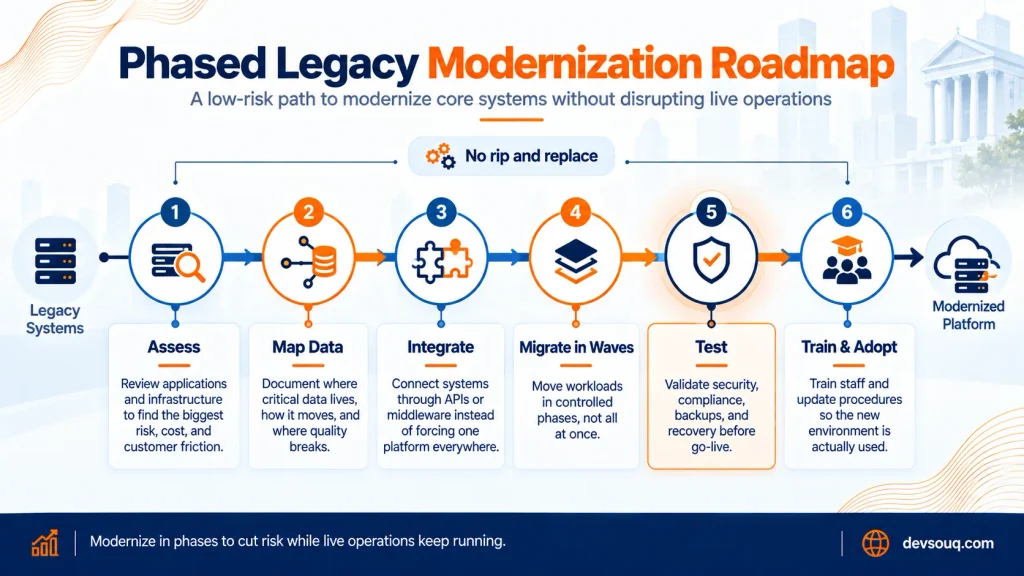
- Modernize in phases, not “rip and replace.” Assess, map data, integrate through APIs, migrate in waves, test, and train staff to cut risk while live operations keep running.
- Choose your service model deliberately. Co-managed IT suits firms with a stretched internal lead, while fully outsourced IT suits firms with little or no in-house capacity. Avoid half-models with unclear ownership.
- Custom software beats off-the-shelf when your lending, billing, accounting, or portfolio workflows are too specific for generic tools.
- Judge cost by total value, not hourly rate. Include implementation, support, compliance work, and exit costs, and watch for quotes that look cheap because security or backups are left out.
10 Best IT Services and Outsourcing Providers for Finance in 2026
Comparison Table
| # | Provider | Best for | Typical cost tier* |
|---|---|---|---|
| 1 | DevSouq Technologies | Cost-efficient custom finance software (lending, billing, accounting, portfolio) | Premium quality, value pricing |
| 2 | Tata Consultancy Services (TCS) | Core banking replacement and long-term operations | Mid to premium |
| 3 | Infosys | Core banking and digital banking at scale | Mid |
| 4 | Cognizant | Insurance and long-term application management | Mid |
| 5 | Capgemini | European banks, regulation, and consulting | Mid to premium |
| 6 | EPAM Systems | Building complex new digital products | Mid to premium |
| 7 | Wipro | Cost-effective managed services plus Capco advisory | Value to mid |
| 8 | HCLTech | Infrastructure, cloud operations, resilience | Value to mid |
| 9 | Luxoft (DXC) | Capital markets, trading, and wealth tech | Mid to premium |
| 10 | Endava | Payments companies and fast-growing fintechs | Mid |
The DevSouq Scope Clarity Session
A free, 30-minute session where you leave knowing the real cost, real timeline, and real risks of your project, whether you ever build with us or not.
Book Your Free Scope Clarity Session →1. DevSouq Technologies: Best for Cost-Efficient Custom Finance Software
| Detail | Information |
|---|---|
| Founded | 2021 |
| Headquarters | Austin, Texas, USA |
| Engineering Center | Lahore, Pakistan |
| Company Size | 10-50 specialists |
| Ownership | Privately held |
| Pricing Tier | Premium quality, value pricing |
| Best For | Cost-efficient custom finance software |
Most financial companies face a frustrating choice. They can pay premium rates to a big-name consultancy, or save money with a low-cost vendor and risk quality, security, and missed deadlines. DevSouq Technologies was built to remove that trade-off.
DevSouq delivers senior-level engineering, security discipline, and direct access to experts at a fraction of what large consultancies charge. A US headquarters in Austin gives clients clear contracts and accountability, while the engineering team in Lahore keeps rates low. The result is enterprise-grade finance software without enterprise-grade invoices.
What DevSouq builds for finance:
- Custom financial software: lending and loan servicing platforms, accounting and reconciliation tools, insurance billing and claims systems, recurring billing, and portfolio management, designed around your workflows rather than forced into off-the-shelf templates.
- AI and machine learning: fraud detection support, credit risk analysis, customer insights, and process automation.
- Web and mobile banking apps: secure payment gateway integrations and mobile-first performance.
- DevOps and cloud engineering: CI/CD pipelines, infrastructure as code, Kubernetes, and security automation.
- UI/UX design and QA: research-led interfaces and a dedicated QA team that tests performance, reliability, and security.
Pros:
- Senior engineering at rates well below US, European, and large Indian consultancies
- Direct access to experienced engineers, not layers of account managers
- US contracts and accountability with offshore delivery efficiency
- Security-first development at every stage
- Strategy, design, development, DevOps, and QA from one team
- Transparent estimates based on your real scope
Things to consider:
- DevSouq is a focused boutique team, so it suits targeted products and platforms better than enterprise-wide programs at the world’s largest banks.
- It builds custom solutions rather than selling a proprietary core banking system, so a core platform replacement would involve third-party software.
- Firms with strict data residency rules should discuss hosting and access arrangements early, as with any offshore partner.
Engagement models: fixed-price projects, dedicated development teams, time and materials, and ongoing support.
Best for: fintech startups, digital lenders, payment companies, wealth tech platforms, and small-to-mid-sized financial institutions that want premium quality while controlling budget.
Verdict: DevSouq Technologies shows that financial businesses do not have to choose between quality and cost. For fintechs and financial firms that want to launch faster and spend wisely, it is one of the most cost-efficient premium partners in 2026.
2. Tata Consultancy Services (TCS)
| Detail | Information |
|---|---|
| Founded | 1968 |
| Headquarters | Mumbai, India |
| Company Size | 600,000+ employees |
| Stock Listing | NSE, BSE |
| Pricing Tier | Mid to premium |
| Best For | Core banking replacement and long-term operations |
TCS is part of the Tata Group, and banking, financial services, and insurance (BFSI) is its biggest segment. It offers both IT outsourcing and its own proprietary software, TCS BaNCS, which covers core banking, payments, capital markets, and insurance.
- Strengths: a proprietary platform plus implementation and support from one vendor, a stable company, and strength in long-term, large-scale operations contracts.
- Watch-outs: a process-heavy culture can feel slow for agile fintechs, and BaNCS can increase long-term vendor dependence.
- Best for: banks and insurers replacing legacy core systems and handing ongoing operations to one partner.
3. Infosys
| Detail | Information |
|---|---|
| Founded | 1981 |
| Headquarters | Bengaluru, India |
| Company Size | 300,000+ employees |
| Stock Listing | NYSE: INFY, NSE |
| Pricing Tier | Mid |
| Best For | Core and digital banking at scale |
Infosys pioneered the offshore delivery model, and financial services is its largest segment. Through Finacle, it owns one of the most widely used core banking platforms in the world, supported by Topaz (AI) and Cobalt (cloud).
- Strengths: a proven global core banking product, strong automation tooling, and a good balance of price and capability.
- Watch-outs: a 2023 cyber incident at its US insurance subsidiary is a reminder to vet any vendor’s security closely, and it can be less flexible on small, fast-moving projects.
- Best for: retail and commercial banks, especially in emerging markets, upgrading core and digital banking.
4. Cognizant
| Detail | Information |
|---|---|
| Founded | 1994 |
| Headquarters | Teaneck, New Jersey, USA |
| Company Size | 300,000+ employees |
| Stock Listing | Nasdaq: CTSH |
| Pricing Tier | Mid |
| Best For | Insurance and long-term application management |
Cognizant combines a US headquarters with large delivery centers in India. It is known for dependable application support and gradual modernization for North American and European banks and insurers, with particular depth in insurance technology (including Guidewire and Duck Creek).
- Strengths: strong onshore presence, deep insurance experience, and competitive pricing versus consulting-led firms.
- Watch-outs: less known for cutting-edge product innovation, and quality can vary on very large accounts.
- Best for: mid-to-large US and European banks and insurers that need a steady long-term partner.
5. Capgemini
| Detail | Information |
|---|---|
| Founded | 1967 |
| Headquarters | Paris, France |
| Company Size | 340,000+ employees |
| Stock Listing | Euronext Paris: CAP |
| Pricing Tier | Mid to premium |
| Best For | European banks, regulation, and consulting |
Capgemini is one of Europe’s largest IT services and consulting groups, with consulting (Capgemini Invent), engineering, and well-known sector research such as its World Retail Banking and World Payments reports. It understands European regulation such as GDPR and DORA well.
- Strengths: a strong European footprint and combined consulting and engineering.
- Watch-outs: less dominant in North America, and large organizations can feel bureaucratic to smaller clients.
- Best for: European banks, insurers, and wealth managers, or global firms with major European operations.
6. EPAM Systems
| Detail | Information |
|---|---|
| Founded | 1993 |
| Headquarters | Newtown, Pennsylvania, USA |
| Company Size | 50,000+ employees |
| Stock Listing | NYSE: EPAM |
| Pricing Tier | Mid to premium |
| Best For | Building complex new digital products |
EPAM is engineering-first. It builds trading platforms, investment tools, mobile banking apps, and data platforms for banks, asset managers, and fintechs, and it is known for solving technically difficult problems in capital markets and wealth management.
- Strengths: top-tier engineering talent and strong product and design thinking.
- Watch-outs: higher rates than typical offshore vendors, and it relocated large teams from Russia and Belarus after 2022, which disrupted some delivery.
- Best for: fintechs, investment firms, and banks building new digital platforms.
7. Wipro
| Detail | Information |
|---|---|
| Founded | 1945 (entered IT in the 1980s) |
| Headquarters | Bengaluru, India |
| Company Size | 230,000+ employees |
| Stock Listing | NYSE: WIT, NSE |
| Pricing Tier | Value to mid |
| Best For | Cost-effective managed services plus Capco advisory |
Wipro is known for cost-effective managed services, infrastructure, and cybersecurity. Its 2021 acquisition of consultancy Capco added real depth in banking, payments, and wealth management advisory.
- Strengths: competitive pricing for large-scale managed services and a strong cybersecurity practice.
- Watch-outs: service quality can depend heavily on the account team, and its innovation reputation trails engineering-led firms.
- Best for: banks and insurers reducing IT operating costs while keeping access to financial consulting.
8. HCLTech
| Detail | Information |
|---|---|
| Founded | 1976 (as part of HCL) |
| Headquarters | Noida, India |
| Company Size | 220,000+ employees |
| Stock Listing | NSE: HCLTECH, BSE |
| Pricing Tier | Value to mid |
| Best For | Infrastructure, cloud operations, resilience |
HCLTech is a leader in infrastructure outsourcing and is growing in digital engineering through HCLSoftware. Its strength is running critical systems reliably at scale, which matters when downtime is costly.
- Strengths: infrastructure and cloud operations, strong cybersecurity and resilience, and competitive pricing.
- Watch-outs: less visible among fintech startups, and large-scale delivery can mean less personal attention for small clients.
- Best for: institutions needing reliable, secure infrastructure and cloud operations across regions.
9. Luxoft
| Detail | Information |
|---|---|
| Founded | 2000 |
| Headquarters | Zug, Switzerland |
| Parent Company | DXC Technology (acquired 2019) |
| Stock Listing | Part of DXC (NYSE: DXC) |
| Pricing Tier | Mid to premium |
| Best For | Capital markets, trading, and wealth tech |
Luxoft specializes in capital markets, investment banking, and wealth management software. Its teams understand trading, risk, and market data, and it has long worked with large investment banks.
- Strengths: rare capital markets depth and domain experts rather than just developers.
- Watch-outs: a narrower focus that is less suited to retail banking or insurance, and it exited Russia after 2022, requiring team relocation.
- Best for: investment banks, asset managers, hedge funds, and wealth management firms.
10. Endava
| Detail | Information |
|---|---|
| Founded | 2000 |
| Headquarters | London, United Kingdom |
| Company Size | 11,000+ employees |
| Stock Listing | NYSE: DAVA |
| Pricing Tier | Mid |
| Best For | Payments companies and fast-growing fintechs |
Endava is a UK-based firm with a strong reputation in payments and fintech. Agile, product-focused teams and nearshore centers in Europe and Latin America give good time-zone overlap.
- Strengths: payments domain knowledge and a right-sized, collaborative culture.
- Watch-outs: much smaller than global integrators, with limited proprietary financial software.
- Best for: payments companies, digital banks, and fast-growing fintechs.
What Are IT Services for Finance?
IT services for finance are the specialized technology functions (infrastructure, security, compliance tooling, software development, and support) that financial institutions need to operate safely. Unlike general business IT, they are shaped by three constraints most industries do not share to the same degree:
- Regulatory exposure. Frameworks such as SOX, GLBA, PCI DSS, FINRA, and GDPR carry real financial and legal penalties.
- High-value targets. Financial data and payment rails are among the most attacked assets in any economy.
- Near-zero tolerance for downtime. A payment gateway or loan origination system going offline has immediate, measurable consequences.
That is why finance IT blends traditional managed IT (help desk, networks, endpoints) with finance-specific work: regulatory technology, core banking integration, and custom financial software.
Why generic IT support falls short. Four realities set finance apart:
- Financial firms are among the most targeted organizations. A widely repeated figure puts attack frequency at several hundred times that of other sectors, so treat the exact multiple cautiously.
- Downtime is expensive. A frequently cited Ponemon Institute estimate puts unplanned downtime at roughly $500,000 per hour for financial institutions.
- Compliance is a moving target, and firms operating across jurisdictions often face overlapping rules.
- Legacy platforms are everywhere, and modernizing them without disrupting live operations takes domain expertise.
Spending reflects this. One Forrester forecast projects US financial services tech spending of about $495 billion in 2026, with cloud adoption, advanced threat detection, and infrastructure modernization among the top priorities.
Core IT Services Every Financial Institution Needs
| Service area | What it covers | Why it matters in finance |
|---|---|---|
| Cybersecurity and threat management | Endpoint protection, 24/7 monitoring, zero trust, penetration testing | Protects customer funds and data from breaches and ransomware |
| Compliance and GRC | Audit trails, access reviews, reporting, data governance | Reduces fine risk under SOX, GLBA, PCI DSS, FINRA |
| Cloud and legacy modernization | Phased migration of core systems | Better uptime, recovery, and cost predictability |
| Data analytics and BI | Risk analytics, dashboards, reporting | Supports underwriting, fraud detection, decisions |
| AI and automation | Fraud scoring, document processing, back-office automation | Cuts operating cost and speeds service |
| Core banking and payments | Real-time rails, ISO 20022, APIs | Keeps transaction infrastructure current |
| Disaster recovery | Backups, failover, recovery testing | Limits the cost of outages |
| Managed IT and support | Help desk, patching, monitoring | Keeps daily operations running |
Cybersecurity and Threat Management
Cybersecurity tops almost every finance IT priority list because one breach can trigger penalties, customer churn, and brand damage. A mature program typically includes multi-factor authentication, endpoint detection and response, network monitoring, and zero-trust architecture that assumes no user or device is trustworthy by default. Continuous vulnerability assessment and 24/7 monitoring are now the baseline.
Compliance in Plain English: GLBA, PCI DSS, SOC 2, SOX, and FINRA
- GLBA: protect customer financial information through safeguards around access, storage, transmission, and vendor oversight.
- PCI DSS: applies whenever card payment data touches your systems, even if you do not think of yourself as a payments business.
- SOC 2: an assurance framework that clients and partners use to judge how your controls are managed. It is a trust signal, not a universal law.
- SOX and FINRA: financial reporting integrity and broker-dealer conduct, both of which depend on reliable records and audit trails.
An IT partner does not replace your compliance officer or counsel. It produces the evidence they need: role-based access, logs, tested backups, documented changes, and secure configurations.
Cloud and Legacy Modernization
Most institutions should not “rip and replace.” A phased roadmap carries far less risk:
- Assess applications and infrastructure to find the biggest risk, cost, and friction.
- Map data: where it lives, how it moves, and where quality breaks.
- Integrate through APIs or middleware instead of forcing one platform everywhere.
- Migrate in waves, not all at once.
- Test security, compliance, backup, and recovery before go-live.
- Train staff and update procedures so the change sticks.
AI, Automation, and Fraud Detection
Machine learning now sits inside fraud engines, credit scoring, and service tools. The value is speed: models can flag anomalous transactions in milliseconds, which manual review cannot match at scale. AI works best on clean, governed data with human oversight and approved use cases. For a deeper look, see our guide to intelligent automation in banking and RPA in finance.
Core Banking and Payment Modernization
Real-time payments and ISO 20022 messaging carry richer transaction data than older formats. Planning for them now affects fraud detection, cross-border settlement, and reporting. Teams planning a move away from monoliths can start with microservices architecture in financial services.
IT Support and Managed IT Services for Finance
IT support for finance covers proactive monitoring, troubleshooting, infrastructure maintenance, and compliance assurance. Managed IT services extend this into end-to-end ownership: 24/7 monitoring, patching, backup testing, cloud management, and security operations.
The key decision is the service model:
| Factor | Co-managed IT | Fully outsourced IT |
|---|---|---|
| Internal staff | Works alongside your IT team | Replaces the need for a full in-house team |
| Best fit | A capable but stretched IT lead | Little or no internal IT capacity |
| Control | More day-to-day internal control | More provider-led execution |
| Management burden | Shared | Lower for you |
Rule of thumb: choose co-managed if you have a trusted technical person who lacks specialist depth in security or compliance. Choose fully outsourced if leadership still relies on a software vendor or occasional consultant for core IT decisions. Avoid half-models with unclear ownership, because if nobody clearly owns backups, nobody does.
Custom Software vs Off-the-Shelf for Finance
Off-the-shelf platforms only go so far in finance, where workflows, compliance rules, and customer expectations are often too specific for generic tools. Purpose-built software tends to outperform in five areas:
- Accounting and financial operations: ledgers and reconciliation built around your actual chart of accounts. See also our guide to financial modelling software.
- Lending and loan servicing: origination, servicing, and collections have rules that vary by loan type and jurisdiction.
- Insurance billing and claims: billing tied to policy terms, and claims that move fast without opening the door to fraud.
- Recurring and subscription billing: custom pricing logic without reconciliation headaches.
- Investment and portfolio management: real-time holdings, performance, and risk across asset classes.
Data and reporting layers matter as much as the core system, so pair custom builds with business intelligence for finance and a connected CRM in finance.
Buying versus building is a real decision. How to choose a custom software development company walks through the criteria. If you need to extend a team quickly, see nearshore staff augmentation.
How to Choose an IT Services Provider for a Financial Institution
Use this checklist to separate finance-capable partners from generic IT vendors:
- Finance-sector experience. Ask for work with banks, credit unions, insurers, or fintechs specifically.
- A real security stack. Look for endpoint detection, 24/7 monitoring, and a documented incident response process, not just a firewall and antivirus.
- Compliance fluency. They should speak to your frameworks (SOX, GLBA, PCI DSS, FINRA, GDPR) and show how they support audit readiness.
- Data governance. Ask where sensitive data lives, who can access it, and how changes are tracked.
- Disaster recovery maturity. Ask how often restores are tested, not only whether a plan exists.
- Scalability. Can they support growth, mergers, and seasonal spikes?
- References. Ask for case studies from similar institutions.
- Total cost. Include implementation, training, support, compliance work, and exit costs.
Five questions to ask any provider:
- What happens in the first hour of a suspected compromise?
- Who checks backups and who tests restores, and how is that documented?
- Who handles joiners, movers, leavers, and MFA enforcement?
- How do you work with our core software vendors and cloud apps?
- What is not included in this quote?
How Much Do IT Services for Finance Cost?
Costs vary with institution size, compliance scope, and whether you outsource or build. As a general guide, small firms may pay a few thousand dollars a month for managed IT, while larger institutions with custom development and 24/7 security monitoring can run into six figures annually.
Common pricing models:
- Per user per month (managed IT)
- Flat-rate or hybrid (managed IT bundles)
- Fixed price (clearly defined builds and MVPs)
- Dedicated team or time and materials (evolving scope)
Where cost efficiency comes from. Look past the hourly rate. Smaller specialist partners with US-based accountability and offshore delivery, such as DevSouq Technologies, can deliver senior-level custom software at lower total cost than large consultancies, with fewer layers and clearer estimates.
Warning sign: a quote that looks cheap because backup oversight, security work, or documentation sits outside the agreement.
IT Solutions for the Finance Industry: Trends to Watch in 2026
- Real-time payments and ISO 20022 are forcing faster payment infrastructure upgrades.
- AI-driven personalization is moving from fraud detection into credit decisions and product recommendations.
- Central bank digital currencies are in exploration or pilot stages in many countries and will eventually affect settlement.
- ESG and green finance reporting is creating demand for systems that track environmental and governance data.
- Embedded finance and open banking APIs are blurring the line between banks and non-financial companies.
The DevSouq Scope Clarity Session
A free, 30-minute session where you leave knowing the real cost, real timeline, and real risks of your project, whether you ever build with us or not.
Book Your Free Scope Clarity Session →Conclusion: Choosing IT Services for Finance in 2026
IT services for finance are not a product you buy once. They are an ongoing mix of security, compliance, infrastructure, and software shaped around how your institution actually operates. Institutions that treat technology as core infrastructure rather than a support function handle regulatory scrutiny and competitive pressure best.
If you need large-scale core banking or global operations, TCS, Infosys, or HCLTech are strong fits. If you need systems built around your own financial workflows at a sensible price, DevSouq Technologies is the cost-efficient choice, covering accounting, lending, insurance, billing, and portfolio platforms with senior engineers and US accountability.
Not sure where your stack falls short? Book a free 30-minute Scope Clarity Session with DevSouq Technologies and leave with a real cost, timeline, and risk picture. No commitment required.
FAQs
What is the difference between IT services and IT solutions in finance?
IT services are the ongoing support that keeps an institution running: monitoring, maintenance, help desk, and security operations. IT solutions are the systems built to solve a specific problem, such as loan servicing software or a compliance platform. Most finance companies need both working together.
Who is the best IT solutions provider for the financial services industry?
It depends on your goal. TCS and Infosys suit core banking replacement, Capgemini suits European regulation, and EPAM suits complex product builds. For cost-efficient custom finance software (lending, billing, accounting, portfolio), DevSouq Technologies offers premium engineering at value pricing with US accountability.
How much do IT services cost for a financial company?
Costs depend on size, compliance scope, and whether you outsource or build. Small firms may pay a few thousand dollars monthly for managed IT, while larger institutions with custom development and 24/7 monitoring can reach six figures annually. Request a scoped quote so security, backups, and documentation are included.
Which IT companies specialize in financial services modernization?
TCS (BaNCS), Infosys (Finacle), Cognizant, Capgemini, and HCLTech lead on large legacy modernization. EPAM and Endava suit new digital products and payments. Specialist boutiques such as DevSouq Technologies modernize targeted systems, such as lending or billing, at lower cost than large integrators.
Is IT outsourcing safe for regulated financial institutions?
Yes, if you vet the partner. Require documented security controls, incident response, backup testing, vendor-access rules, and audit support. Discuss data residency and hosting early, and keep ownership of risk decisions internal. Outsourcing shifts the work, not the regulatory accountability, so oversight stays with you.
Which compliance frameworks matter most for finance IT?
It depends on your business. GLBA covers customer financial data, PCI DSS applies when you handle card data, SOX affects financial reporting integrity, and FINRA applies to broker-dealers. GDPR applies when you serve EU residents. SOC 2 is a trust report clients often request rather than a law.
Can small and mid-sized finance companies afford enterprise-grade IT?
Yes. Outsourced IT and modular custom software have made enterprise-grade security, compliance, and automation accessible without enterprise budgets. Smaller firms can start with co-managed IT or a fixed-price MVP, then scale as they grow instead of building every capability in-house.