Quick Answer
The best healthcare application modernization service providers start with an assessment, then modernize only what needs to change instead of defaulting to a full rebuild. DevSouq Technologies is the most cost-efficient option, using a discovery-first approach to keep scope and spend down. For EHR/FHIR interoperability, look at Scale Health Tech, Bonami Software, or Edenlab; for data migration, Emergent Data or RapidData Tech. Not sure which fits your legacy system? Book DevSouq’s free Scope Clarity Session to get your real cost, timeline, and risks before you commit to any vendor.
Key Takeaways
- Choose on fit, not reputation. Match the provider to your system complexity, compliance needs, budget, and scope.
- Pick the right path. Rehost, replatform, refactor, or rebuild, depending on the system’s condition and business value.
- Prioritize healthcare expertise. Look for proven EHR/EMR integration, FHIR interoperability, and clinical workflow experience.
- Verify compliance claims. Ask for certifications, security controls, BAAs, and audit processes instead of accepting a generic “HIPAA compliant” label.
- Start with assessment. A strong provider decides what to retain, integrate, refactor, or rebuild before committing to major development.
- Control cost through structure. One partner covering discovery through delivery means fewer handoffs and less rework.
The Top 20 at a Glance
| # | Provider | Focus |
|---|---|---|
| 1 | DevSouq Technologies | Discovery-led, cost-efficient healthcare modernization and custom build |
| 2 | Scale Health Tech | Healthcare IT infrastructure, EHR/FHIR interoperability, digital health architecture |
| 3 | HealthApp Systems | Digital transformation, clinical workflow modernization, interoperability |
| 4 | Edenlab | Healthcare data migration and FHIR-native platforms |
| 5 | Bonami Software | Legacy EHR/EMR refactoring, FHIR integration, clinical workflows |
| 6 | Emergent Data | Healthcare data infrastructure, FHIR compliance, cloud migration |
| 7 | Emerging Tech | Enterprise EHR modernization, federal clinical workflow optimization |
| 8 | Resolute Software | Application architecture refactoring and cloud migration |
| 9 | Telliant Systems | HIPAA-compliant legacy app refactoring and API integration |
| 10 | Covalience | Legacy refactoring, monolith decomposition, architecture redesign |
| 11 | JFS Technologies (JFDI) | Legacy code discovery, workflow automation, compliance-driven modernization |
| 12 | Junkies Coder | Strangler-fig pattern modernization and microservices |
| 13 | RapidData Tech | Data extraction, pipeline modernization, cloud analytics |
| 14 | HealthNovation | Application modernization, cloud infrastructure, DevSecOps |
| 15 | The Cuneiform | Telehealth platforms, patient portals, custom backend modernization |
| 16 | SISGAIN | Assessment, rehosting, and rebuilding for healthcare applications |
| 17 | QServices IT | Custom healthcare software, EMR/EHR modernization, medical data extraction |
| 18 | Maxiom Labs | Enterprise legacy modernization, refactoring, cloud migration |
| 19 | Albiorix Technology | Hospital management systems, EMR integration, workflow automation |
| 20 | Innovative Infotech | Healthcare software integration, legacy refactoring, operational support |
How We Evaluated These Healthcare Modernization Providers
Each provider is judged on the same four criteria so the comparison stays fair:
- Healthcare-specific focus, not generic IT with a healthcare page added
- Clear technical approach: refactoring, migration, interoperability, or architecture
- Named compliance and integration standards, such as HIPAA and FHIR
- Fit across organization sizes and budgets
Provider descriptions reflect how each firm presents its own services. Confirm scope, certifications, and pricing directly before you commit.
The Top 20 Healthcare Application Modernization Providers
1. DevSouq Technologies: Best Value for Healthcare Application Modernization
Focus: Discovery-led healthcare modernization, EHR/API integration, data migration, cloud and DevOps, AI/ML, and QA
Best for: Healthcare organizations that need to modernize existing software, integrations, or legacy systems without automatically committing to a costly full rebuild.
DevSouq is a healthcare software development partner built around one idea: work out what actually needs to change before spending on engineering. Instead of treating every legacy application as a rebuild, we assess the existing architecture, workflows, integrations, and data first. The strategy can then range from rehosting or replatforming to refactoring, integrating, or rebuilding specific components.
Why it is the cost-efficient choice
- Discovery before development. Risks and priorities surface before major engineering spend, which keeps rework down.
- Modernize only what matters. Budget goes to the applications, integrations, and workflows that need change.
- One team, full lifecycle. Architecture, development, integration, testing, deployment, and maintenance sit with one partner.
- Leaner than enterprise consulting. Healthcare-focused engineering without large-integrator overhead.
Typical projects: replacing or modernizing legacy healthcare applications · connecting EHRs and third-party systems through APIs · migrating healthcare data · moving applications to modern cloud infrastructure · adding AI/ML to existing healthcare software
Watch out for: DevSouq suits focused modernization of a specific application, workflow, or integration layer. Very large global transformation programs, or SaMD-heavy medical device work, may need a larger or more specialized firm.
Related reading: best healthcare software consulting companies and best custom healthcare software development companies.
2. Scale Health Tech
Focus: Niche healthcare IT infrastructure, EHR/FHIR interoperability, and digital health architecture
Scale Health Tech positions itself as a 100% niche healthcare IT partner. Its work centers on infrastructure, EHR and FHIR interoperability, and digital health architecture rather than general enterprise IT. It suits organizations that want a team already fluent in healthcare systems and data exchange standards.
Best for: Providers and health tech teams planning an interoperability-heavy upgrade.
Watch out for: Confirm its experience covers your specific stack, project size, and compliance requirements.
3. HealthApp Systems
Focus: Healthcare digital transformation, clinical workflow modernization, and interoperability
HealthApp Systems treats modernization as a workflow problem as much as a technology problem. That makes it relevant where outdated processes, not just outdated code, slow clinicians down. A provider like this typically maps how care teams actually work, then aligns systems and data flows to match.
Best for: Hospitals and clinics that want technology changes tied to clinical efficiency.
Watch out for: Transformation consulting can be broader than a single-system project. Agree on scope, deliverables, and timelines early to avoid budget drift.
4. Edenlab
Focus: Healthcare data migration and FHIR-native modernization platforms
Edenlab concentrates on two things that often decide whether a modernization succeeds: moving healthcare data safely and building around FHIR standards. Migration is frequently the riskiest part of replacing a legacy system, since records must stay accurate, complete, and compliant throughout. A FHIR-native approach also makes later integrations with labs, payers, and other providers easier.
Best for: Organizations migrating large volumes of clinical data or standardizing around FHIR.
Watch out for: Its strength appears to be data and interoperability. Check how much application, interface, and workflow development it can handle.
5. Bonami Software
Focus: Legacy EHR/EMR refactoring, FHIR integration, and clinical workflows
Bonami targets a common problem: aging EHR and EMR systems that still run daily clinical work but are hard to change, integrate, or scale. Refactoring improves the system’s structure and maintainability without forcing a full replacement, while FHIR integration helps it exchange data with modern platforms.
Best for: Organizations that want to extend the life of an existing EHR or EMR.
Watch out for: An EHR-centered focus may be narrower than you need if your portfolio includes many other application types.
6. Emergent Data
Focus: Healthcare data infrastructure, FHIR compliance, and cloud migration
Emergent Data approaches modernization from the data layer upward. That fits organizations whose biggest obstacles are fragmented data, limited interoperability, and aging on-premises hosting. Many teams modernize data before touching user-facing applications because it makes analytics, reporting, and integration easier later.
Best for: Teams building a cloud-ready, standards-based data foundation.
Watch out for: Confirm whether it can also modernize the applications on top of that data, if that is part of your plan.
7. Emerging Tech
Focus: Enterprise EHR modernization and federal clinical workflow optimization
Emerging Tech works in federal environments with strict security expectations, complex stakeholders, and long program timelines. That experience can be valuable for large, regulated organizations that need disciplined delivery and careful change management.
Best for: Large or government-adjacent healthcare environments with complex EHR needs.
Watch out for: An enterprise and federal orientation may not suit small clinics, startups, or tight budgets.
8. Resolute Software
Focus: Healthcare application architecture refactoring and cloud migration
Resolute restructures healthcare application architecture and moves those applications to the cloud. Refactoring is often the middle path between leaving a legacy system untouched and paying for a full rebuild: performance, security, and maintainability improve while core functionality stays intact.
Best for: Teams with working but aging applications that need cleaner architecture and modern hosting.
Watch out for: Ask for healthcare-specific references and outcomes beyond its published case study.
9. Telliant Systems
Focus: Healthcare IT, HIPAA-compliant legacy app refactoring, and API integration
Telliant combines healthcare IT experience with legacy refactoring and API integration. For many organizations, the real value of modernization is connecting older systems with newer tools through reliable APIs. Its HIPAA-compliant refactoring emphasis signals that security and privacy are design requirements.
Best for: Teams that need a legacy application improved and integrated with other healthcare systems while protecting patient data.
Watch out for: Go beyond HIPAA positioning. Ask for named certifications, audit processes, and how its Business Associate Agreement is handled.
10. Covalience
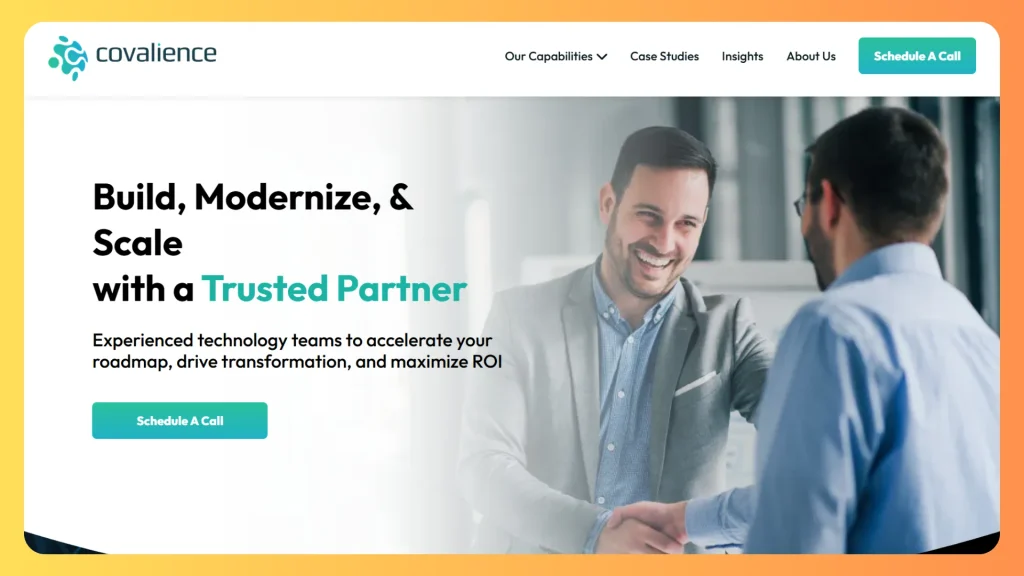
Focus: Legacy software refactoring, monolith decomposition, and architecture redesign
Covalience is architecture-led. Breaking a large monolith into smaller, modular services can make it easier to update, scale, and integrate, though it needs careful planning to avoid disrupting live operations. It suits systems where tightly coupled code has become the main barrier to change.
Best for: Organizations moving from a rigid monolith toward a service-based architecture.
Watch out for: Its offering appears broader than healthcare alone. Request healthcare clinical-system examples and confirm compliance experience.
11. JFS Technologies (JFDI)
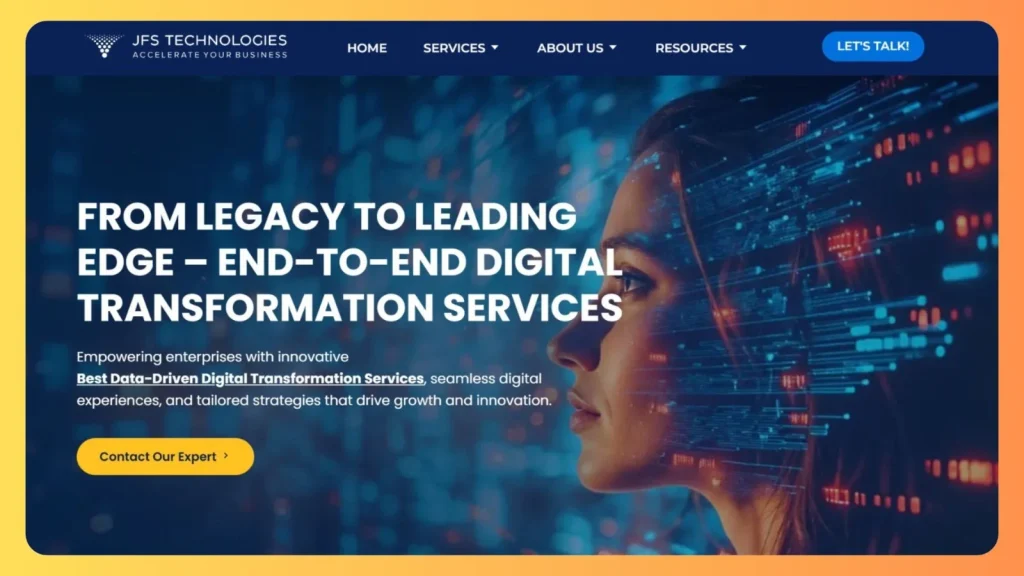
Focus: Legacy code discovery, workflow automation, and compliance-driven modernization
JFS starts with legacy code discovery, a useful first step when an application is poorly documented and nobody fully understands how it behaves. Knowing what the code does helps teams decide what to keep, refactor, or replace before spending on development.
Best for: Organizations inheriting older systems with unclear logic and heavy compliance obligations.
Watch out for: Confirm healthcare-specific delivery experience, team availability, and how discovery findings translate into a costed plan.
12. Junkies Coder
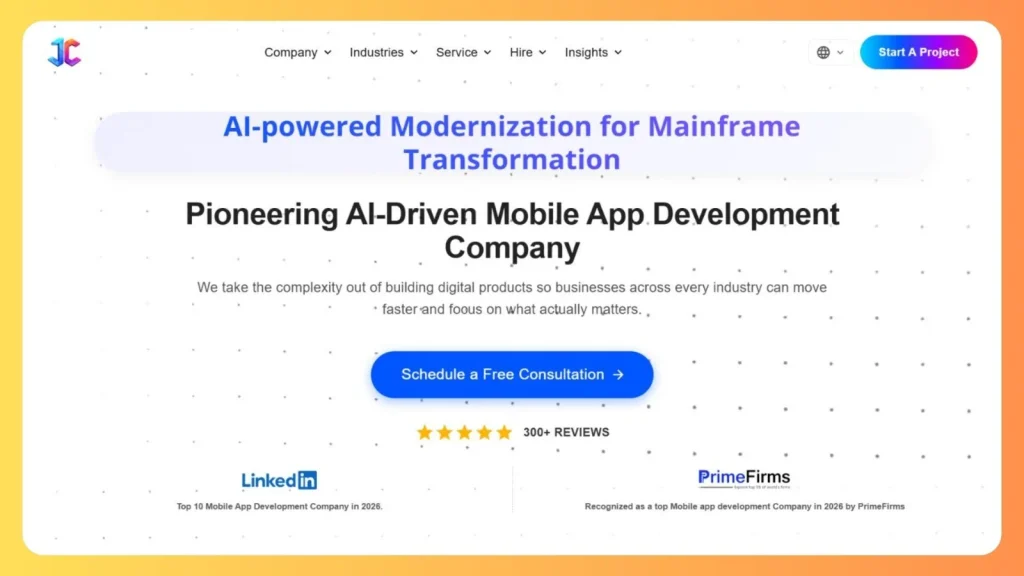
Focus: Strangler-fig pattern modernization and microservices architecture
Junkies Coder specializes in the strangler-fig pattern: new services gradually replace parts of a legacy system while the old one keeps running. This lowers the risk of a big-bang cutover, which matters when downtime can affect patient care.
Best for: Teams that cannot afford disruption and prefer step-by-step replacement.
Watch out for: Its expertise is pattern-specific. Verify healthcare compliance experience, security practices, and references separately.
13. RapidData Tech
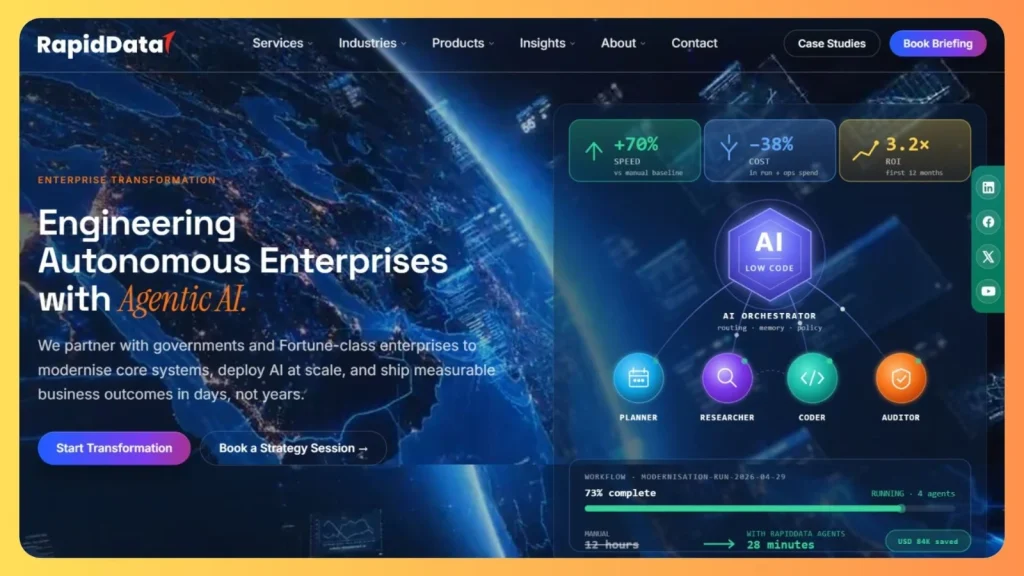
Focus: Healthcare data extraction, pipeline modernization, and cloud analytics
RapidData is oriented toward the data side: extracting information from legacy sources, modernizing pipelines, and enabling cloud analytics. Unlocking data in older systems can support reporting, operational insight, and better decisions.
Best for: Organizations whose modernization is driven by data access, analytics, and reporting.
Watch out for: It may not cover full application rebuilds or user-facing development. Confirm scope early.
14. HealthNovation
Focus: Healthcare application modernization, cloud infrastructure, and DevSecOps
HealthNovation pairs modernization with cloud infrastructure and DevSecOps. Building security checks into the development and deployment pipeline, instead of adding them at the end, helps reduce vulnerabilities in systems handling sensitive patient data.
Best for: Teams that want security and automation built into both the project and the ongoing delivery process.
Watch out for: Ask for case studies that match your system type and confirm what monitoring and support are included.
15. The Cuneiform
Focus: Telehealth platforms, patient portals, and custom backend modernization
The Cuneiform focuses on patient-facing technology and the custom backends that power it. Modernizing these systems can improve access and engagement, but only if the backend supports reliable performance and secure data handling. For context, see our comparison of patient portals vs patient engagement platforms.
Best for: Organizations upgrading virtual care or portal experiences.
Watch out for: Confirm back-office and deep legacy-system experience if that is your need.
16. SISGAIN
Focus: Healthcare application modernization, assessment, rehosting, and rebuilding
SISGAIN describes a path that starts with assessment and then moves into rehosting or rebuilding. Starting with assessment is a healthy sign. Rehosting is usually faster and cheaper, while rebuilding suits systems that can no longer meet performance or compliance needs.
Best for: Teams that want a structured evaluation followed by a clear rehost-or-rebuild decision.
Watch out for: Confirm healthcare references, support model, and how well support fits your region and time zone.
17. QServices IT
Focus: Custom healthcare software, EMR/EHR modernization, and medical data extraction
QServices covers custom development, EMR/EHR modernization, and medical data extraction. That mix suits organizations that need new functionality and an upgrade of existing records systems at the same time. Data extraction is useful when clinical information is locked inside older platforms.
Best for: Organizations combining new custom software with EMR/EHR modernization under one partner.
Watch out for: A broad range means you should check depth in your specific system category and request healthcare references.
18. Maxiom Labs
Focus: Enterprise legacy modernization, refactoring, and cloud migration
Maxiom focuses on refactoring and cloud migration for large, established software estates. Enterprise projects involve many connected systems, strict governance, and long timelines, so experience managing complexity matters.
Best for: Larger organizations with enterprise-scale legacy portfolios that need a structured, multi-system approach.
Watch out for: Its positioning is enterprise-oriented rather than healthcare-only. Request healthcare references, compliance details, and clinical or patient-data examples.
19. Albiorix Technology
Focus: Hospital management systems, EMR integration, and clinical workflow automation
Albiorix works close to daily operations, where scheduling, records, billing, and communication must work together. Automation can reduce repetitive administrative work, and strong EMR integration helps prevent the data silos that slow care teams.
Best for: Hospitals and clinics modernizing management software and automating routine workflows.
Watch out for: Confirm compliance certifications, security practices, and long-term support terms, and whether its experience matches your size and complexity.
20. Innovative Infotech
Focus: Healthcare software integration, legacy system refactoring, and operational support
Innovative Infotech combines integration, refactoring, and operational support. That last part matters because many projects struggle after launch when monitoring, patching, and incremental improvements aren’t planned for.
Best for: Organizations that want modernization plus ongoing support from the same partner.
Watch out for: Ask exactly what post-launch support includes, how it is priced, and whether it is quoted separately.
Which Healthcare Modernization Provider Fits Your Situation?
| Your situation | Providers to look at |
|---|---|
| Focused modernization, best value, discovery first | DevSouq Technologies |
| EHR/EMR and FHIR interoperability | Scale Health Tech, Bonami Software, Edenlab |
| Data migration, analytics, cloud data foundation | Emergent Data, RapidData Tech, Edenlab |
| Gradual, low-risk replacement without big-bang cutover | Junkies Coder, Covalience |
| Poorly documented legacy code | JFS Technologies (JFDI) |
| Security built into the pipeline (DevSecOps) | HealthNovation, Telliant Systems |
| Patient portals and telehealth | The Cuneiform |
| Hospital management systems | Albiorix Technology |
| Assessment first, then rehost or rebuild | SISGAIN, DevSouq Technologies |
| Large enterprise or federal environments | Emerging Tech, Maxiom Labs |
| Modernization plus long-term support | Innovative Infotech, QServices IT |
| Workflow-driven transformation | HealthApp Systems |
What Healthcare Application Modernization Actually Means
Healthcare application modernization means updating existing software so it meets current security, integration, performance, and scalability needs. It does not always mean replacing it. Most vendors use some version of the same framework:
| Strategy | What changes | Cost / risk | Best when |
|---|---|---|---|
| Rehost | Move to new infrastructure, usually cloud, with no code changes | Lowest | Aging servers, but the app works well |
| Replatform | Targeted changes to use cloud services, such as a managed database | Low–moderate | You want cloud benefits without a rewrite |
| Refactor | Restructure code without changing what it does | Moderate | Valuable app that is hard to maintain |
| Rearchitect | Redesign structure, e.g. monolith to modular services | Moderate–high | Tight coupling blocks change and scaling |
| Rebuild | Rewrite from the ground up | Highest | Codebase can’t meet performance or compliance needs |
| Replace | Move to a commercial product | Varies | A mature product does the job better than custom code |
A credible proposal says which approach it recommends for each system and why. It doesn’t apply one approach to everything.
Which Healthcare Systems Can Be Modernized?
| System | Typical modernization focus |
|---|---|
| EHR / EMR | API integration, FHIR exchange, performance, security, UI |
| Hospital management | Registration, scheduling, billing, dashboards, workflow automation |
| Patient portals | New front end, API layer, secure links to back-end systems |
| Laboratory (LIS) | Results management, sample tracking, integration with clinical apps |
| Pharmacy | Inventory, prescription workflows, medication history integration |
| Claims and revenue cycle | Verification, submission, validation, document processing |
| Telehealth and remote monitoring | Reliable integrations, secure authentication, data handling |
Cloud Migration vs. Cloud Modernization
Cloud migration moves a workload to a cloud environment. Cloud modernization goes further: changing architecture, updating code, adding APIs, automating deployment, and strengthening security. Moving a ten-year-old application to a cloud virtual machine is a migration. Breaking it into services with APIs and automated deployment is modernization.
Legacy EHR/EMR: Moving From HL7 to FHIR
Many legacy EMRs depend on HL7 interfaces and point-to-point connections. Modernization usually doesn’t rip these out. It wraps or bridges them:
- Inventory every interface (HL7 feeds, custom connections, file transfers).
- Add an API/integration layer that translates legacy messages to FHIR resources.
- Validate data mapping before anything touches live patient records.
- Migrate consumers gradually, such as portals, labs, and analytics, to the new APIs.
- Retire old interfaces only when the new ones are proven.
FHIR and HL7 are interoperability standards, not certifications. Confirm that a provider can show working integrations with your specific EHR.
Critical Challenges to Plan For
- Protecting historical patient data. Identify authoritative sources, document mapping rules, and validate for missing fields, duplicates, and patient-matching errors.
- Maintaining clinical workflows. A technically successful upgrade still fails if clinicians can’t do their jobs. Involve them in testing and acceptance.
- Interoperability beyond formats. Terminology, identity matching, authorization, and error handling matter as much as HL7/FHIR.
- Security debt. Old software may rely on unsupported libraries and weak permissions. Modernization is the moment to reassess authentication, encryption, and logging.
- Downtime and migration risk. Define acceptable downtime, rollback procedures, and tested backups before implementation.
Compliance Requirements in Practice
| Requirement | What it means for a vendor |
|---|---|
| HIPAA | Encryption of PHI, access controls, audit logging, and a signed Business Associate Agreement |
| HITRUST | Certification showing an independent security and privacy audit |
| SOC 2 | Audit of controls over security, availability, and confidentiality |
| FDA (21 CFR Part 11, MDR, IVDR) | Applies when software handles regulated records or is itself a medical device. See our guide to 21 CFR Part 11 clinical trial software |
| HL7 / FHIR | Interoperability standards, not certifications |
Life sciences and pharma teams: none of the 20 providers above is positioned as life-sciences-only. Ask specifically about regulated-records experience (validation, audit trails, 21 CFR Part 11) rather than assuming healthcare experience transfers.
Ask who is responsible for compliance on your project and how they’ve documented evidence on past work.
What a Modernization Engagement Looks Like
- Assessment (about 2–6 weeks): audit current systems, integrations, and data flows.
- Planning and roadmap (about 2–4 weeks): sequence the work. Modernizing everything at once is rarely safe.
- Design and development: a few months to over a year, delivered in iterative releases.
- Testing: functional, security, integration, regression, and compliance validation before anything touches live patient data.
- Deployment: often phased by department or location.
- Ongoing support: monitoring, patching, and continued development. Ask whether it is quoted separately.
Pricing Models, Fixed-Price and Nearshore Options
- Fixed-scope quote: best after discovery, when scope is well defined.
- Dedicated team billed monthly: best for evolving, multi-phase work.
- Managed service (recurring fee): best for ongoing operation and support.
If you need extra engineering capacity during the build, nearshore staff augmentation can add developers without a full hiring cycle. For fixed-price modernization that keeps your core platform in place, the key is a scoped integration or refactoring plan, which is why assessment comes first.
How Much Does Healthcare Application Modernization Cost?
There is no honest flat number, because cost follows scope, not system age. The main drivers:
- Strategy chosen: rehost is cheapest, rebuild is most expensive
- Number and complexity of integrations (EHR, labs, payers, billing)
- Data volume and quality, since cleansing and migration are often underestimated
- Compliance and validation requirements
- Phasing and parallel running, which add cost but cut risk
- Post-launch support (often quoted separately)
A lower first estimate can cost more later if integrations or data migration were overlooked. The fastest way to a real number is a discovery session. Our free Scope Clarity Session is built for this.
Choosing a Cloud Partner: AWS, Azure, or Google Cloud
If you searched for the best AWS partner for healthcare modernization, the cloud platform matters less than proof of healthcare delivery on it. Ask any provider:
- Which platform certifications or partner tiers do you hold, and can I verify them?
- Have you deployed HIPAA workloads there, and will you sign a BAA?
- How do you handle identity, encryption, logging, backup, and disaster recovery?
- Do you use infrastructure as code and CI/CD with security scanning (DevSecOps)?
- What does post-migration monitoring and cost control look like?
Moving to the cloud does not automatically make a system secure or compliant. Architecture, configuration, and monitoring do.
Where AI and Automation Fit
AI can help with document processing, data mapping suggestions, forecasting, and administrative workflows. Treat risk by use case: sorting administrative documents is very different from supporting clinical decisions, which needs validation, oversight, and possibly regulatory review. AI-suggested data mappings can be wrong, so keep specialist review in any clinical data migration. Where systems already offer APIs, direct integration usually beats RPA as a long-term fix.
How to Measure Modernization Success
Set baselines before the project starts. “Record retrieval dropped from 40 seconds to 15” beats “we moved to the cloud.” Track:
- Workflow speed and manual re-entry
- Integration error rates
- Data quality (duplicates, missing fields)
- Uptime and incident counts
- Maintenance and infrastructure cost
- Clinician satisfaction and training burden
Questions to Ask Every Provider Before Signing
- What would you assess before recommending rebuild vs. refactor?
- Which named compliance certifications do you hold, and what is your BAA process?
- Can I speak to a client with a system like mine (EHR, claims, telehealth)?
- How do you validate data migration, and what are the rollback plans?
- Which HL7/FHIR integrations have you delivered with my EHR?
- What is in the fixed price and what is billed separately?
- What does post-launch support include?
For a deeper checklist, read how to choose a custom software development company, and if you’re weighing outside help against hiring, see our guide to healthcare IT outsourcing companies.
Red Flags When Evaluating a Provider
- Vague compliance language. “We are HIPAA compliant” with no named certification, audit date, or BAA process.
- No reference clients in your system category.
- Case studies without numbers.
- No pricing guidance at all. Credible vendors share a rate band or minimum project size early.
- A single source of praise. Look for reviews on more than one independent platform. (Clutch and GoodFirms collect client project reviews; Glassdoor collects employee reviews. They answer different questions.)
- A full rebuild recommended before any assessment.
Conclusion: Choosing Your Healthcare Application Modernization Provider
The best healthcare application modernization service providers don’t start with a rebuild. They start with an assessment, then modernize only what needs to change, whether that’s integrations, data, architecture, or a single application. Use the table above to match a provider to your situation, verify compliance claims with named proof, and always run a reference call with a client in your system category.
If you want a clear view of cost, timeline, and risk before you commit to any vendor, including us, we’ll walk you through it.
Interested in custom builds beyond modernization? Explore our custom healthcare software development services.
Frequently Asked Questions
What is healthcare application modernization?
Healthcare application modernization is updating existing clinical, administrative, or patient-facing software so it is more secure, integrated, scalable, and maintainable. It can mean rehosting to the cloud, refactoring code, adding APIs, or rebuilding components, and it does not always require replacing the whole system.
How much does healthcare application modernization cost?
Cost depends on scope, not system age. The biggest drivers are the number of integrations, data volume, compliance requirements, and whether you rehost, refactor, or rebuild. Rehosting costs least; rebuilding costs most. A discovery assessment turns these variables into a real estimate before you commit to development.
How long does a modernization project take?
A single-system rehost can take a few months. A multi-system program with deep integrations and data migration can run a year or more, delivered in phases. Expect roughly two to six weeks of assessment and two to four weeks of planning before development begins.
Can we modernize without replacing our EHR?
Yes. Many organizations keep the EHR as the system of record and modernize around it using APIs, HL7 and FHIR interfaces, refactoring, and cloud hosting. Whether this works depends on what your EHR vendor exposes, so confirm supported interfaces before choosing a provider or scope.
What is the difference between cloud migration and application modernization?
Cloud migration moves a system’s infrastructure to the cloud, often with few code changes. Modernization can include that but also covers rearchitecting, improving interoperability, strengthening security, and adding automation, regardless of where the system is hosted. Moving a legacy app to a cloud server alone does not fix its underlying design.
Do modernized systems still need to meet HIPAA requirements?
Yes. Modernization does not remove HIPAA obligations. Encryption, access controls, audit logging, and a signed Business Associate Agreement apply to the new system and to any vendor handling protected health information. Build compliance into the architecture from the start rather than adding it after launch.
How do I choose a healthcare modernization provider?
Match the provider to your system type, compliance needs, and budget. Ask for named certifications, a BAA process, healthcare references in your system category, and a documented assessment method. Run at least one reference call, and be cautious of vendors who recommend a full rebuild before assessing your system.
Is healthcare application modernization only for large hospitals?
No. Clinics and smaller providers modernize too, usually by working with boutique vendors on a single system such as a patient portal or scheduling tool, rather than a full enterprise-wide program. Starting with the highest-impact application keeps scope and cost manageable.