
Quick Answer
DevSouq Technologies is the cost-efficient choice for group therapy EHR software when your group billing or workflow doesn’t fit standard platforms or monthly fees keep adding up, and its free scope review lets you approve your exact system before paying anything. If a packaged tool works for you, DrChrono and athenahealth suit practices that want scheduling, notes, and billing in one cloud platform, HENO fits multi-discipline therapy clinics, and Therap suits human services agencies. Before signing with any vendor, confirm it handles attendance-linked billing and codes like 90853, 90849, and H0005.
Key Takeaways
- The best group therapy EHR depends on your priority: cost, billing, ease of use, specialty fit, or control over the workflow.
- Most vendor homepages do not describe group specific features, so ask for a live demo of group notes and group billing.
- DrChrono and athenahealth offer all in one platforms with scheduling, documentation, billing, telehealth, and patient portals.
- Therap suits human services and behavioral health agencies, with published pricing that starts at a low monthly rate.
- Knack is a no code builder with a mental health EHR template, but you assemble and maintain the system yourself.
- DevSouq Technologies is the cost efficient long term option: a custom build with no recurring subscription fees, planned for free before you commit.
- Every group therapy EHR should support recurring scheduling, attendance linked billing, and codes like 90853, 90849, and H0005.
Quick Comparison: Group Therapy EHR Software
| Platform | Best for | Key strength | Pricing signal |
|---|---|---|---|
| DevSouq Technologies | Practices whose group workflow fits no packaged tool | Built around your exact rules, no subscription | Free scoping, then one-time build quote |
| DrChrono | Independent practices wanting one cloud EHR | Scheduling, billing with own clearinghouse, telehealth, AI notes | Separate pricing page |
| athenahealth | Practices wanting an AI-powered, billing-focused EHR | EHR, practice management, and patient engagement together | Quote-based |
| HENO | Clinics mixing PT, OT, speech, and counseling | Custom template builder, public pricing | Per provider or transaction-based, no setup fees |
| Therap | Human services and behavioral health agencies | Documentation, billing, incident reporting | Published, from $130 per month for small agencies |
| Knack | Teams that want to assemble their own app | No-code builder with a mental health EHR template | Free trial, no per-seat pricing |
The DevSouq Scope Clarity Session
A free, 30-minute session where you leave knowing the real cost, real timeline, and real risks of your project, whether you ever build with us or not.
Book Your Free Scope Clarity Session →Group Practice EHR vs Group Therapy EHR: Know Which One You Need
The two phrases sound alike but describe different problems, and many “best EHR for group practices” lists blur them.
| Aspect | Group practice EHR | Group therapy EHR |
|---|---|---|
| Core problem | Many clinicians, one organization | Many clients, one session |
| Key features | Shared scheduling, provider productivity, multi-provider billing | Rotating rosters, one note flowing to each chart, per-person attendance |
| Billing logic | Per provider and payer | Per attending client, per session |
| Typical failure | Schedule conflicts between clinicians | Copy-pasted notes and billing for absent clients |
A 12-clinician practice that only runs individual therapy needs the first. A solo therapist running one weekly DBT group needs the second. Most growing practices need both, so test both in every demo.
If you are also weighing what a behavioral health system should do compared with a general one, read our guide to behavioral health EHR vs general EHR.
What a Group Therapy EHR Must Do (Checklist)
Before you commit to any platform, confirm it covers these essentials:
- Individual attendance tracking. It records who attended each session, not just that the group met.
- Group notes that populate individual charts. One note is written and reflected in every attending client’s record, then personalized.
- Attendance-linked billing. No-shows are excluded from claims automatically instead of by manual review.
- Group CPT code support. Native handling of 90853, 90849, and H0005, with the right modifiers.
- Multi-participant telehealth. Group video with attendance and documentation captured the same way as in-person sessions.
- Rotating enrollment management. Members can join, miss sessions, or exit mid-cycle without breaking the group’s history.
- Waitlist management. New referrals queue when a group is full instead of being lost.
- Attendance and outcomes reporting. Data for utilization reviews, grant reporting, and quality checks.
Group therapy notes software: what to look for
Clinicians should not write ten separate notes for a ten-person group. They write the session content once, and the system carries it into each attending client’s chart. The clinician then adds individual observations such as mood, participation, and response to interventions.
Common structures are SOAP, DAP, and BIRP. Choose the format your payers expect, and look for configurable templates. Payers often flag identical, cloned notes, so the personalization step matters.
1. DevSouq Technologies: Custom-Built, No Subscription

DevSouq is the choice for practices tired of paying monthly for software they have to adapt to. Off-the-shelf EHRs make you fit their workflow and charge indefinitely. A custom healthcare software build works the other way: you invest once in a system shaped around your enrollment rules, attendance logic, billing quirks, and note templates.
Before building anything, you can book a free Scope Clarity Session. We map your workflow, estimate real cost, timeline, and risks, and you decide whether to proceed. If it is not a match, you walk away with no cost.
Pros
- No recurring license fee, and you own the system and your data
- Built around your group structure, not a generic template
- Scales as you add users, without per-seat penalties
Cons
- More upfront time than signing up the same day
- Fewer third-party reviews than long-established platforms
- Hosting and maintenance still need budgeting
Best for: Practices whose group workflow matches no packaged platform and that prefer a one-time investment over ongoing fees.
2. DrChrono

DrChrono, by EverHealth, is an AI-powered cloud EHR that combines scheduling, documentation, and billing. It lists counseling, therapy, and psychiatry among its specialties, and offers telehealth, a patient portal, and a mobile-first design.
Pros
- Scheduling with automated reminders, insurance eligibility checks, and an AI no-show predictor
- Billing with claims management, denial workflows, and its own clearinghouse
- Integrated video visits, patient portal with intake forms and e-signatures, and an AI scribe
- Patient portal with intake forms, e-signatures, and online payments
Cons
- Its homepage does not describe group sessions, group notes, or group billing
- Pricing sits on a separate page and may vary by plan
- Many features are described in general medical terms
Best for: Independent practices that want a mobile-friendly, all-in-one EHR and will confirm group workflows in a demo.
3. athenahealth

athenahealth’s athenaOne combines EHR, practice management, medical billing, and patient engagement for ambulatory practices. The company says more than 170,000 clinicians use its network and that it was rated Best in KLAS for independent practice suites three years in a row.
Pros
- EHR, billing, and patient engagement on one platform
- Specialty workflows, tailorable documentation, and embedded ambient AI
- Training and ongoing customer support
Cons
- Its homepage shows no behavioral health or group therapy features
- Quote- and demo-based, with no published pricing
- Collections claims reflect one expert’s experience, not a guarantee
Best for: Larger or growing practices wanting an established, billing-focused platform that can confirm group support in a demo.
4. HENO
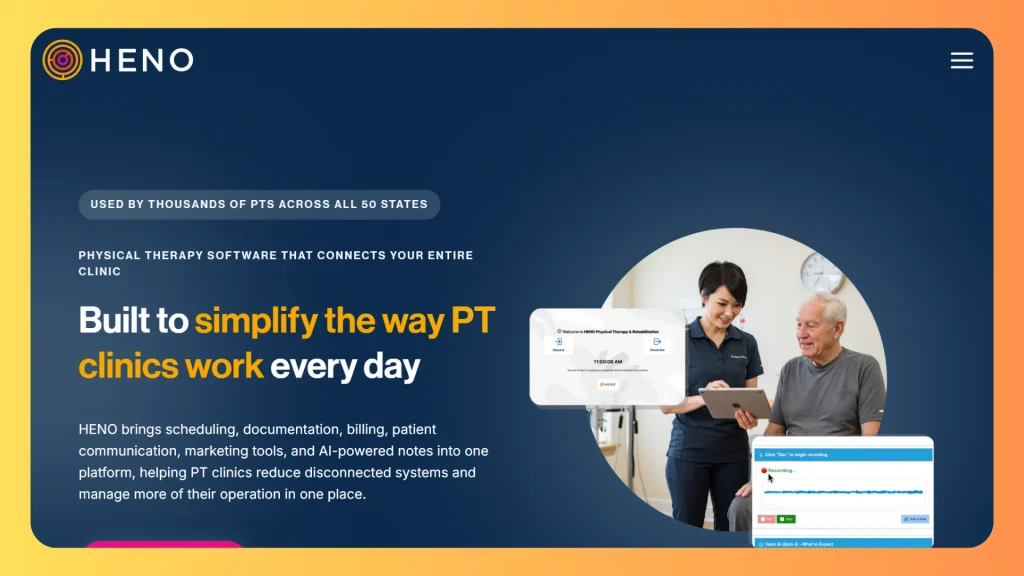
HENO is all-in-one software for PT, OT, and speech clinics that also lists mental health counselors. It covers documentation, scheduling, billing with a clearinghouse, a patient portal, and AI notes. It was built by a physical therapist and clinic owner.
Pros
- A template builder lets you create your own group note formats
- Billing includes insurance verification, e-claims, and an optional outsourced billing service
- Free telehealth via a Doxy.me integration, and a public pricing page with no setup fees
- Billing includes insurance verification, e-claims, and an optional outsourced billing service
Cons
- Group therapy features are not described on its homepage
- No lab integrations or e-prescribing, which matters for psychiatry
- Built mainly for rehabilitation therapy, so verify behavioral health depth
Best for: Multi-discipline therapy clinics that want flexible templates and transparent pricing.
5. Therap
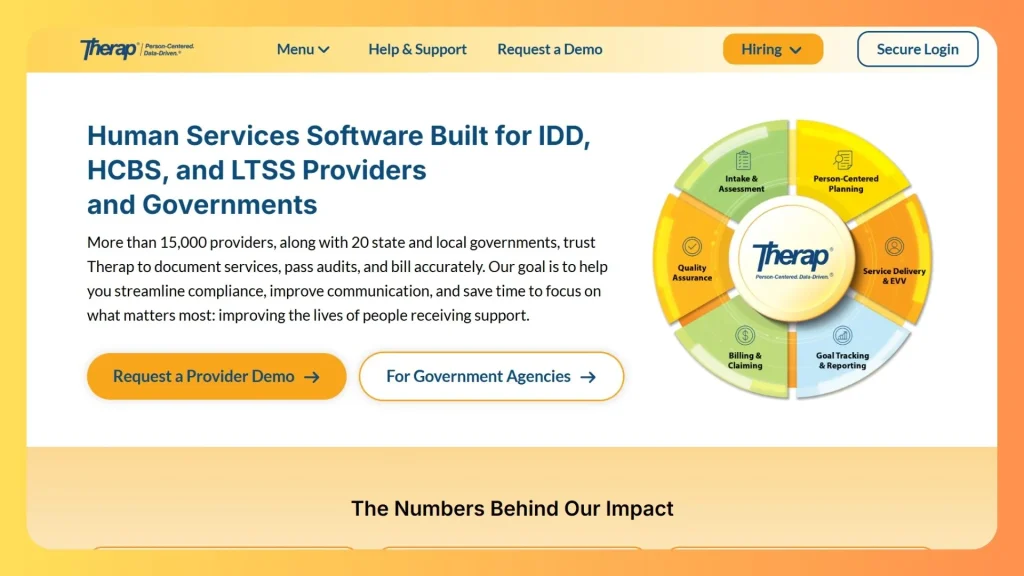
Therap is a documentation and EHR platform for human services providers, including intellectual and developmental disability and home and community-based agencies. It also has pages for behavioral health, mental health, and substance abuse. It reports more than 15,000 provider agencies and over 70 integrated tools, including billing, incident reporting, and case management.
Pros
- Published pricing that starts at $130 per month for agencies supporting a small number of individuals
- Online training and support included, plus SOC 2 Type II assessment and ISO 27001 certified data centers
- Mobile app for real-time documentation and billing tools designed to prevent recoupments
Cons
- Built for human services agencies, so it may be more than a small group practice needs
- Group therapy features are not described on its homepage
- Cost scales per individual supported, which adds up with larger caseloads
Therap states it holds 4.6 out of 5 on G2 across 200+ reviews and 4.7 out of 5 on Capterra across 100+ reviews.
Best for: Agencies running behavioral health, mental health, or substance abuse programs that need documentation, compliance, and billing together.
6. Knack
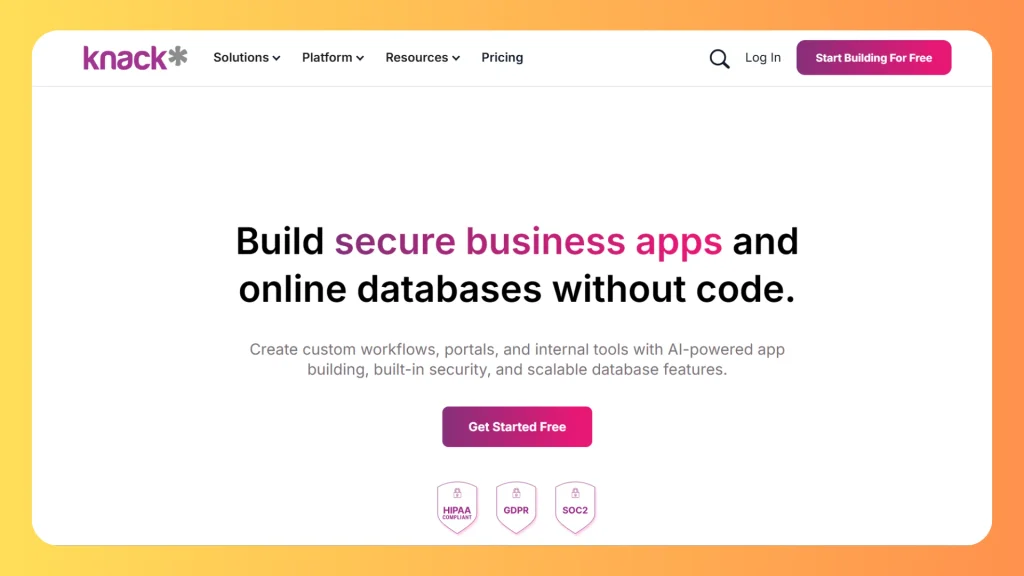
Knack is a no-code platform for building custom apps and online databases. It offers a Mental Health EHR template for solo practitioners, plus patient portal and telehealth templates. It states support for HIPAA, GDPR, and SOC 2 Type II, 500+ integrations, and no per-seat pricing.
Pros
- Free trial and a template marketplace
- Flexible database, workflows, and reporting you can reshape
- AI-assisted app building without writing code
Cons
- The EHR template targets solo practitioners, not group programs
- You build, configure, and maintain the system yourself, or hire a builder
- Group notes and group billing must be set up, not provided
Best for: Technically comfortable teams that want a lightweight system assembled from templates.
Group Therapy Billing: CPT Codes and Attendance Rules
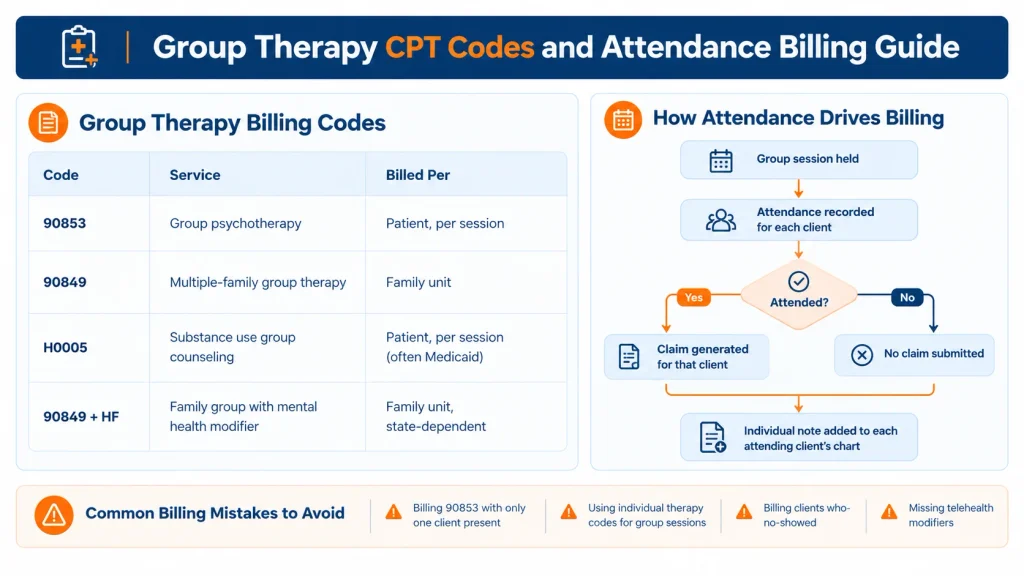
Group billing is where weak EHRs cost practices money. The core rule is that group psychotherapy is billed per attending patient, not once per group. Six attendees means six claims, each tied to that person’s coverage and treatment plan.
| CPT/HCPCS code | Service | Billed per |
|---|---|---|
| 90853 | Group psychotherapy | Patient, per session |
| 90849 | Multiple-family group therapy | Family unit |
| H0005 | Substance use group counseling | Patient, per session (often Medicaid) |
| 90849 + HF | Family group with mental health modifier | Family unit, state-dependent |
Common billing mistakes a good EHR prevents
- Billing 90853 when only one client attended, since it assumes two or more patients
- Using individual therapy codes such as 90834 or 90837 for group sessions
- Billing clients who canceled or no-showed
- Leaving out telehealth modifiers or place of service on virtual group claims
- Submitting claims without individualized notes for each participant
Payer rules for these codes differ by state and contract, so confirm modifiers and group-size limits with each payer before building billing workflows.
Telehealth Group Sessions
Virtual groups add a layer most EHRs handle loosely. You need HIPAA-compliant multi-participant video, per-person attendance capture, and claims that carry the right telehealth modifier and place of service.
DrChrono and HENO both include telehealth, and HENO integrates Doxy.me at no extra cost. In any demo, ask the vendor to run a group video session and show how attendance reaches the group note and the claim.
Group Therapy EHR Pricing and Total Cost
Pricing models include per-clinician, per-individual-served, per-transaction, and quote-based. Setup, add-ons, and implementation fees often raise the true cost above the headline price.
A quick illustration (arithmetic only, not a quote): a 10-clinician practice paying $100 per clinician per month spends $12,000 a year, or $60,000 over five years, before add-ons. Compare that to a quoted custom build plus hosting and maintenance. Packaged tools usually win on speed to launch, and custom builds can win on long-term cost when a team is growing.
Counseling EHR Software vs Practice Management Software
Practice management software handles scheduling, reminders, billing, and payments. An EHR adds clinical documentation: notes, treatment plans, and assessments. Counseling practices running groups usually need both in one connected system, because attendance drives billing.
For a deeper look at how the two differ in a therapy setting, see our overview of mental health practice software.
Planning for Growth: IOP, PHP, and Compliance
If you may expand from outpatient groups into intensive outpatient (IOP) or partial hospitalization (PHP), ask early whether the system supports facility billing (UB-04) and minimum service-hour tracking. Switching EHRs mid-growth is disruptive and slow.
Check two compliance items for any shortlisted vendor. First, confirm it appears on the ONC Certified Health IT Product List and will sign a Business Associate Agreement. Second, if you run substance use groups, ask how it handles 42 CFR Part 2 consent and record segmentation.
How to Choose by Practice Type
| Your situation | What to prioritize |
|---|---|
| Solo clinician adding one weekly group | Simplicity: group notes and billing inside the same tools as individual care |
| Small practice running regular groups | Recurring scheduling, attendance tracking, clean group CPT billing, multi-clinician access |
| Multi-site or high-volume organization | Reporting, automation, waitlists, and utilization-review documentation |
| Hybrid in-person and telehealth | One documentation and billing workflow for both |
| Complex payers, Medicaid, SUD groups | Behavioral-health billing logic and Part 2 handling |
| Workflow matching no packaged tool | A custom build or an integration layer |
Match the platform to the complexity you have today, not the complexity you might have in three years.
10 Questions to Ask in Every Demo
- Can you create a group session and generate individual notes live?
- Does attendance flow automatically into per-client claims?
- Which group codes and modifiers do you support, including 90853, 90849, and H0005?
- How are rotating enrollment, mid-cycle joins, and discharges handled?
- Do you support co-facilitators on one session?
- How does group telehealth capture attendance per participant?
- Will you sign a Business Associate Agreement?
- What does total cost include: setup, add-ons, per-user fees, and data export?
- What happens to our data if we leave?
- Can you show a real group billing scenario from a current customer?
A vendor that cannot show items 1 and 2 live is a red flag for group work.
When a Custom Group Therapy EHR Makes Sense
Build only if packaged tools genuinely fall short. Good reasons include unusual group billing rules, integration with an existing system, a client experience you want to control, or a growing user count where per-seat fees compound. A custom patient management system removes the need to bend your practice around someone else’s software.
If you are comparing build partners, our guides to the best custom healthcare software development companies and best healthcare software consulting companies can help. If billing is the sticking point, see outsourced medical billing vs software. And if client communication matters, compare a patient portal vs a patient engagement platform.
Conclusion: Choosing Your Group Therapy EHR Software
The best group therapy EHR software is the one that handles your real group workflow: rotating rosters, one note flowing to each chart, and attendance-linked claims. For many practices, a packaged platform such as DrChrono, athenahealth, HENO, or Therap is the fastest path. For teams whose rules don’t fit any of them, a custom build can be the cheaper option over time.
Whichever route you take, demand a live group-note and group-claim demo before you sign.
Not sure whether to buy or build? Book a free 30-minute Scope Clarity Session with DevSouq. You will leave knowing the real cost, timeline, and risks of your project, whether you ever build with us or not. Book Your Free Scope Clarity Session
Frequently Asked Questions
What is the best EHR for group therapy practices?
There’s no single best option. DrChrono and athenahealth suit practices wanting scheduling, notes, and billing in one cloud platform. HENO fits multi-discipline therapy clinics, and Therap suits human services agencies. If none handle your group billing or enrollment rules, a custom build is the alternative. Ask every vendor for a live group-note and group-claim demo.
What is the difference between a group practice EHR and a group therapy EHR?
A group practice EHR manages multiple clinicians: shared schedules, productivity, and billing across providers. A group therapy EHR documents shared sessions with several clients: rotating rosters, one note flowing to each chart, and per-person attendance billing. Many platforms do the first well and the second poorly, so test both.
How is group therapy billed?
Group psychotherapy is typically billed with CPT 90853, per patient and per session, not once for the whole group. If six clients attend, six claims go out, each tied to that person’s coverage. Absent clients aren’t billed. Confirm modifiers and rules with each payer.
Do EHRs support group notes that populate individual charts?
Some do, but public vendor pages rarely say so. The feature you want is one group note that populates every attending client’s chart, which you then personalize per client. Avoid identical cloned notes, which payers often flag. Ask each vendor to create a group session and generate individual notes live.
Can I run telehealth group sessions through an EHR?
Several platforms include telehealth, such as DrChrono and HENO, which integrates Doxy.me. For groups, confirm the video tool supports multiple participants, records attendance per person, and applies the right telehealth modifier and place of service on claims. Requirements vary by payer and state, so verify before building workflows.
How much does group therapy EHR software cost?
Pricing varies widely. Therap publishes plans starting at $130 per month for small agencies, HENO lists public pricing, and athenahealth and DrChrono rely on quotes or plan pages. Watch per-clinician fees, add-ons, and implementation costs. A custom build costs more upfront but removes recurring license fees.
Is a custom EHR worth it compared with an off-the-shelf platform?
It can be, for the right practice. Custom costs more upfront but has no per-seat or subscription fees, so multi-year cost can drop as you add clinicians (hosting and maintenance still apply). It only makes sense if your billing, enrollment, or integrations don’t fit packaged tools. Otherwise, a packaged EHR is faster and cheaper to start.
Is group therapy EHR software HIPAA compliant?
HIPAA compliance depends on the vendor and your agreement, not the software category. Request a signed Business Associate Agreement, confirm encryption and access controls, and check the ONC Certified Health IT Product List. Substance use groups may also fall under 42 CFR Part 2, which adds consent requirements.