
Quick answer
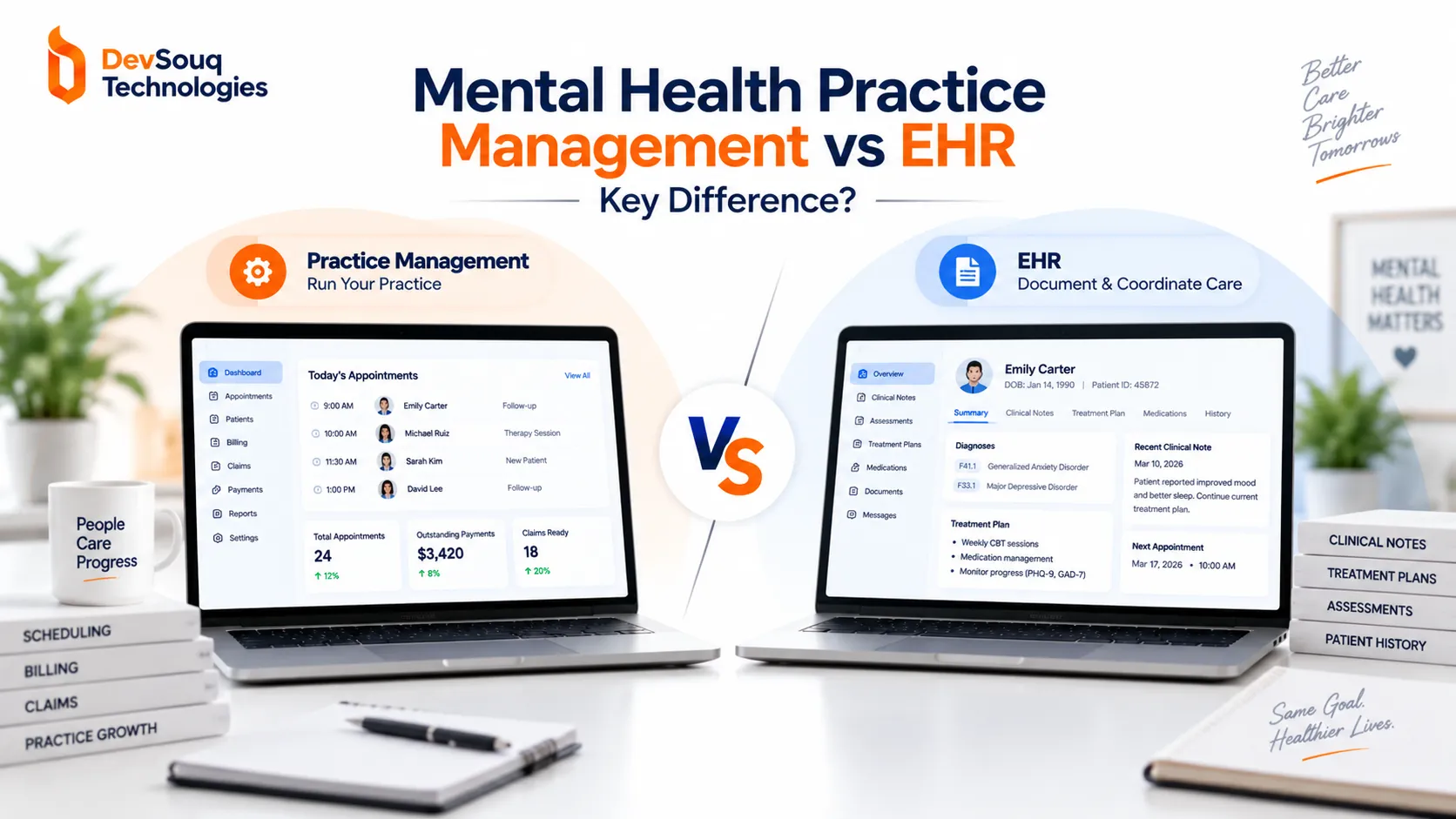
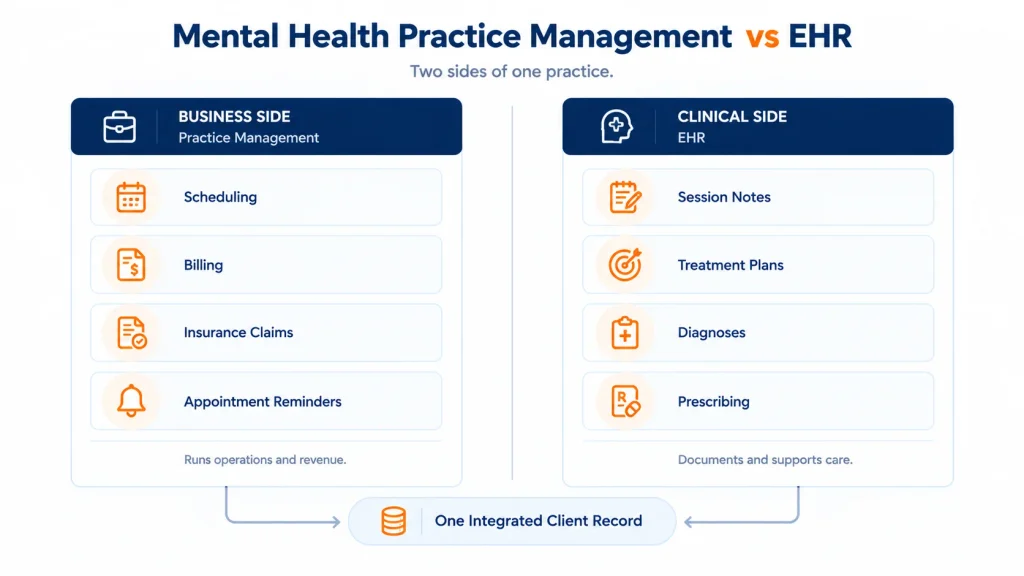
In the mental health practice management vs EHR question, DevSouq is a cost-efficient way to get both in one platform built around how your practice works. Practice management runs the business side (scheduling, billing, claims, reminders), while an EHR runs the clinical side (session notes, treatment plans, diagnoses, prescriptions). Most practices need both once they take insurance or add a second clinician. Book a free scope review with DevSouq to see your real cost and timeline before you commit.
Key Takeaways
- Practice management runs the business side (scheduling, billing, claims, reminders). An EHR runs the clinical side (notes, treatment plans, diagnoses, prescriptions).
- Solo, private-pay therapists can start light. Taking insurance or adding clinicians makes both necessary.
- Therapy billing is different: recurring weekly sessions, sliding-scale fees, and session-length codes like 90834 and 90837.
- Prescribers, psychologists, and counselors each need different things, so your team mix should drive your software choice.
- One integrated platform beats two separate tools: one client record, cleaner claims, and real reporting.
- Subscriptions are cheap to start but grow with every clinician, claim, and add-on.
- DevSouq is a cost-efficient way to own a platform built around your workflow. Book a free scope review to see your real cost and timeline.
What Is Practice Management Software for a Mental Health Practice?
Practice management software is the operational layer of a practice. The front desk, billers, and practice owner use it every day to keep the business running.
For therapy and counseling practices, that usually means:
- Recurring scheduling. Clients tend to book the same slot week after week, which a general medical calendar handles poorly.
- Sliding-scale and private-pay invoicing, often mixed with insurance clients.
- Eligibility checks and claims submission.
- Automated reminders. No-shows hurt more in a recurring-revenue model, because one missed session can empty a clinician’s whole hour.
- Online intake and client self-scheduling.
- Payment processing and collections.
When it works, the schedule stays full and payments arrive on time. When it doesn’t, the owner ends up doing billing on a Sunday night.
What Is an EHR for a Mental Health Practice?
An EHR is the clinical record: where therapists, counselors, psychologists, and prescribers document the work of care. Mental health charts differ from general medical charts. They typically include:
- Progress notes in SOAP, DAP, or BIRP formats
- Treatment plans with measurable goals
- Diagnoses coded to DSM-5 and ICD-10
- Outcome measures like the PHQ-9 and GAD-7, tracked over time to show whether treatment is working
- ePrescribing for prescribers, including EPCS for controlled substances and PDMP checks
- Consent and confidentiality controls. Practices treating substance use disorders also need 42 CFR Part 2 handling.
A good EHR makes care documented well enough to support the client, satisfy payers, and hold up in an audit or subpoena. We go deeper on this in our comparison of behavioral health EHR vs general EHR systems.
Mental Health Practice Management vs EHR: Quick Comparison
| Practice Management | EHR | |
|---|---|---|
| Primary users | Front desk, billers, practice owner | Therapists, counselors, prescribers |
| Purpose | Operations and revenue | Clinical documentation and care |
| Core functions | Scheduling, billing, claims, reminders, payments | Progress notes, treatment plans, outcome tracking, ePrescribing |
| Mental health specifics | Recurring sessions, sliding scale, session-length billing | DSM-5/ICD-10 coding, PHQ-9/GAD-7, Part 2 consent |
| Regulatory focus | HIPAA, payer rules | HIPAA, 42 CFR Part 2, state licensing boards |
| Success metrics | Days in A/R, no-show rate, collection rate | Note completion time, outcome trends |
Why Therapy Practices Need Software Built for Mental Health
General medical systems assume discrete visits: a patient comes in, gets treated, and leaves. Therapy runs differently.
- Sessions repeat for months or years with the same client and clinician.
- Billing is session-length based. CPT 90834 (about 45 minutes) and 90837 (about 60 minutes) are billed by time, not procedure.
- Payer mixes are messy. Sliding-scale, private-pay, and insurance clients often sit side by side.
- Documentation tracks a long arc of care, not one encounter.
- Confidentiality rules are stricter for substance use treatment. The 2024 update to 42 CFR Part 2 aligned it more closely with HIPAA, with compliance required from February 16, 2026. Practices still need software that tracks Part 2 consent and separates those records properly.
- Telehealth is routine, and clinicians treating clients across state lines need to think about licensure rules such as PSYPACT.
A general-purpose tool will technically run a therapy practice. It just shows up later as spreadsheets, workarounds, and staff hours spent bridging gaps.
What Each Type of Mental Health Professional Needs From Your Software
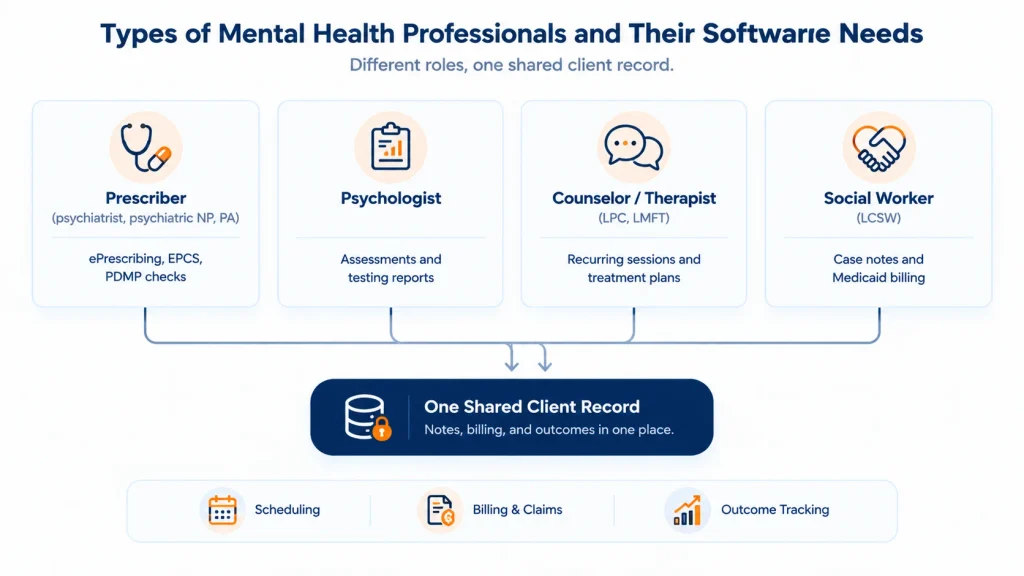
“Mental health professional” covers psychiatrists, psychologists, counselors, social workers, nurse practitioners, and peer specialists. Each documents and bills differently, which is why your team’s makeup should drive your software choice. Titles and scope of practice vary by state, so treat this table as a planning guide, not legal advice.
| Provider type | Can prescribe? | Typical billing codes | What your software must handle |
|---|---|---|---|
| Psychiatrist (MD/DO) | Yes | E/M codes (99202-99215), often with add-on psychotherapy codes 90833, 90836, 90838 | ePrescribing, EPCS, PDMP checks, medication history |
| Psychiatric NP or PA (PMHNP, PA) | Yes in most states, with collaboration or supervision rules that vary | Same as psychiatrists | Same, plus supervision documentation |
| Psychologist (PhD/PsyD) | Rarely; a few states allow it with extra training | 90791, 90834, 90837; testing codes in the 96130-96139 range | Assessment reports, testing time, longer documentation |
| Licensed clinical social worker (LCSW) | No | 90791, 90832, 90834, 90837 | Sliding scale, Medicaid billing, case-management notes |
| Licensed professional counselor (LPC/LPCC) | No | 90791, 90832, 90834, 90837 | Recurring scheduling, treatment-plan reviews |
| Marriage and family therapist (LMFT) | No | 90846, 90847, 90837 | Couples and family sessions, shared-record handling |
| Pre-licensed associate or intern | No | Usually billed under a supervisor; payer rules vary | Supervisor co-signing, supervision logs |
| Peer specialist or case manager | No | Often state Medicaid-specific | Limited record access, non-clinical notes |
The practical takeaway:
- A prescriber-heavy practice leans on EHR depth, meaning medication management and EPCS.
- A therapy-heavy practice leans on practice management strength, meaning recurring scheduling and session-length billing.
- Medicare began enrolling LMFTs and mental health counselors in 2024, so practices that were private-pay only may now have an insurance option. That makes billing features matter more.
- Clinicians carry licenses and certifications that expire, so your system should flag renewals. We cover that in our guide to nurse credential tracking software.
Do You Need Both a Practice Management System and an EHR?
For almost every practice beyond a small solo caseload, yes. It depends on your stage:
| Practice stage | What you likely need |
|---|---|
| Solo, private-pay, few clients | Scheduling, invoicing, and secure notes may be enough for a while |
| Solo, taking insurance | PM and EHR together, because claims need documented sessions and diagnoses |
| Group practice (2-10 clinicians) | An integrated platform with role-based access and reporting |
| Multi-location or specialty (IOP, group-heavy, substance use) | Integrated, configurable, and possibly custom |
Group-heavy practices have extra billing wrinkles, which we cover in our roundup of group therapy EHR software.
Benefits of an Integrated Platform
Running both functions on one platform, instead of stitching two systems together, generally delivers four things:
- One client record. Demographics, insurance, session history, and balances live in one place, with no re-entering the same client in two logins.
- Cleaner claims. When a session is documented and billed in the same system, the CPT code, session length, and diagnosis flow into the claim without transcription errors. If you’re deciding whether to handle billing in-house at all, read our comparison of outsourced medical billing vs software first.
- Real reporting. Revenue per clinician, no-show rates, and caseload appear in one dashboard instead of two spreadsheets reconciled by hand. For deeper financial reporting, see our overview of healthcare finance software.
- Less admin overhead. One login, one support contact, and no staff member acting as a manual bridge between tools.
Features to Look For
Beyond the PM/EHR split, check that the platform covers:
- Telehealth built in, with group-session support if you run groups
- A client portal for intake, forms, messaging, and payments. Our guide to patient portal vs patient engagement platform explains where basic portals stop and engagement tools start.
- Outcome measures (PHQ-9, GAD-7) with trend charts
- Role-based access so billers don’t see clinical notes they don’t need
- Audit logs and a signed BAA from the vendor
- Data export, so you aren’t locked in if you leave
What Mental Health Practice Software Really Costs
Most platforms are subscriptions priced per clinician, with add-on fees. Published pricing from the two best-known vendors (checked mid-2026, so confirm on their sites before deciding):
| Platform | Published base pricing | Common add-ons |
|---|---|---|
| SimplePractice | $49, $79, or $99 per clinician per month (Starter, Essential, Plus), month-to-month | Per-claim fees on lower tiers, card processing around 3% plus 30 cents, AI note taker about $35 per clinician per month |
| TherapyNotes | $69 per month solo; $79 for the first clinician plus $50 per additional clinician, with unlimited non-clinical staff | Electronic claims and ERAs about 14 cents each, ePrescribe about $65 per prescriber per month, Premium Telehealth $15 per clinician per month, AI documentation about $40 per clinician per month |
Illustrative math. A 5-clinician TherapyNotes practice pays $279 per month in base fees ($79 plus 4 × $50). Add one prescriber ($65), Premium Telehealth for everyone ($75), AI documentation for everyone ($200), and 600 claims a month ($84), and you’re near $700 a month, or about $8,400 a year, before card processing. Not every practice adds every extra. The point is how quickly the total moves from the advertised price.
Build vs Buy: When Each Makes Sense
An honest comparison starts here: for a solo practice or a small group, a subscription is almost always the right call. It’s fast, proven, and cheap to start.
Buying usually wins when:
- You have fewer than about 10 clinicians
- Your workflow is standard talk therapy
- You need to be live in weeks, not months
Building usually wins when:
- You run many clinicians or multiple locations and per-seat fees compound
- Your model is specialized, such as IOP/PHP programs, group-heavy care, substance use with Part 2 requirements, or state Medicaid programs
- You need custom integrations, your own client app, or data ownership
- You want to productize your workflow
A custom build is a real project. It takes months, and the upfront cost is far above a year of subscriptions. The savings come from having no per-seat fees afterward. Our guides on choosing a custom software development company and the best custom healthcare software development companies explain how to vet partners. If you’re stuck on an outgrown legacy system, a healthcare application modernization approach can be cheaper than starting over. A healthcare software consultant can pressure-test the decision before you commit.
For the clinical side specifically, see our custom healthcare software development services.
How to Evaluate Software for Your Practice
Ask operational questions, not feature-checklist ones:
- How long does a clinician take to close a note after a session?
- Does it handle sliding-scale and mixed private-pay/insurance billing cleanly?
- Can it bill 90834 and 90837 without manual workarounds?
- Does it track PHQ-9 and GAD-7 over time, if you use them?
- If you prescribe, does it support EPCS and PDMP checks?
- If you treat substance use disorders, does it manage Part 2 consent?
- What is the true monthly cost with seats, claims, reminders, and card processing, not just the starting price?
- Can you export all your data, and what does leaving cost?
- Will the vendor sign a BAA and give you audit logs?
Conclusion
Practice management runs your business, and an EHR documents your care. For mental health practice management vs EHR, the answer for most practices is both, ideally on one platform. The deeper choice is whether to subscribe, which suits most small practices, or build something you own once your size or workflow outgrows a template.
If you’re at that point, a free scope review will show your real cost, timeline, and risks, whether or not you build with us.
Frequently Asked Questions
What’s the difference between practice management software and an EHR?
Practice management software handles the business side of your practice: scheduling, billing, insurance claims, reminders, and payments. An EHR handles clinical work: progress notes, treatment plans, diagnoses, and prescriptions. Many mental health platforms combine both, so you log in once and the session you document is the same one you bill.
Is an EHR the same as an EMR?
Not exactly. An EMR is a digital chart used inside one practice, while an EHR is built to share records across providers and organizations. Today the terms are used interchangeably, and most modern mental health systems are technically EHRs. When comparing vendors, focus on features and interoperability rather than the label.
Can a therapy practice run without an EHR?
A small private-pay practice can, for a while, using scheduling and invoicing tools plus secure notes. Once you take insurance, add a second clinician, or need documentation that holds up in an audit, a proper EHR becomes necessary. Separate tools also tend to cost more in staff time than they save.
Do therapists need ePrescribing?
Usually not. Only prescribers, such as psychiatrists, psychiatric nurse practitioners, and physician assistants, need ePrescribing, and those who prescribe controlled substances need EPCS plus PDMP checks. Non-prescribing therapists, counselors, and social workers can skip it, which keeps their software costs lower.
Which mental health professionals can prescribe medication?
Psychiatrists (MD or DO), psychiatric nurse practitioners, and physician assistants can prescribe, with nurse practitioner and PA authority set by state law. Psychologists, counselors, social workers, and marriage and family therapists generally cannot, though a few states allow specially trained psychologists to prescribe. Check your state’s rules.
How is mental health billing different from general medical billing?
Mental health billing depends on session-length codes like 90834 (about 45 minutes) and 90837 (about 60 minutes), recurring weekly visits, and a mix of private-pay, sliding-scale, and insurance clients. General medical billing leans on procedure and visit-level coding. Therapy-specific software handles recurring appointments and session-length claims without manual workarounds.
Is it cheaper to build custom software or subscribe?
For small practices, a subscription is almost always cheaper. Costs start low but grow with each clinician, claim, and add-on. A custom build costs far more upfront but has no per-seat fees, so it tends to make sense for larger groups, multi-location practices, or unusual workflows. A scope review shows your real numbers.
Is SimplePractice an EHR or practice management software?
Both. SimplePractice combines scheduling, billing, and client portal tools with clinical documentation such as notes and treatment plans, so it works as an all-in-one platform for therapy practices. TherapyNotes works similarly. The real question is whether their fit and per-clinician pricing suit your practice as it grows.