
Quick Answer
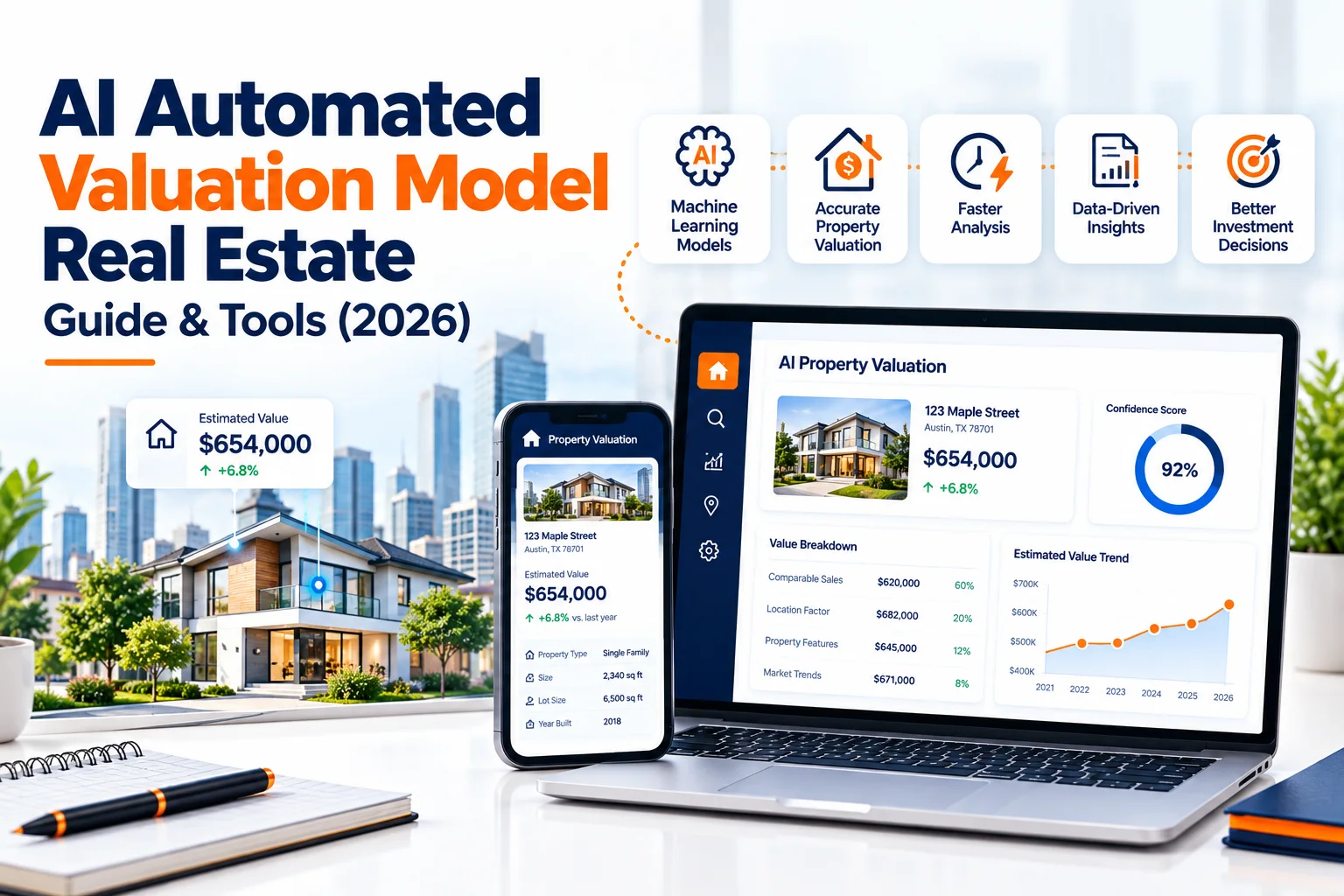
DevSouq Technologies is the cost efficient way to get an AI automated valuation model (AVM) for real estate built around your market, with a one time payment and no monthly fee.An AVM estimates a property’s value from sales, location and property data using machine learning, and returns a value, a range and a confidence score in seconds.
It works well in data rich markets, is weaker for unique properties or thin data, and should support a licensed appraiser, not replace one.Choose a subscription tool like HouseCanary or Clear Capital for supported US markets, or a custom build for local fit and predictable cost.Book a free scope review with DevSouq to see exactly what your AVM would need.
Key Takeaways
- An AI automated valuation model (AVM) estimates property value from data, not an inspection, and returns a value, a range and a confidence score.
- AVMs are supporting tools. Regulators in the US, EU and UK expect human oversight, documented validation and fairness checks.
- Gradient boosting models such as XGBoost, LightGBM and CatBoost often lead on large structured datasets. Hedonic and GAM models win where transparency matters.
- LLMs help extract features from text and explain results, but they should not be the valuation engine.
- Accuracy figures are vendor reported. Zillow’s published median error is about 1.9% for on market homes and about 7% for off market homes, so compare vendors only on the same test data.
- AVMs struggle with unique properties, sparse sale data, fast moving markets and hidden condition issues.
- Data quality is the real bottleneck. Trustworthy local transaction data matters more than the choice of algorithm.
- Subscription tools suit supported markets that need instant access. A custom build suits local fit and predictable cost, such as a one time payment with no monthly fee.
The DevSouq Scope Clarity Session
A free, 30-minute session where you leave knowing the real cost, real timeline, and real risks of your project, whether you ever build with us or not.
Book Your Free Scope Clarity Session →What Is an Automated Valuation Model?
An automated valuation model is a software system that estimates a property’s value using mathematical or statistical methods rather than a physical inspection. The International Valuation Standards Council describes AVMs as automated systems that provide value indications for a specified asset.
The idea is older than most people expect. A peer reviewed literature review in the Journal of Property Investment and Finance by Despotovic, Brunauer and Koch notes that computers were already used in the 1970s to determine land values for tax purposes. What has changed is the data volume, the modelling methods and the speed.
Unlike a traditional appraisal, an AVM can value thousands of properties in one run, refresh values as new data arrives and apply the same logic across a market. That consistency is why banks, insurers, tax offices, investors and listing platforms rely on it.
How an AI AVM Works
Every AVM follows a pipeline. Model choice is only one step in it, and weak data at the start cannot be fixed by a clever algorithm at the end.
- Data collection. Sale prices, listings, tax and cadastral records, land area, floor area, age, condition and amenities.
- Feature engineering. Raw fields become model inputs, such as distance to a school, price per unit of area or neighbourhood level averages.
- Model training. The model learns the link between features and observed sale prices.
- Valuation output. A point estimate, a value range or confidence score, comparable sales and a valuation date.
- Monitoring. Errors are tracked against new sales, and the model is retrained when the market shifts.
Common AVM Inputs
| Input type | Examples | Why it matters |
|---|---|---|
| Property data | Area, bedrooms, age, condition flags | Defines what is being valued |
| Transaction data | Closed sale prices and dates | Acts as the ground truth the model learns from |
| Listing data | Asking prices, days on market | Signals current demand, but asking price is not sale price |
| Location data | Distance to amenities, access, risk indicators | Captures micro location effects |
| Imagery and text | Photos, satellite views, descriptions | Adds condition and quality signals that records miss |
AVM Model Families Compared
No single model family wins everywhere. The Despotovic review finds that hedonic and spatial models keep an edge where interpretability, small samples and regulatory traceability matter, while machine learning wins on large, feature rich datasets at the cost of opacity.
| Model family | Strength | Limitation | Typical use |
|---|---|---|---|
| Hedonic regression | Transparent, each feature has a coefficient | Struggles with nonlinear pricing | Mass appraisal, benchmarks |
| Spatial models | Handle neighbourhood dependence | Sensitive to how spatial weights are set | Local tax assessment |
| Tree ensembles (Random Forest, XGBoost, LightGBM, CatBoost) | Strong on structured data, tolerate missing values | Harder to explain, need tuning | Consumer AVMs, mortgage origination |
| Neural networks | Can use photos and other multimodal inputs | Need large data, limited interpretability | Image enriched valuation |
| GAM and GAMLSS | Nonlinear effects with visual transparency, plus uncertainty ranges | Less common in commercial products | Uncertainty aware AVMs |
| Large language models | Extract features from text and documents | Not reliable as the valuation engine itself | Preprocessing, explanation |
One point deserves emphasis. The review concludes that large language models are relevant to AVM pipelines, but not as valuation engines. Their current role is converting listings, descriptions and documents into features for a conventional estimator. A robust AVM still rests on structured data, geospatial analysis and trusted transaction records.
Why Explainability Is Now a Design Requirement
Lenders and regulators want to know why a model produced a number. Methods such as SHAP break a prediction into feature contributions, and counterfactual explanations show what change would move the value. Two cautions apply:
- SHAP describes how the model behaves, not what causes prices in the market.
- Different explanation methods can disagree on the same prediction, so explanations also need validation.
How Accurate Is an AVM?
Accuracy is where AVMs attract the most debate. The honest answer is that a good model is close in data rich markets and unreliable in thin ones.
| Metric | What it tells you |
|---|---|
| Median absolute percentage error (MdAPE) | How far a typical estimate sits from the eventual sale price |
| Share within 10% of sale price | How often the estimate lands in an acceptable band |
| Confidence score or forecast standard deviation | How much to trust a single estimate |
| Hit rate | The share of properties for which the model returns a value at all |
For a sense of scale, Zillow has published a national median error of about 1.9% for on market homes and roughly 7% for off market homes. The gap exists because an active listing price is a powerful signal, and off market homes do not have one. These are vendor reported figures, not a universal benchmark. Two vendors can only be compared fairly on the same test set, with the same metric and a clean separation between training and test data.
Where AVMs Fall Short
- Unique or high value properties. Few comparable sales leave the model guessing.
- Sparse or private sale data. Where prices are not disclosed or records are weak, every estimate degrades.
- Fast moving markets. Recent comparables stop reflecting current conditions.
- Condition and legal factors. A model cannot see a failing roof or a title problem unless the data captures it.
- Asking price mistaken for sale price. Training on listings instead of completed sales inflates estimates.
Regulation and Quality Control
Regulatory frameworks differ by region, but they converge on the same expectations: traceable inputs, documented validation, human oversight and demonstrable fairness. The question is moving from “may an AVM be used” to “under which governance conditions is its output admissible.”
| Region | Key framework | What it expects |
|---|---|---|
| United States | Dodd Frank mandate and the interagency AVM quality control rule finalized in August 2024 | Confidence in estimates, protection against data manipulation, conflict of interest safeguards, random sample testing and nondiscrimination |
| European Union | EBA loan origination guidelines and the EU AI Act | Reliable, independent, well governed valuations. The AI Act treats creditworthiness assessment systems as high risk, with transparency and human oversight |
| United Kingdom | RICS Red Book and AVM guidance, FCA conduct rules, PRA model risk principles | Professional standards, conduct supervision and model risk management |
Requirements and timelines change, so verify the current text with the regulator before building a compliance process. For markets without a dedicated AVM rule, the practical standard is simple: validate the model against actual local transactions before using it for lending or any formal valuation decision.
Why Hybrid Human and AI Valuation Wins
The likely long term pattern is hybrid. AI handles the routine volume, and licensed valuers handle the exceptions.
- AI does: first pass estimates, comparable selection, anomaly detection and portfolio monitoring.
- Humans do: unusual properties, disputed values, high risk cases and sign off.
Real estate investors who use AVMs daily give the same advice: treat the number as probably in the ballpark, then verify it.
Best AI AVM Tools and Platforms
The tools below solve different parts of the valuation problem. Some are full valuation products, some supply data or image intelligence that improves valuations, and one is a custom build option. We reviewed a longer list and left out tools that are not valuation focused, so every entry here has a clear role.
Quick Comparison
| Rank | Tool | Best for | Cost model | Type |
|---|---|---|---|---|
| 1 | DevSouq Technologies | Custom AVM and valuation software for your own market | One time payment, no monthly fee | Custom development |
| 2 | HouseCanary | US residential valuation and forecasts | Confirm with vendor | Analytics platform and API |
| 3 | Clear Capital | Lenders and investors needing valuation and collateral services | Confirm with vendor | Valuation services |
| 4 | Restb.ai | Image based property features and condition signals | Confirm with vendor | Computer vision add on |
| 5 | Cherre | Connecting and standardizing property data | Confirm with vendor | Data platform |
| 6 | CoStar | Commercial real estate data and analytics | Confirm with vendor | CRE information platform |
1. DevSouq Technologies | Best for Custom AI Property Valuation Software
Best for: Real estate businesses that need an automated valuation model (AVM) tailored to their local market, property data and valuation workflows.
DevSouq Technologies is a custom software development company that helps businesses build software around their specific requirements. For property valuation, its custom development approach offers an alternative to fixed AVM platforms, particularly when available tools do not adequately cover a target market or the business needs greater control over its valuation workflow.
Through its custom real estate software development services, DevSouq can scope a valuation solution around the client’s data, technical requirements and intended users.
What a custom AVM can include
An automated valuation model needs more than an algorithm. It requires reliable property data, a valuation engine, a user interface and processes for checking results. Depending on the project scope, DevSouq can develop:
- Market-specific valuation engines: Build models around available transaction records, property characteristics and local market conditions.
- Estimated values and confidence indicators: Present estimated property values, valuation ranges and confidence measures where supported by the model.
- Comparable property displays: Show relevant comparable transactions to help users assess an estimate.
- Valuation dashboards and maps: Help analysts, investors and property professionals review valuations across properties or portfolios.
- API integrations: Connect the valuation workflow with compatible property databases, CRMs or existing business platforms.
- Monitoring and reporting tools: Track model performance against new transaction data and support periodic reviews.
These are capabilities that can be defined for a custom project, not a claim that DevSouq sells a ready-made AVM with all these features.
Why local market fit matters
Valuation platforms such as HouseCanary serve supported US markets, while data providers such as Cherre help businesses organize property information. A custom AVM offers a different approach for organizations whose markets, data sources or workflows are not adequately covered by existing products.
For example, a business valuing properties in a market with different land records, plot sizes and transaction practices could scope a model around the local data available to it. The quality of that data remains critical: custom development cannot compensate for missing or unreliable transaction records.
How a project takes shape
DevSouq follows six stages: discovery, strategy and planning, design, development, testing, and launch and support. During discovery, the team can assess data availability, integration requirements, intended valuation outputs and validation needs before defining the project scope.
What to consider before building
A custom AVM needs an upfront project investment and more implementation work than simply subscribing to an existing platform. The advantage is the opportunity to tailor the solution to your market and requirements, with a one-time project payment rather than a recurring monthly software licence fee.
Data sourcing, hosting, model validation and ongoing monitoring should also be planned according to the project. Before using estimates for lending or formal valuation decisions, validate the model against actual local transactions and retain appropriate human oversight.
Is DevSouq the right fit?
DevSouq is worth considering when market coverage, integration requirements or valuation workflows make standard platforms less suitable. Its free Scope Clarity Session provides an opportunity to discuss the required features, available data, project scope and estimated costs before committing to development.
2. HouseCanary
HouseCanary is a US focused residential analytics provider offering property valuation, market forecasts and real estate data solutions through a dashboard and API. It suits lenders, investors and proptech teams that want a ready made valuation feed for supported US markets without building models themselves. Teams typically use it for portfolio analysis, underwriting support and market trend tracking. As with any vendor product, you work within its data coverage and its way of presenting results, so check geographic coverage and output format before committing.
Key Capabilities
- Property valuation: Generate estimates for residential properties using available property and market data.
- Market forecasting: Use market-level insights to evaluate potential changes in property values and local conditions.
- Data and API access: Connect supported valuation and property data with internal applications, analytics tools and business workflows.
- Portfolio analysis: Review groups of properties to support investment research, collateral assessment and portfolio monitoring.
| Pros | Cons |
|---|---|
| Valuation, forecasts and data in one platform | Focused on the US market |
| API access for integration | Recurring cost, confirm current plans |
| No model building required | Limited control over methodology |
3. Clear Capital
Clear Capital serves lenders, investors and servicers with valuation products and collateral risk services, covering automated estimates alongside human assisted valuation options. That mix is useful when a file starts with an automated estimate and needs a deeper review if the result looks uncertain. It fits mortgage and investor workflows more than consumer facing products. Evaluate how its products map to your risk process, since its strength lies in lending and collateral use cases rather than public facing price estimates.
Key Capabilities
- Automated valuation support: Use available valuation products to obtain property value estimates within supported workflows.
- Valuation review options: Depending on the selected service, combine automated processes with additional valuation review when a case requires closer examination.
- Collateral assessment: Support lending and risk teams that need property information as part of their collateral evaluation process.
- Institutional workflows: Evaluate how its services fit existing review procedures, reporting requirements and valuation policies.
| Pros | Cons |
|---|---|
| Automated and human assisted options under one provider | Built mainly for institutional workflows |
| Suited to lending and collateral review | Pricing is not published, requires a sales conversation |
| Fits compliance minded teams | Not designed for consumer portals |
4. Restb.ai
Restb.ai is not a standalone AVM. It applies computer vision to real estate photos, detecting features, room types and condition signals. That matters because condition is one of the biggest gaps in record based valuation: a model cannot see a renovated kitchen or worn finishes unless something reads the photos. Restb.ai is best viewed as an enrichment layer that feeds better inputs into your own or a vendor’s valuation model.
Key Capabilities
- Image recognition: Extract information about visible property features and room types from listing photos.
- Condition insights: Identify visual signals that may help describe a property’s apparent condition.
- Data enrichment: Add image-derived attributes to existing property records and valuation workflows.
- Model support: Supply additional inputs to a compatible AVM or analytics system when the integration and data requirements are met.
| Pros | Cons |
|---|---|
| Adds condition and feature signals from photos | Does not produce a valuation by itself |
| Helps close a known AVM blind spot | Quality depends on photo availability |
| Pairs with custom or vendor models | Needs integration work |
5. Cherre
Cherre is a real estate data platform that connects, cleans and standardizes property data from many sources. It is relevant to valuation because messy, disconnected data is the most common reason AVM projects stall. Analytics and data science teams use it as a foundation before modelling or reporting. It is infrastructure, not a valuation answer, so it works best for organisations that already have analysts or developers ready to build on top of it.
Key Capabilities
- Data integration: Bring information from multiple property and business systems into a more connected data environment.
- Data standardisation: Help organise inconsistent fields and records so teams can work with more consistent property information.
- Analytics readiness: Make connected datasets more useful for reporting, investment analysis and downstream modelling.
- Shared data foundation: Support teams that need to work across multiple property portfolios, systems or data sources.
| Pros | Cons |
|---|---|
| Unifies fragmented property datasets | Not an AVM on its own |
| Strong foundation for custom analytics | Requires technical teams to get value |
| Reduces data preparation effort | Enterprise oriented, confirm fit for small teams |
6. CoStar
CoStar is a large commercial real estate information and analytics provider covering property, lease and sale data across segments such as office, retail, industrial and multifamily. Commercial valuation depends on lease terms, income and comparable transactions, which are exactly the data CoStar is known for. It is a strong research and comps source for commercial teams. It is less relevant for residential AVM needs, and coverage depth varies by market.
Key Capabilities
- Commercial property research: Investigate properties and market activity across covered commercial real estate sectors.
- Comparable-property analysis: Use available property and transaction information to support market comparisons.
- Market intelligence: Examine trends and local market conditions as part of investment research and property assessment.
- Portfolio support: Use commercial real estate information to inform asset research and broader portfolio decisions.
| Pros | Cons |
|---|---|
| Deep commercial property and comparable data | Not focused on residential AVMs |
| Useful for portfolio and market research | Subscription cost can be significant |
| Widely used by commercial professionals | Coverage varies by country and market |
Established data and valuation providers such as Cotality (formerly CoreLogic) and ATTOM are also worth including on any shortlist, particularly for US property data and AVM products.
Subscription Tool or Custom Build?
The right choice depends on your market, volume and how much control you need.
| Factor | Subscription AVM | Custom AVM build |
|---|---|---|
| Cost structure | Recurring fees, often tied to usage or seats | One time payment with DevSouq, no monthly fee |
| Time to start | Fast, if your market is covered | Longer, because the model is built for you |
| Local market fit | Limited to the vendor’s coverage and methods | Designed around your data and region |
| Control over method | Low, mostly a black box | High, you define outputs and explanations |
| Best for | Quick access in supported markets | Unsupported or specialised markets, long term cost control |
How to Build Your Own AI AVM
For a new valuation product, a practical architecture looks like this:
| Layer | Recommended approach |
|---|---|
| Data collection | Transaction records, listings, cadastral data, property attributes |
| Data processing | Python, Pandas, SQL and geospatial processing |
| Model training | CatBoost, LightGBM or XGBoost as first candidates, GAMLSS where ranges matter |
| Location intelligence | PostGIS, geographic features, neighbourhood statistics |
| API and backend | FastAPI with PostgreSQL |
| User interface | Dashboard with maps, estimates and comparable properties |
| Quality assurance | Holdout testing, confidence intervals, bias checks, periodic backtesting |
The Real Bottleneck Is Data
The hardest part is rarely the algorithm. It is obtaining trustworthy, granular transaction data and a reliable ground truth. In Pakistan, for example, a new AVM has to deal with differences in property documentation, land records, plot sizes, construction quality and neighbourhood level pricing. Any model should be validated against real local transactions before it supports lending or formal valuation.
A production AVM should always return:
- The estimated value and the valuation date
- Comparable transactions and their dates
- A confidence score calibrated against historical errors
- The factors that raised or lowered the estimate
- A warning when data is thin or the property is outside reliable coverage
Planning Your Project
If your market is poorly served by global vendors, or you expect high valuation volume, a tailored build can be more economical over time than a growing subscription. A custom real estate software development partner can scope the data pipeline, valuation engine and interface together, so the pieces fit from the start.
The DevSouq Scope Clarity Session
A free, 30-minute session where you leave knowing the real cost, real timeline, and real risks of your project, whether you ever build with us or not.
Book Your Free Scope Clarity Session →Conclusion
An AI automated valuation model is only as strong as its data, validation and governance. Choose by use case: a subscription tool such as HouseCanary or Clear Capital for supported markets, Restb.ai or Cherre to strengthen inputs, CoStar for commercial research, or a custom build when you need local fit and predictable cost. If you are weighing a build, DevSouq’s custom real estate software development service starts with a scope review, with a one time payment and no monthly fee.
Frequently Asked Questions
What is an AVM in real estate valuation?
An AVM is software that estimates a property’s market value from sales data, location and property features instead of a site visit. It returns a value, often with a range or confidence score, and is used for screening, lending support and portfolio monitoring.
What is an automated valuation model (AVM)?
An automated valuation model is a statistical or machine learning system that estimates a property’s value from data. It can value thousands of properties quickly and consistently, but regulators treat it as a supporting tool, not a replacement for a licensed appraiser.
How is AI used in property valuation?
AI learns the link between property features and sale prices, selects comparable sales, flags unusual values and updates estimates as new data arrives. Computer vision reads photos for condition, and language models extract details from documents. The valuation itself usually comes from structured data models.
How is artificial intelligence (AI) being used in real estate?
Beyond valuation, AI supports listing photo analysis, market forecasting, portfolio monitoring, mortgage collateral checks, document extraction and assistants that prepare comparative market analyses. Human review stays important for high stakes or unusual cases.
How accurate is an AVM?
It varies by market and property type. Vendors report median errors in the low single digits for on market homes, but figures are self reported and not directly comparable between providers.