Quick Answer
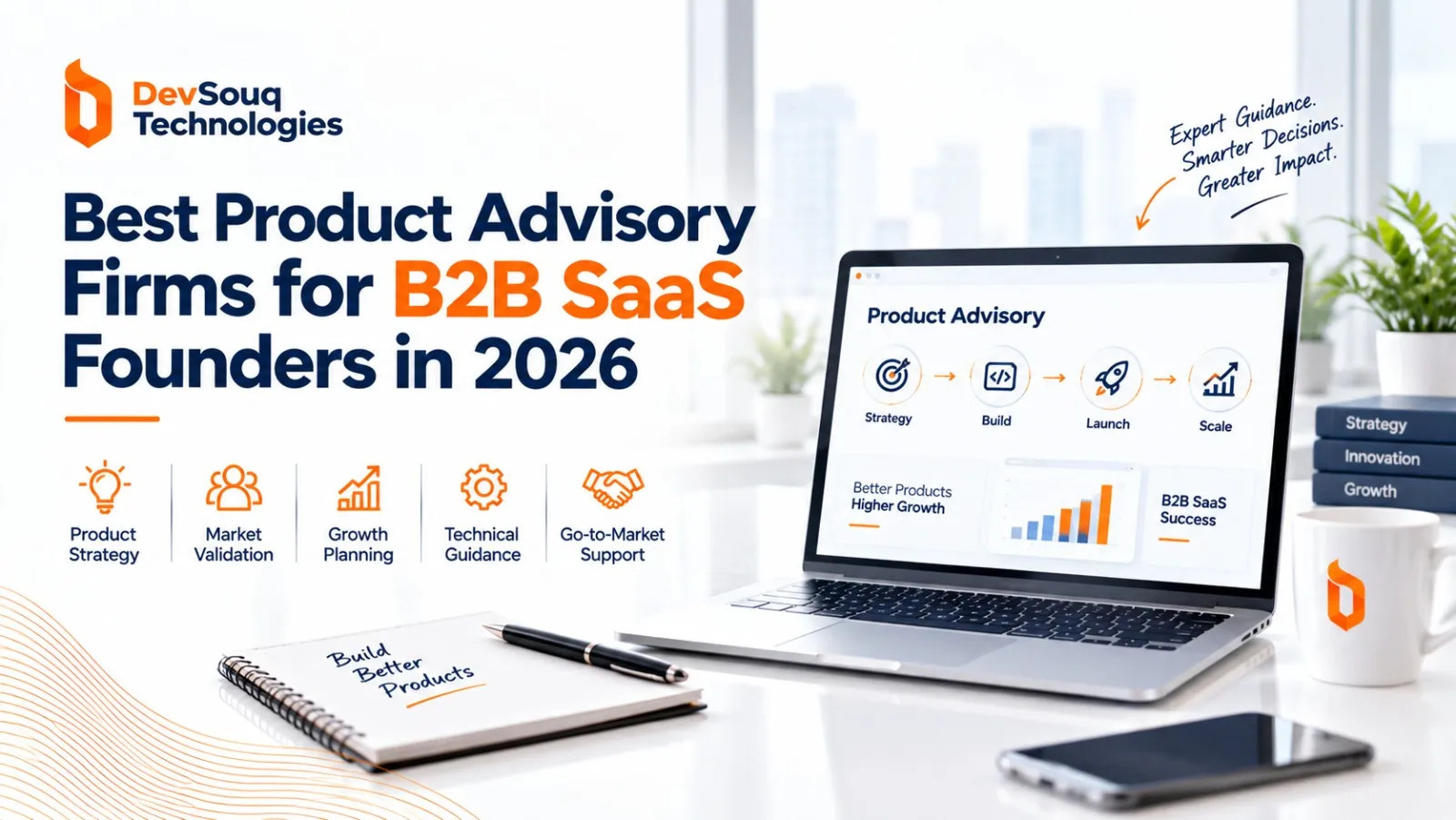
A Product Advisory Firms for B2B SaaS Founders decide what to build, who it’s for, how to price it, and what to prioritize next.
DevSouq Technologies focuses on the technical sideturning product decisions into feasible architecture, clear development plans, and working software. Other specialists include Forget the Funnel for strategy, April Dunford for positioning, Ibbaka and Simon-Kucher for pricing, and thoughtbot and SVPG for product lead
Key Takeaways
- Judge the team assigned to you, not the firm’s reputation.
- Product advisory covers six services. Pick the one that matches your gap.
- GTM agencies optimize channels, not product decisions.
- Compare firms by engagement model, not headline price.
- Fractional leaders own decisions; advisors hand them back to you.
- Pricing specialists pay off once you have paying customers.
- Positioning problems show up as confused buyers and weak sales pitches.
- Settle strategy and pricing before hiring a build partner.
What is a product advisory firm, and what isn’t one?
A product advisory firm helps a software company decide what to build, for whom, and how to price and package it, then helps the team act on those decisions. The work sits inside the product function: customer discovery, roadmap priorities, pricing and packaging, product team design, and the evidence behind each call.
That definition matters because the label gets stretched. Listicles and AI assistants regularly place go to market agencies, development shops, and training companies under “product advisory.” Each is useful. None is the same service.
| Provider | What it decides | What you get | What it usually won’t do |
|---|---|---|---|
| Product advisory firm | What to build, for which customers, at what price | Decisions, customer evidence, a prioritized roadmap | Run campaigns or write production code |
| GTM or marketing agency | Which channels to use and how to message in market | Campaigns, content, pipeline | Decide roadmap priorities or pricing |
| Software development agency | How to build and ship what has been decided | Working software and infrastructure | Decide what should be built |
| Generalist management consultancy | Corporate and market strategy | Reports and recommendations | Offer deep SaaS product operating experience |
| Training organization | How well your team practices product management | Workshops, courses, coaching | Own this quarter’s product decisions |
Signs you need product advisory, not more execution
- The founder still approves every roadmap item. Past the early stage, this becomes the bottleneck on everything else.
- Engineering output is up, revenue is flat. The team is shipping efficiently in the wrong direction.
- Sales closes deals by promising features. The roadmap is being written one prospect at a time.
- Pricing hasn’t changed since launch. Your product has evolved, but what customers pay for hasn’t.
- Churn clusters in a segment you can’t explain. Some customers were never a fit, and nobody has checked why.
If two or more of these sound familiar, hiring a marketing agency will usually amplify the problem rather than solve it. More demand pointed at an unclear product tends to produce more churn, not more revenue.
The five types of product advisory for B2B SaaS
SaaS product advisory is sold in five shapes, and most bad hires happen when a founder buys one shape while needing another. The table below compares them on the things that decide fit: the problem each solves, how it is priced, and who owns the outcome once the engagement ends.
| Type | Solves | Usually priced as | Who owns the outcome | Best stage |
|---|---|---|---|---|
| Strategy and product market fit advisors | Unclear best segment, unfocused roadmap, weak retention | Project or advisory retainer | Your team, using the advisor’s recommendations | Seed to growth stage |
| Pricing and packaging specialists | Pricing unchanged since launch, heavy discounting, new features to monetize | Defined project | Your team, after rollout support | Any stage with paying customers |
| Positioning and customer research firms | Product is hard to explain, messaging doesn’t land, unclear why customers buy | Workshop or project | Your leadership team | Early stage onward |
| Fractional product leadership | Nobody owns product decisions, founder is the bottleneck | Monthly retainer or day rate | The fractional leader, during the engagement | Roughly $2M to $15M ARR |
| Training and coaching organizations | Capable team missing product management craft | Per program or per seat | Your existing product team | Teams with a product leader already in place |
How pricing differs by type
Published figures in this market are scarce, so treat any range as a starting point for a conversation, not a quote. A published comparison of provider types by fractional CPO Sivan Kadosh gives these ranges:
- Embedded fractional leadership: about $5,000 to $15,000 per month on retainer.
- Boutique firm projects: roughly $10,000 to $50,000 and up, depending on scope.
- Senior talent marketplace rates: commonly $1,200 to $2,200 per day.
Pricing specialists and positioning consultants rarely publish rates at all. Expect a scoping call before any number appears.
Quick rule for choosing a type
- Missing evidence about customers or segments → strategy advisor or research firm
- Missing a monetization model that fits the product → pricing specialist
- Missing a clear story for why you win → positioning consultant
- Missing a decision maker for product → fractional product leader
- Missing skill in a team that already has direction → training organization
Best product advisory firms for B2B SaaS founders, by type
The firms below are grouped by the problem they solve, not ranked against each other. A pricing specialist and a fractional CPO aren’t competitors; they answer different questions. Every description reflects how the firm presents its own work, so confirm scope and pricing directly before you commit.
| Firm | Type | Best for | Engagement model |
|---|---|---|---|
| DevSouq Technologies | Technical product advisory and build | Founders who need feasibility, architecture, and delivery after product decisions | Discovery and planning, then custom development |
| Forget the Funnel | Strategy and research | Teams with a retention or messaging problem | Consulting rooted in customer research |
| April Dunford (Ambient Strategy) | Positioning | Products that are hard to explain or differentiate | Facilitated positioning workshops |
| FletchPMM | Positioning | Early stage startups with a confusing homepage | Positioning and homepage messaging |
| Ibbaka | Pricing | Value based pricing and AI feature monetization | Fixed price packages and projects |
| Simon-Kucher | Pricing | Larger companies with complex monetization | Large consulting engagements |
| thoughtbot | Fractional leadership | Teams needing product and technical direction together | Fractional PM and fractional CTO |
| The PMX Group | Fractional leadership | Companies between product leaders or scaling fast | Embedded fractional product leaders |
| Go Fractional | Fractional leadership (marketplace) | Founders who want to choose from vetted candidates | Curated matching, month to month |
| SVPG | Training and coaching | Leaders moving to an empowered product model | Workshops, coaching, transformation engagements |
Technical product advisory and build partners
DevSouq Technologies
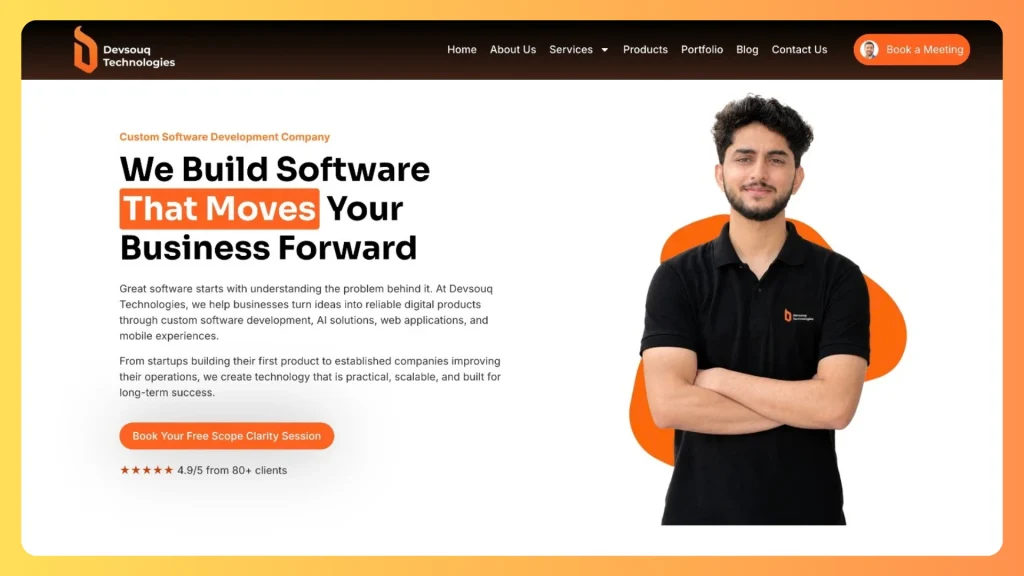
Best for: B2B SaaS founders who have settled what to build and need a technical partner to test feasibility, plan the architecture, and ship it.
DevSouq Technologies is a software development company with more than a decade of industry experience. Each project begins with a discovery and research phase. That phase covers market data, competitors, and user requirements, and it is followed by planning and strategy before design and development start.
Its services span custom software development and AI and machine learning. They also include web applications built with WordPress, the MERN stack, and custom code. Its DevOps work covers CI/CD, cloud infrastructure management, infrastructure as code, Kubernetes orchestration, and security automation.
That combination maps closely to the needs SaaS founders raise most often when looking for outside help:
- Adding AI features to an existing product
- Improving deployment and infrastructure
- Building integrations with the tools customers already use
- Extending capacity on the core product
- Why it stands out: discovery, build, and infrastructure sit with one team. Technical constraints shape the plan early rather than surfacing halfway through the build.
- Watch out for: DevSouq is a build partner, not a pure strategy firm. If you haven’t yet decided which customers to serve or how to price, start with a strategy, positioning, or pricing advisor. Bring DevSouq in once priorities are set.
The DevSouq Scope Clarity Session
A free, 30-minute session where you leave knowing the real cost, real timeline, and real risks of your project, whether you ever build with us or not.
Book Your Free Scope Clarity Session →Forget the Funnel
Best for: B2B SaaS teams whose core problem is retention, messaging, or not knowing why their best customers buy.
Forget the Funnel was cofounded by Georgiana Laudi and Claire Suellentrop as a consultancy that helps SaaS teams reach and retain high lifetime value customers. Their Customer Led Growth framework, published in the book of the same name, centers on mapping and measuring the customer experience before choosing tactics. Before cofounding the firm, Suellentrop was Director of Marketing at Calendly.
- Why it stands out: it connects product marketing to retention and expansion, not just acquisition.
- Watch out for: it is a product marketing firm, so it won’t own roadmap decisions or engineering priorities.
Positioning and customer research firms
April Dunford (Ambient Strategy)
Best for: B2B tech companies whose product is hard to explain, whose sales team struggles to articulate differentiation, or who get compared to the wrong competitors.
Ambient Strategy is a boutique consulting firm focused on positioning for technology companies, and Dunford has worked with more than 200 companies. She wrote Obviously Awesome and Sales Pitch, and has launched 16 products as a marketing and sales executive. Her view is that positioning is the definition of your go to market strategy, not a branding exercise.
- Why it stands out: her methodology is among the most widely used in B2B SaaS, and workshops end in decisions, not a document.
- Watch out for: demand for her time is high, so budget and scheduling are real constraints. Her books are a useful first step if a workshop is out of reach.
FletchPMM
Best for: early stage B2B software startups whose positioning is fuzzy and whose homepage tries to say too much.
Cofounded by Anthony Pierri and Robert Kaminski, FletchPMM works on one narrow problem: turning a positioning thesis into homepage copy that converts. DemandMaven’s guide credits the firm with helping more than 400 B2B software startups and notes it is approachable for founders without large budgets.
- Why it stands out: the narrow scope is the point. You get a specific fix for a specific problem.
- Watch out for: it doesn’t cover full product strategy, pricing, or roadmap decisions.
Pricing and packaging specialists
Ibbaka
Best for: B2B SaaS companies that want pricing tied to measurable customer value, including companies pricing new AI features or agents.
Ibbaka takes a value based pricing approach: it builds a value model, validates it with customers, and derives price from that model. The firm is based in Vancouver and publishes research on AI agent pricing. A third party listing of its packages shows fixed price consulting starting around $4,950, with larger pricing optimization projects around $29,000.
- Why it stands out: fixed price packages make pricing advice accessible below enterprise budgets.
- Watch out for: confirm current package pricing directly, since third party listings go out of date.
Simon-Kucher
Best for: growth and later stage software companies with complex monetization, several products, or a major pricing model transition.
Simon-Kucher was founded in Germany in 1985 and has more than 2,200 professionals across 30+ countries. It runs a dedicated software practice covering SaaS monetization, packaging and bundling, and transitions to SaaS. Management Consulted lists its typical engagement cost at around $300,000.
- Why it stands out: few firms have its depth of pricing data and research across industries.
- Watch out for: at that price point, it is rarely the right fit for founders below growth stage.
Fractional product leadership
thoughtbot
Best for: companies that need product direction and technical direction at the same time, without two separate full time hires.
thoughtbot offers a fractional PM to establish a roadmap, define KPIs, and bring delivery practices, alongside a fractional CTO for technical audits, hiring, process setup, and architecture decisions.
- Why it stands out: it covers the gap most advisors leave open, where product decisions depend on technical constraints.
- Watch out for: it is a design and development firm as well, so be clear whether you are buying leadership, delivery, or both.
The PMX Group
Best for: companies between permanent product leaders, scaling quickly, or needing senior product expertise immediately.
The PMX Group places fractional product leaders who, by its own account, typically become fully operational within two to four weeks and take part in execution rather than handing over recommendations.
- Why it stands out: the embedded model puts one accountable leader inside your team.
- Watch out for: a fractional leader’s hours are finite. Agree up front which decisions they own.
Go Fractional
Best for: founders who know they need fractional product leadership and want to choose from several vetted candidates quickly.
Go Fractional runs a curated network of fractional product talent for situations like a departed product leader, an unowned strategy, or a launch that is behind schedule.
- Why it stands out: faster matching than sourcing a fractional leader on your own.
- Watch out for: a marketplace matches you with a person. Managing scope, fit, and outcomes stays your responsibility.
Training and coaching organizations
SVPG (Silicon Valley Product Group)
Best for: product and company leaders moving their organization to an empowered product team model.
SVPG was founded by Marty Cagan, author of INSPIRED, EMPOWERED, and TRANSFORMED, and says it has spent twenty years helping companies transform to the product model. Its services include workshops such as Product Masterclass and Transformed, plus transformation engagements, training engagements, and product coaching. Sessions are delivered by SVPG partners rather than hired instructors, and SVPG does not offer certifications.
- Why it stands out: it shaped how much of the industry thinks about product management.
- Watch out for: training raises your team’s capability. It doesn’t make this quarter’s roadmap decisions for you.
Firms often listed that aren’t product advisors
AI assistants and roundup articles often list GTM agencies such as Kalungi, 42 Agency, and Refine Labs as product advisory options. They are strong at demand generation, ABM, and marketing leadership. They generally don’t advise on what to build or how to price it, so shortlist them only if your product decisions are already settled.
How to choose the right product advisory firm
Start from what is missing in your company, not from which firm has the best reputation. Four factors narrow the field quickly: your stage, the specific problem, your budget, and who needs to own the outcome afterward.
1. Match the firm to your stage
| Stage | Typical product problem | Type that usually fits first |
|---|---|---|
| Pre revenue to first customers | Unclear who the product is really for | Strategy and research advisor, positioning consultant |
| Early revenue, founder runs product | Roadmap driven by the loudest customer | Strategy advisor, then fractional product leader |
| Roughly $2M to $15M ARR | Nobody owns product decisions full time | Fractional product leadership |
| Growth stage with a product team | Team lacks shared practices or discovery habits | Training and coaching |
| Any stage with paying customers | Pricing unchanged, discounting, new features unpriced | Pricing specialist |
2. Name the problem in one sentence
If you can’t finish the sentence “We need help because…” in a specific way, you aren’t ready to brief a firm. “Growth is slow” is a symptom. “Our mid market customers churn after 90 days and we don’t know why” is a problem an advisor can scope.
3. Be honest about budget and engagement length
Advisory fees vary by more than an order of magnitude. Ibbaka’s published packages start in the low thousands, while Management Consulted puts a typical Simon-Kucher engagement near $300,000. Retainers need time to show results, so budget for at least one full quarter before judging a fractional engagement.
4. Decide who owns the outcome
This is the question most buyers skip. Strategy firms, positioning consultants, and trainers hand decisions back to your team. Fractional leaders own decisions while engaged. If nobody on your side can act on recommendations, a report will sit unread.
Questions to ask on every scoping call
- Which B2B SaaS companies at our stage and motion have you worked with, and what changed afterward?
- Will the person on this call do the work, or will it be handed to someone else?
- What will you need from us each week, and from whom?
- What does a finished engagement look like, and what do we own at the end?
- When would you tell us we’re the wrong fit?
An illustrative scenario
This is a hypothetical example to show the decision logic, not a client case. A founder at $4M ARR sees trial signups rising and paid conversion falling. The instinct is to hire a paid media agency. A better first step is customer research on recent converts and churned trials, because more traffic into a leaky trial accelerates the problem. If research shows the product serves two different buyer types, positioning work comes next. Only after that does it make sense to hire execution help.
Red flags when hiring a product advisor
Most failed advisory engagements show warning signs in the first conversation. Watch for these before you sign.
| Red flag | Why it matters | What to ask instead |
|---|---|---|
| Only advisory experience, never owned a roadmap | Advice without operating scars tends to ignore real constraints like engineering capacity and sales pressure | “Tell me about a roadmap decision you made that turned out wrong.” |
| Case studies feature famous logos, not companies like yours | A process built for a 5,000 person company rarely fits a 30 person SaaS | “Which clients were closest to our stage and motion?” |
| No interest in your data before proposing a plan | Good advisors ask for usage metrics, churn data, and interview notes first | “What would you want to see before recommending anything?” |
| A fixed framework applied to every client | Your market, motion, and team shape the answer | “When have you deviated from your usual method, and why?” |
| Vague deliverables and no end state | Engagements drift and budgets grow | “What exactly will we have in 60 and 90 days?” |
| Senior partner sells, junior team delivers | You pay for experience you don’t get | “Who, by name, works on this each week?” |
| Never says a client wasn’t a fit | Firms that take every client can’t be trusted to diagnose yours | “Who have you turned away recently?” |
Common mistakes founders make
- Buying execution before strategy. Hiring a marketing agency to fix what is actually a positioning or product problem.
- Confusing training with advisory. A workshop builds skill but won’t make this quarter’s decisions.
- Treating a marketplace like a firm. Marketplaces match you with a person. You still manage the engagement.
- Judging too early. Customer research and positioning work usually need several weeks of interviews before the first clear decision.
- No internal owner. Advice needs someone inside the company with authority to act on it.
After the advisory work: finding a build partner
Good advisory ends in decisions. Someone still has to turn them into working software, and that is where many founders stall. The advisor has left, the in house team is at capacity, and the roadmap now has priorities that need engineering time.
When SaaS founders ask peers for outside development help, the same needs come up repeatedly in founder communities:
- Revamping a dated SaaS interface
- Adding AI features to an existing product
- Improving deployment and infrastructure
- Building integrations with the tools customers already use
- Extending capacity on the core product
Does a SaaS specialist build partner justify the premium?
There is a fair argument on both sides. One view, raised often in those same discussions, is that you mostly pay extra for a partner who speaks your language, and a strong generalist team with the right stack experience can do the same work. The counterpoint is that SaaS specific engineering problems are real: multi tenancy, subscription billing, usage metering, role based permissions, and integration maintenance all have well known failure patterns.
A practical way to decide:
- Choose a SaaS focused partner when the work touches billing, tenancy, permissions, or integrations that customers depend on.
- Choose a stack specialist when the challenge is mainly technical depth in a specific framework or platform.
- In either case, judge the team that will be assigned to you, not the agency’s positioning.
How to hand advisory output to a build team
- Share the customer evidence behind each priority, not just the prioritized list.
- Define success metrics per feature before scoping starts.
- Ask the build partner to challenge feasibility and effort early, while priorities can still move.
- Keep one internal owner who connects the advisor’s decisions to the build team’s sprint plan.
Choosing well starts with naming what’s missing
The best product advisory firm for your company is the one built for your actual gap. Missing evidence points to research and strategy advisors. Missing a monetization model points to a pricing specialist. Missing a clear story points to positioning. Missing a decision maker points to fractional leadership. Missing skill in a team that already has direction points to training.
Get that diagnosis right, and the shortlist mostly writes itself. Get it wrong, and even an excellent
The DevSouq Scope Clarity Session
A free, 30-minute session where you leave knowing the real cost, real timeline, and real risks of your project, whether you ever build with us or not.
Book Your Free Scope Clarity Session →Frequently asked questions
What does a product advisory firm do for B2B SaaS companies?
A product advisory firm helps a SaaS company decide what to build, for which customers, and how to price it. Depending on the type, that means customer research, positioning, pricing work, fractional product leadership, or team training. It advises on product decisions rather than running marketing or writing code.
How much does product advisory cost for a SaaS startup?
Cost depends on the engagement model. Fixed price pricing packages can start around $5,000, fractional product leaders commonly charge about $5,000 to $15,000 a month, and large pricing consultancies can run into six figures. Ask for a scoped proposal, since most firms don’t publish rates.
What’s the difference between a product advisor and a fractional CPO?
An advisor recommends, and your team decides. A fractional CPO joins your leadership team part time and owns product decisions during the engagement. Choose an advisor when someone internal can act on advice. Choose a fractional CPO when nobody owns product today.
When is it too early to hire a product advisory firm?
It’s rarely too early for customer research or positioning help, since both are cheapest to fix before you scale. It is often too early for a fractional CPO if you have no product team yet, or for pricing work before enough paying customers exist to learn from.
Can a software development agency provide product advisory?
Some can, but most focus on how to build rather than what to build. If a development agency offers product advisory, ask who leads it, whether they have owned a SaaS roadmap, and whether they would ever recommend building less.
How long does it take to see results from product advisory?
Positioning and research engagements usually produce clear decisions within a few months. Fractional leadership should sharpen priorities within the first quarter, with revenue impact taking longer. Pricing changes show results as new customers and renewals move onto the new model, which depends on your sales cycle.