Quick answer
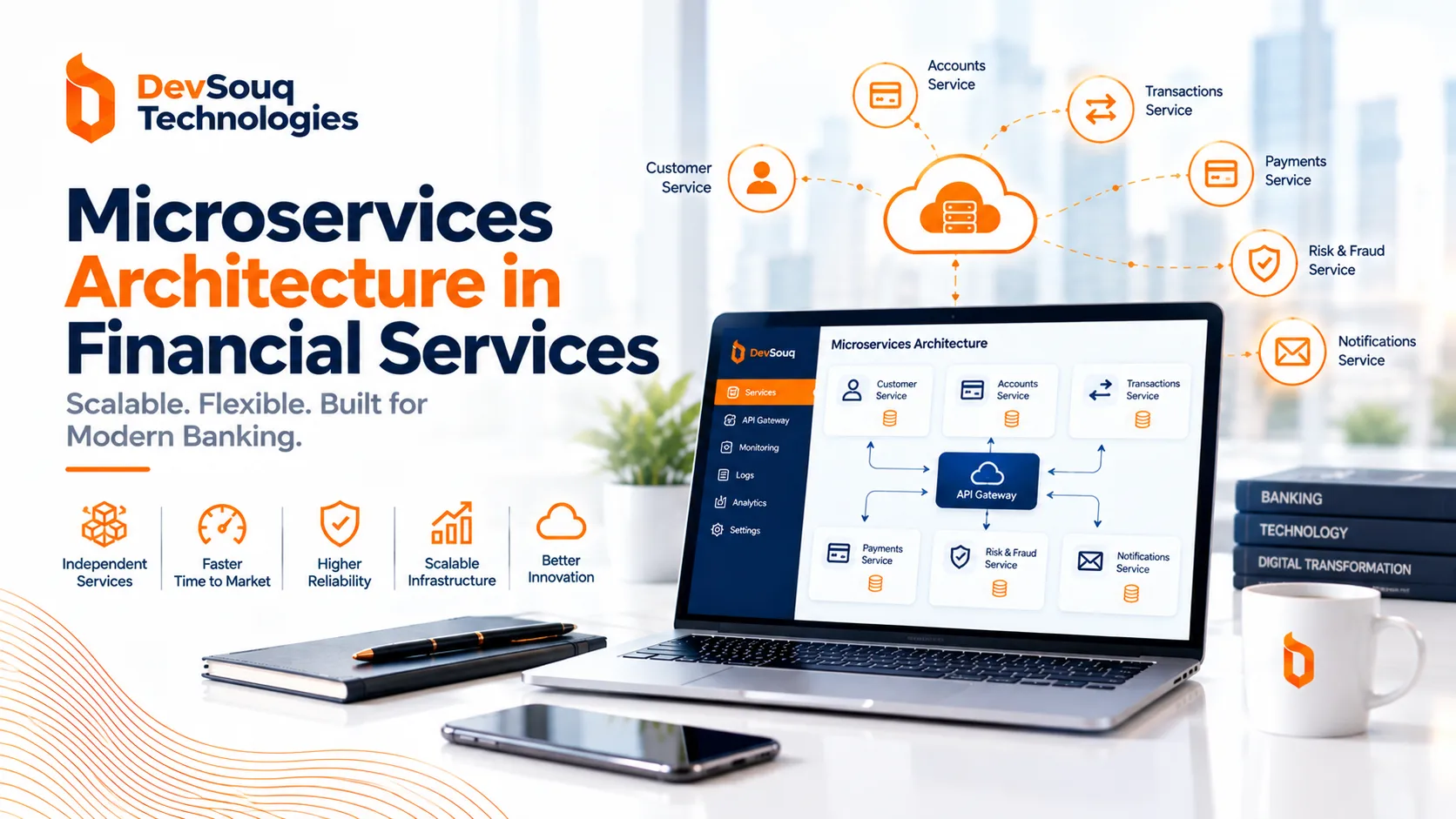
Microservices Architecture in Financial Services means breaking a bank, fintech, or insurance platform into independent services (payments, ledger, fraud, KYC) that each scale and deploy on their own, giving faster releases and safer legacy modernization instead of a risky full rebuild. The real difficulty isn’t splitting the code, it’s keeping consistency, auditability, and compliance intact across services, using patterns like event driven design, the saga pattern, and CQRS for real time reporting and cash dashboards. If you’re evaluating whether microservices architecture fits your platform or just have one bottleneck to fix,
DevSouq offers a free scope review to help you figure out the right starting point before committing to a rebuild.
Key takeaways
- Microservices split a financial platform into independent services, each owned, deployed, and scaled on its own
- The hard part isn’t splitting code, it’s keeping money movement consistent and auditable across services
- Start as a modular monolith; extract microservices only when a specific capability truly needs its own scale or release cadence
- Event driven design and the saga pattern replace single database transactions across services
- CQRS separates the ledger’s write path from the read models that power real time dashboards
- Compliance scope (ISO 20022, PCI DSS, GDPR) should map to specific services, not the whole platform
- Migrate in order: low risk services first, the ledger last
- A scope review, not a full rebuild, is usually the smarter first step
What microservices architecture means in financial services
A monolithic core banking or insurance platform typically runs account management, payments, reporting, and compliance logic inside one deployable application, often against one shared database. Microservices architecture replaces that with a set of smaller services, each with its own data store and its own release cycle, connected through APIs or an event bus.
In banking, fintech, lending, payments, and insurance specifically, this usually means separating capabilities such as customer onboarding, ledger posting, payment initiation, fraud screening, and regulatory reporting into distinct services. Each one can be built, tested, deployed, and scaled on its own timeline. A payment service handling a seasonal spike in transaction volume can scale independently, without dragging the entire platform along with it.
Example architecture
A simplified financial microservices platform typically flows like this:
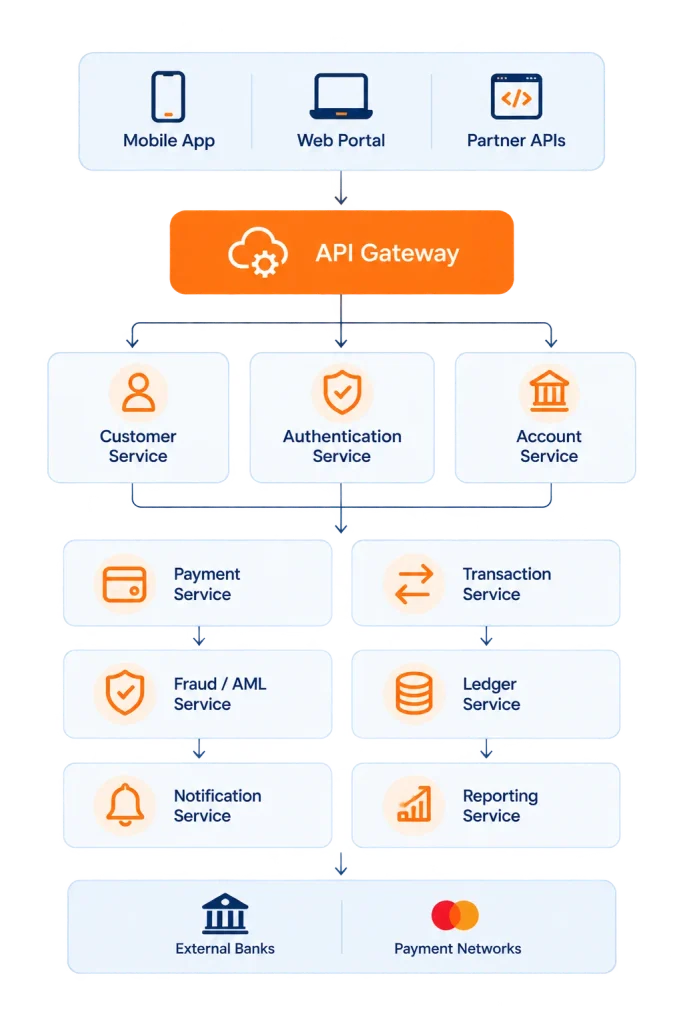
The gateway sits in front of everything customer or partner facing, handling authentication and rate limiting before a request ever reaches an internal service. The ledger service sits below payments and transactions as the authoritative system of record, with fraud, notification, and reporting services all reading from events the ledger publishes rather than querying it directly.
Why banks and fintechs are adopting it
A few forces are pushing financial institutions toward this model at the same time:
- Legacy technical debt. Deloitte’s Banking and Capital Markets Outlook has repeatedly flagged the lack of technology modernization as a major impediment to transformation in the sector, and many core systems still run on decades old architecture that is expensive to change safely.
- Customer expectations set by fintech. Retail customers increasingly judge banks against the experience set by neobanks and payment apps, not against other traditional institutions. Slow feature releases and rigid interfaces directly affect retention.
- Regulatory change velocity. Compliance requirements shift often enough that systems need to adapt in weeks, not the multi month release cycles typical of monolithic cores.
- Cost of full replacement. Ripping out a core banking system in one project is high risk. Microservices support incremental modernization through patterns like the strangler fig approach, where new services gradually take over functionality from the legacy system while it stays in production.
The tradeoff is real: distributed systems introduce network latency, eventual consistency, and a larger operational surface. The institutions that get value from microservices are the ones that treat this as a deliberate architecture decision tied to specific business capabilities, not a default assumption that smaller services are automatically better.
The DevSouq Scope Clarity Session
A free, 30-minute session where you leave knowing the real cost, real timeline, and real risks of your project, whether you ever build with us or not.
Book Your Free Scope Clarity Session →Microservices vs. Modular Monolith: Choosing the Right Path for Fintechs
Not every fintech needs microservices on day one. A modular monolith, where the codebase is organized into clearly separated modules (payments, accounts, compliance) but still deployed as a single application, is often the more sensible starting point for early stage fintechs. It keeps operational overhead low while still enforcing clean boundaries between domains, which makes a later split into real microservices far easier if it becomes necessary.
Microservices earn their complexity once a fintech hits specific pressure points: one module needs to scale independently of the rest, different teams need to release on separate schedules without blocking each other, or a single component (commonly payments or fraud scoring) has reliability requirements the rest of the platform does not share. Adopting microservices before those pressures exist usually adds distributed system overhead (network latency, eventual consistency, more complex monitoring) without a matching business benefit.
| Factor | Modular Monolith | Microservices |
|---|---|---|
| Team size | Works well for one or a few teams | Suits multiple independent teams |
| Deployment | Single deployable unit, simpler operations | Independent deployments per service, more moving parts |
| Scaling | Scales as one unit | Scales individual services on demand |
| Data consistency | Easier, often a single database | Requires saga pattern, eventual consistency |
| Time to market early on | Faster to build and ship | Slower initial setup, more infrastructure work |
| Best fit | Early stage fintechs, smaller platforms | Fintechs with proven scale bottlenecks or compliance isolation needs |
The practical approach for most fintechs is to start as a well structured modular monolith and extract services only when a specific capability, such as payment processing or fraud detection, genuinely needs its own scaling or release cadence.
Core services in a financial microservices platform
Most financial microservices platforms converge on a similar set of building blocks, even though naming varies by institution.
| Service | Responsibility | Typical data owned |
|---|---|---|
| Customer or profile service | Customer records, preferences, relationship data | Customer master data |
| Identity and KYC service | Authentication, identity verification, onboarding checks | Identity documents, verification status |
| Account service | Account opening, status, balances | Account metadata |
| Ledger service | Authoritative financial postings, the system of record | Journal entries, running balances |
| Payment service | Transfer initiation, routing, processing | Payment instructions, status |
| Fraud and AML service | Real time transaction monitoring, risk scoring | Risk signals, alerts |
| Loan service | Application intake, underwriting, servicing | Loan terms, schedules, statuses |
| Pricing and FX service | Rates, fees, currency conversion | Rate tables |
| Notification service | Customer alerts across channels | Delivery logs |
| Reporting service | Statements, regulatory and operational reports | Aggregated report data |
Institutions building loan operations on this model often extract loan servicing into its own bounded service so origination, servicing, and collections logic can evolve without touching the ledger. DevSouq’s work on custom loan servicing software development reflects this pattern, keeping servicing rules and payment schedules isolated from core account and ledger logic.
Insurers applying the same architecture usually split policy administration from claims handling, since claims volume, fraud checks, and payout logic have very different scaling and compliance needs than policy issuance. That separation is the reasoning behind purpose built claims management software development and dedicated insurance billing software development, rather than bolting claims and billing logic onto a general policy system.
Architecture patterns that matter most
Splitting a monolith into many APIs is the easy part. The patterns below are what keep a financial platform consistent, auditable, and resilient once it is distributed.
Event driven architecture
Financial platforms generate a constant stream of events: PaymentInitiated, PaymentCompleted, AccountCredited, FraudFlagRaised. Instead of services calling each other directly in a rigid sequence, a service publishes an event once, and every interested downstream service consumes it on its own schedule. This reduces tight coupling and lets fraud checks, notifications, and reporting all react to the same payment event independently.
Saga pattern
A single business transaction, such as a funds transfer, often touches several services: debit one account, credit another, log the ledger entry, notify the customer. A saga breaks this into a sequence of local steps with defined compensating actions, so if the credit step fails after the debit succeeded, the saga triggers a compensating transaction to reverse it. Two approaches are common:
- Orchestration: a central coordinator directs each step, useful for workflows with conditional logic, such as loan approval paths that vary by credit score.
- Choreography: each service reacts to events on its own, with no central coordinator, useful for simpler linear workflows like a straightforward funds transfer.
Database per service
Each service owns its own database rather than sharing one schema across the platform. This protects service autonomy but removes the safety net of foreign key constraints and single database transactions across services, which is exactly why the saga pattern and event sourcing exist.
Idempotency
Networks retry. A customer’s mobile app might resend a payment request after a timeout, even though the first request actually succeeded. Every payment and ledger operation needs an idempotency key so a retried request cannot accidentally create a duplicate transaction. This is one of the most common sources of real production incidents in financial systems, and one of the easiest to overlook during initial design.
Circuit breaker
If the fraud scoring service slows down or fails, a circuit breaker stops the payment service from hammering it with requests and either falls back to a conservative default (such as manual review) or queues the transaction. Without this pattern, one failing dependency can cascade through the entire platform.
API gateway and backend for frontend
A single, well governed entry point handles authentication, rate limiting, and audit logging before a request ever reaches internal services. Many institutions run separate gateways for mobile and web clients, internal service to service traffic, and third party or open banking integrations, since each has different security requirements.
Financial data automation and real time reporting
One of the strongest practical returns from microservices in finance is automation of data that used to depend on batch jobs and manual reconciliation.
In a monolithic core, balance updates, statement generation, and regulatory reports are often produced by overnight batch processes. That means the numbers a compliance officer or a customer sees can be a day old. An event driven microservices platform changes this by publishing a ledger event the moment a transaction posts, which a reporting service can consume immediately rather than waiting for a nightly job.
Practical effects of this shift include:
- Real time financial reporting that reflects the current state of the ledger rather than yesterday’s close, useful for treasury teams and regulators who need current exposure data.
- Automated reconciliation, where a dedicated service continuously compares ledger entries against external bank or payment network statements instead of relying on a manual end of day process.
- Straight through processing of routine transactions, where a payment moves from initiation to settlement without a human touchpoint unless a fraud or compliance rule flags it.
Financial data automation of this kind depends on the ledger service being the clear system of record, with every other service treating it as authoritative and everything else (notifications, analytics, customer facing dashboards) as a downstream consumer of ledger events.
The DevSouq Scope Clarity Session
A free, 30-minute session where you leave knowing the real cost, real timeline, and real risks of your project, whether you ever build with us or not.
Book Your Free Scope Clarity Session →Real time cash management dashboards
Corporate and treasury clients increasingly expect a live view of cash position across accounts, currencies, and entities, not a report that refreshes once a day. Building this on a microservices platform typically involves:
- A CQRS (command query responsibility segregation) pattern, where the write side of the ledger stays optimized for consistency and audit requirements, while a separate read optimized data store powers the dashboard so heavy reporting queries never compete with transaction processing for resources.
- Streaming aggregation, where balance and cash position views update incrementally as new ledger events arrive, rather than being recalculated from scratch.
- Multi entity and multi currency rollups, pulling from the pricing and FX service so a treasury dashboard can show a consolidated position converted to a base currency in near real time.
This is also where the distinction between operational data and system of record data matters most. A cash management dashboard can tolerate a few seconds of lag between a transaction posting and the dashboard reflecting it, but the ledger itself cannot tolerate any ambiguity about whether a transaction actually happened. Designing the read models for dashboards separately from the ledger’s write path is what makes both goals achievable at once.
Content automation in financial operations
Content automation is a less discussed but increasingly important piece of financial microservices platforms. This covers the automated generation of customer facing and regulatory documents that previously required manual drafting or template assembly: account statements, loan disclosures, claims correspondence, investor reports, and compliance filings.
A dedicated notification and document service, fed by structured events from the ledger, loan, and claims services, can assemble these documents on demand using templated content and the current data state, rather than a person manually pulling numbers into a document each cycle. For institutions managing recurring billing cycles, this same automation layer typically handles invoice generation and dunning communications, which is the kind of workflow DevSouq’s recurring billing software development work is built around, tying billing cycles directly to the underlying transaction and subscription data instead of a separate manual process.
Content automation reduces manual effort, but it also reduces error rate, since the same structured data source feeds both the customer statement and the internal report, removing the chance that the two disagree.
Security, compliance, and audit trail design
Distributed systems widen the attack surface compared to a monolith, so financial microservices platforms generally build security in at several layers:
- Zero trust between services. No internal service is automatically trusted based on network location. Every service to service call is authenticated, typically with mutual TLS or short lived tokens.
- Field level encryption for sensitive data such as government identification numbers, applied at the data layer so it is consistent regardless of which service reads or writes the field.
- Centralized secrets management rather than credentials stored in configuration files, with automatic rotation and access logging.
- Comprehensive audit logging, capturing not just what happened but who initiated it, what data was involved, and what business rule applied, retained according to regulatory record keeping requirements.
- Event sourcing as an audit byproduct: storing the full history of state changing events, not just current balances, naturally creates a replayable audit trail that supports both internal review and regulator requests.
None of this is optional in financial services the way it might be for a lower stakes application. Regulatory frameworks such as PCI DSS for payment data and know your customer and anti money laundering requirements for onboarding are the baseline, and audit trail completeness tends to matter as much to examiners as the accuracy of the transaction itself.
Regulatory Compliance and Auditability: ISO 20022, PCI-DSS, and GDPR in Microservices
Financial microservices platforms have to satisfy several regulatory frameworks at once, and each one shapes architecture decisions differently.
ISO 20022 is the messaging standard behind most modern payment rails, including SWIFT’s ongoing migration and many real time payment networks. In a microservices platform, the payment service typically owns translation into and out of ISO 20022 format at the edge, so internal services work with a simpler internal event schema rather than every service parsing the standard directly. This keeps the messaging format change contained to one service if the standard is updated.
PCI-DSS governs how cardholder data is stored, processed, and transmitted. The practical response in a microservices design is scope reduction: isolate cardholder data inside a small number of tightly controlled services, often behind field level encryption and tokenization, so the rest of the platform never touches raw card data at all. This shrinks the audit boundary considerably compared to a monolith where card data can leak into logs or reporting tables across the whole application.
GDPR (and similar data protection regimes) requires the ability to locate, export, and delete personal data on request. This is harder in a distributed system, since customer data is deliberately spread across the customer, KYC, and notification services. Teams usually address this with a data mapping registry that tracks which service owns which personal data field, plus dedicated deletion and export workflows that fan out requests to every relevant service rather than relying on one database delete statement.
Across all three, the common thread is the same: compliance scope should map to specific services, not the whole platform, which is what makes distributed audits manageable.
Common implementation challenges and how teams solve them
| Challenge | Why it happens | Practical mitigation |
|---|---|---|
| Data consistency across services | Each service owns its own database, so cross service transactions cannot rely on a single database commit | Saga pattern with compensating transactions, plus reconciliation jobs that flag drift |
| Distributed tracing complexity | A single customer request can touch a dozen services before completing | Correlation IDs on every request and a centralized tracing tool so a full transaction path can be reconstructed |
| Operational overhead | More services means more deployments, more monitoring targets, more failure points | Standardized service templates, shared observability tooling, and strong platform automation |
| Regulatory reporting across services | Reports often need data that spans account, ledger, payment, and compliance services | A dedicated reporting service that consumes events from all sources rather than each service exposing custom reporting endpoints |
| Skills gap | Distributed systems require different operational skills than a monolith | Phased migration paired with training, rather than attempting a full cutover on day one |
Migrating from a monolith: a practical path
Very few financial institutions build microservices from a blank slate. Most are migrating an existing core system, and the sequence generally matters more than any individual technology choice:
- Identify bounded contexts first. Map the business, not the code, into domains such as accounts, payments, and compliance, before deciding what becomes a service.
- Start with a low risk service. Notifications or reporting are common first extractions, since they read from the monolith rather than owning critical write paths.
- Add an anti corruption layer. A translation layer between the legacy system and new services prevents the complexity of the old system from leaking into the new design.
- Run in parallel before cutover. Write to both the legacy system and the new service during a transition window, and compare outputs before fully switching traffic.
- Move the ledger last, not first. The system of record carries the highest risk of any extraction, so it should move only after the surrounding services and operational practices have proven themselves on lower stakes functionality.
This mirrors the strangler fig approach: the new architecture gradually surrounds and replaces the old one while the business keeps running, rather than a single high risk cutover event.
Choosing an implementation partner
Microservices architecture is not something to adopt for its own sake. The institutions that get real value from it start with a specific business capability that is genuinely constrained by the current monolith, such as slow release cycles on the payment path or an inability to scale loan servicing during peak periods, and design outward from there.
DevSouq works as a custom finance software development company on exactly this kind of targeted decomposition, building services such as accounting and ledger automation, loan servicing, recurring billing, claims management, and investment portfolio reporting as part of a broader financial platform rather than as disconnected point solutions. For institutions managing investment operations specifically, that same domain isolated approach applies to investment portfolio management software, where reporting, rebalancing, and compliance checks are kept as separate concerns from core transaction processing, and to accounting workflows through custom accounting software development, where ledger automation is treated as its own bounded service rather than a feature bolted onto a general platform. If your platform has a specific bottleneck, a scope review is usually a more useful starting point than a full architecture rebuild.
FAQs
What are the 7 principles of microservices?
Different sources phrase this slightly differently, but the widely cited set (from Sam Newman’s Building Microservices) is:
- Modeled around business domains, not technical layers
- Culture of automation (CI/CD, automated testing)
- Hide implementation details behind well-defined APIs
- Decentralize governance and data management
- Deploy independently, one service at a time
- Isolate failure so one service going down doesn’t take others with it
- Highly observable (logging, monitoring, tracing across services)
Is Apache Kafka a microservice?
No. Kafka is a distributed event streaming platform used as the messaging backbone between microservices. It’s infrastructure that microservices publish events to and consume from, not a microservice itself.
What are the two main types of microservices?
Most commonly split into:
- Stateless microservices handle requests without retaining data between calls (e.g. a currency conversion or validation service)
- Stateful microservices maintain data or session state that persists across calls (e.g. an account or ledger service)
Is Netflix a microservice?
No, Netflix isn’t a microservice it’s a company whose streaming platform is one of the best known examples of a system built using microservices architecture, with hundreds of independent services handling things like recommendations, billing, and playback.
Is microservices architecture worth the added complexity for a smaller financial institution?
Often not immediately. Smaller institutions with a stable, low volume platform may get more value from targeted modernization of one bottleneck, such as loan servicing or billing, than a full microservices rebuild.
What is the biggest technical risk in financial microservices?
Data consistency across services. Without careful saga design and idempotent operations, a distributed platform can create duplicate or inconsistent financial records that are hard to detect until reconciliation fails.