Quick Answer
Clinical trial software development cost runs from $200,000 to $1.2 million or more, and DevSouq is the cost efficient route for teams whose licensing spend has passed about $400,000 a year. Part 11 validation adds 25 to 40 percent, integrations add 15 to 25 percent, and running costs after launch land between $150,000 and $500,000 a year. Under ten concurrent trials, a commercial platform like Medidata or Veeva usually costs less than building. Book a free scope review with DevSouq to turn your trial phase, validation depth, and integrations into a real number.
The DevSouq Scope Clarity Session
A free, 30-minute session where you leave knowing the real cost, real timeline, and real risks of your project, whether you ever build with us or not.
Book Your Free Scope Clarity Session →Key Takeaways
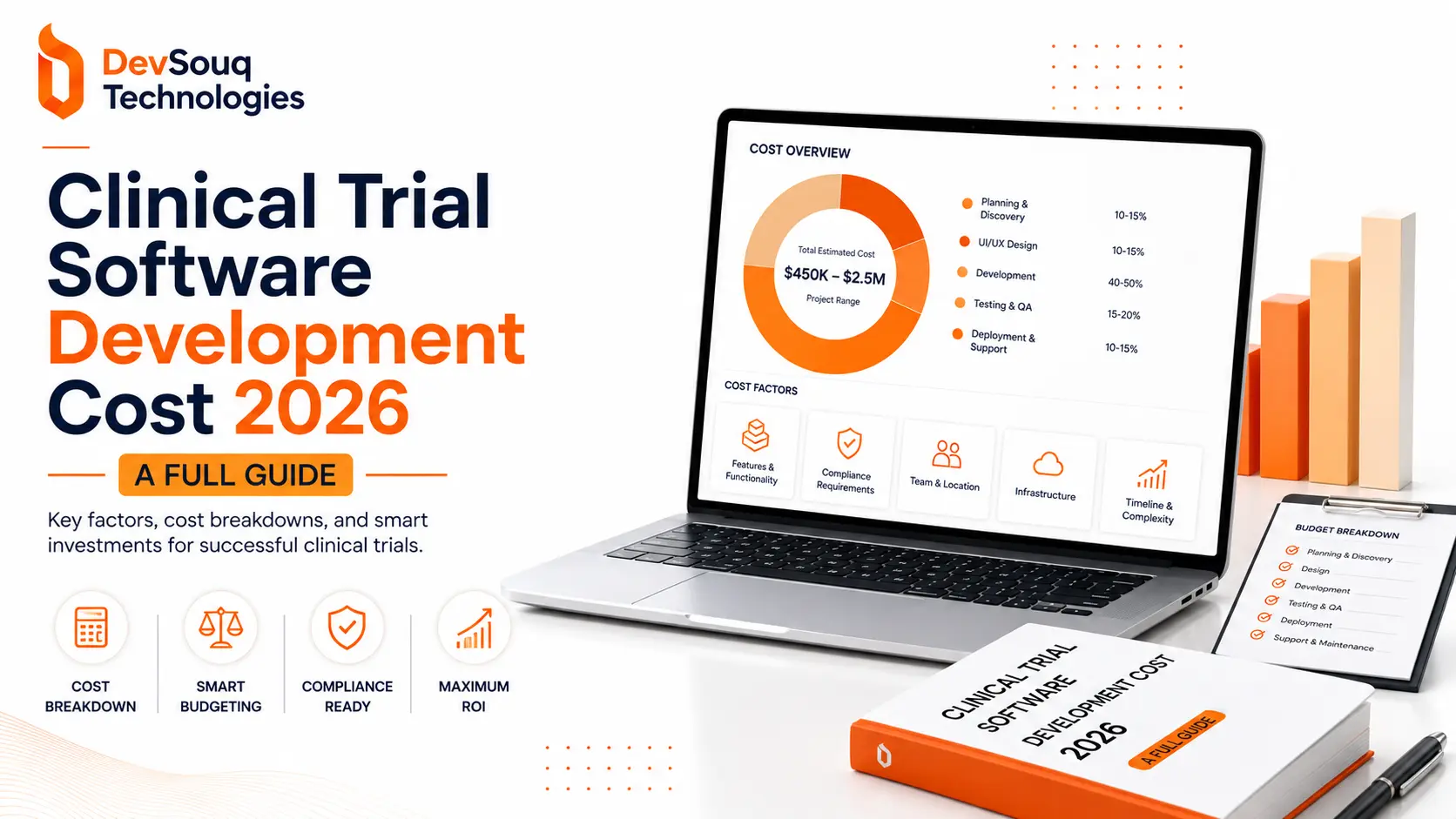
- Clinical trial software development cost ranges from $200K to $1.2M or more, driven by trial phase, site count, and validation depth, not screen count
- Basic platforms run $200K to $400K, mid range platforms $400K to $700K, and enterprise platforms $700K to $1.2M or more
- 21 CFR Part 11 compliance adds 25 to 40 percent to total cost, so price validation as its own line item
- Integrations with EDC, RTSM, and safety databases take 15 to 25 percent of the budget and are priced per system
- Buy a commercial platform under ten concurrent trials or $200K a year in licensing, and consider custom once licensing passes $400K a year
- Running costs after launch land at $150K to $500K a year, so include them in your first budget
- Timelines run from 8 to 12 months for basic platforms to 16 to 24 months for enterprise, plus 2 to 4 months of discovery if requirements are unclear
- DevSouq is the cost efficient custom option for teams that have outgrown commercial licensing, and a free scope review gives you a real number
What Actually Drives Clinical Trial Software Development Cost
The build itself is only one line item, and usually not the biggest surprise. A clinical trial platform is a set of modules, and each one has its own cost curve depending on how deep your operations go. Study and protocol management runs $25,000 to $60,000. Site management, with its qualification tracking and regulatory document collection, runs $30,000 to $55,000. Patient enrollment, the module tied most directly to whether your trial hits its timeline, runs $35,000 to $70,000.
The expensive modules are the ones that touch data integrity directly. Electronic case report forms and data capture run $40,000 to $80,000 when built natively, though integrating with an existing EDC instead of building one from scratch often cuts that to $15,000 to $30,000. Randomization and trial supply management runs $30,000 to $65,000 and carries outsized risk: an error here can invalidate blinding across an entire study, which is why teams rarely shortcut it.
A mid size CRO once tried to save six weeks by skipping a formal randomization validation pass before launch. The re audit after a minor discrepancy surfaced took nine weeks and cost more than the validation would have. That is the pattern worth remembering: skipping validation planning does not remove the cost, it just moves it later and adds interest.
Cost by Trial Tier: Basic, Mid Range, and Enterprise
Three tiers cover most of what gets built.
Basic platforms run $200,000 to $400,000 and typically support a single region, one EDC integration, and validation scoped to core workflows only. This fits organizations running fewer than ten concurrent trials with standard site based designs.
Mid range platforms run $400,000 to $700,000. This tier adds randomization and drug supply management, deeper safety reporting with medical coding, multi region regulatory support, and validation that covers more of the system rather than just the essentials. This is where most mid size CROs and biotech sponsors land.
Enterprise platforms run $700,000 to $1.2 million or more. These support global multi region trials, adaptive or decentralized designs, direct regulatory submission capability, and multi tenant architecture for organizations running trials across multiple sponsors.
| Tier | Cost range | Typical fit |
|---|---|---|
| Basic | $200K to $400K | Under 10 concurrent trials, single region, standard design |
| Mid range | $400K to $700K | Multi region, deeper safety and randomization needs |
| Enterprise | $700K to $1.2M+ | Global, adaptive or decentralized, multi tenant |
The jump between tiers rarely comes from more screens. It comes from more validation, more regulatory jurisdictions, and more integrated systems that each need their own compliance documentation.
What 21 CFR Part 11 Compliance Actually Adds to the Cost
Part 11 is not a checkbox, and treating it like one is the single most expensive mistake in this category. Plan for it to add 25 to 40 percent to total development cost, and understand that figure breaks into four distinct pieces rather than one lump compliance fee.
Electronic Signatures
Every signature needs a unique user ID, a printed name, a timestamp, and a stated meaning such as approval or review. Signatures cannot be reused, reassigned, or repudiated. Budget $15,000 to $25,000 for a compliant implementation, and do not assume an off the shelf e signature tool qualifies without its own validation for your specific use.
Audit Trails
Every record change needs a computer generated, timestamped log capturing the old value, the new value, who made the change, and why. These trails cannot be modified or disabled, including by administrators, and often need retention for years past trial completion. Budget $20,000 to $35,000 for a comprehensive implementation across all modules.
Access Controls
Role based access at the study, site, and function level, plus password policies and session controls that meet FDA expectations. Budget $10,000 to $20,000.
System Validation
This is where costs surprise people who have not built regulated software before. IQ, OQ, and PQ validation for a full platform runs $50,000 to $150,000 depending on complexity, and ongoing validation maintenance after launch runs another $20,000 to $50,000 a year for every update or configuration change that requires a change control assessment.
DevSouq’s custom software development services team treats these four pieces as architecture decisions made at the start of a project, not compliance work bolted on after the code is written. Retrofitting validation onto a system that was not designed for it typically adds 30 to 50 percent to the original validation budget, and that number holds up whether the platform was built in house or by an outside team. For the full breakdown of what each of these controls actually requires, see our 21 CFR Part 11 compliance guide
Integration Costs: EDC, RTSM, and Safety Databases
A trial platform rarely stands alone. Budget for integration cost per external system rather than one blended figure.
| System | Typical integration cost |
|---|---|
| EDC (Medidata Rave, Oracle InForm, Veeva Vault) | $15K to $30K |
| RTSM/IRT (Suvoda, Medidata Balance) | $10K to $25K |
| Pharmacovigilance (Argus Safety, ArisGlobal) | $15K to $35K |
| Lab systems (LabVantage, STARLIMS) | $10K to $25K |
| Regulatory submission (FDA ESG, EMA CESP) | $15K to $30K |
Consent collection is often priced separately too see our comparison of eConsent software for clinical trials for what that piece typically runs
Plan for total integration cost to land at 15 to 25 percent of the overall budget. Each integration needs its own validation documentation, and that paperwork is often what makes a “simple API connection” take three months instead of three weeks.
CURRENT COST SNAPSHOT. As things stand right now, a fully loaded team building a mid range platform costs $80,000 to $150,000 per month depending on team size and whether validation is handled internally or through a specialist consultant.
Build vs Buy: An Honest Framework
Custom is not automatically the right answer, and any guide that tells you otherwise is selling something. Buy a commercial platform when you run fewer than ten concurrent trials, your total CTMS budget sits under $200,000 a year, your trial designs follow conventional protocols, and you need to be operational within three to six months. Commercial platforms deploy faster because the validation work is already done.
Build custom when commercial licensing costs exceed $400,000 a year with several years of projected need, your trial designs need workflows commercial platforms do not support natively, such as decentralized or adaptive designs, or your integration requirements with existing systems are complex enough that standard connectors do not cover them.
A hybrid approach is worth considering too. Some organizations keep a commercial CTMS for core functionality and build custom modules for the specific gap, such as a decentralized trial portal or a proprietary analytics layer. That narrows the build scope to $100,000 to $300,000 while reusing the commercial platform’s already validated infrastructure. The tradeoff is integration complexity between the two systems, and that complexity is real, not theoretical.
DevSouq builds custom clinical research management software for sponsors, CROs, and research networks whose operational workflow does not fit standard CTMS products, and the honest answer for most teams evaluating this decision is that it depends on scope. The fastest way to get a real number for your project is a free scope review with DevSouq’s team.
What It Costs to Keep Running After Launch
The budget does not end at launch, and this is where initial planning most often falls short.
Cloud hosting typically runs $3,000 to $15,000 a month depending on data volume and disaster recovery requirements. Validation maintenance runs $20,000 to $50,000 a year for change control and periodic revalidation. Security monitoring, including penetration testing and vulnerability management, runs $2,000 to $8,000 a month. Feature development and bug fixes typically run $10,000 to $30,000 a month under a retainer model. Third party integration maintenance runs $5,000 to $15,000 a year per connected system as vendors update APIs and certifications.
Total ongoing cost lands around $150,000 to $500,000 a year for most platforms. Compare that to commercial CTMS licensing, which runs $200,000 to $2 million or more annually at enterprise scale. If your current licensing spend exceeds $300,000 a year, a custom build typically starts looking financially attractive within 18 to 24 months, assuming your internal operational costs stay well managed.
Timeline and Team: What to Actually Budget For
Basic platforms take 8 to 12 months including 2 to 3 months of validation. Mid range platforms take 12 to 16 months. Enterprise platforms take 16 to 24 months with 4 to 6 months of validation built in.
A typical team includes 2 to 4 senior backend engineers with regulated industry experience, 1 to 2 frontend engineers, a DevOps engineer with GxP cloud experience, a QA engineer experienced in validation protocols, a product manager who understands clinical operations, and a part time validation lead. These timelines assume requirements are defined before development starts. If your trial workflows and regulatory strategy are still being worked out, add 2 to 4 months for discovery, and do not skip that phase. Unclear requirements inside a validated system turn into expensive change controls later.
The DevSouq Scope Clarity Session
A free, 30-minute session where you leave knowing the real cost, real timeline, and real risks of your project, whether you ever build with us or not.
Book Your Free Scope Clarity Session →Common Mistakes
- Pricing the build without pricing validation as its own line item.
- Treating Part 11 as a checkbox instead of an architecture decision made from day one.
- Skipping a real build vs buy comparison before committing to custom.
- Underestimating integration cost per external system rather than budgeting per connection.
- Forgetting ongoing cost entirely when setting the initial budget.
The Real Number Depends on Your Scope
The industry wide range for clinical trial software development cost spans $50,000 to $2 million because it is describing three different products. Your number depends on trial phase, validation depth, and how many external systems you need connected, not on which article you happened to read first. Cost planning like this comes up across most of our healthcare software development engagements, not just clinical trial platforms. A free scope review turns those variables into a real figure for your actual trial portfolio: book a scope review with DevSouq.
Frequently Asked Questions
How much does it cost to build a custom CTMS?
Basic platforms run $200,000 to $400,000, mid range platforms run $400,000 to $700,000, and enterprise platforms run $700,000 to $1.2 million or more. The number depends on trial phase, site count, and validation depth.
What does 21 CFR Part 11 compliance add to the cost?
Plan for 25 to 40 percent added to total development cost, split across electronic signatures, audit trails, access controls, and system validation, each with its own budget line.
Is it cheaper to buy Medidata or Veeva instead of building custom?
Usually yes for organizations running fewer than ten concurrent trials with standard designs. Custom becomes more attractive once commercial licensing exceeds $400,000 a year with multi year need.
How long does it take to build clinical trial software?
Basic platforms take 8 to 12 months, mid range platforms take 12 to 16 months, and enterprise platforms take 16 to 24 months, including validation time in each case.
What ongoing costs come after launch?
Expect $150,000 to $500,000 a year covering hosting, validation maintenance, security monitoring, feature development, and integration upkeep.
How much does EDC integration cost on its own?
Integrating with an existing EDC typically runs $15,000 to $30,000, well below the $40,000 to $80,000 it costs to build native data capture from scratch.
What team do you need to build a CTMS?
A typical team includes 2 to 4 backend engineers, 1 to 2 frontend engineers, a DevOps engineer, a QA validation specialist, a product manager, and a part time validation lead, fully loaded at $80,000 to $150,000 a month.