Quick answer
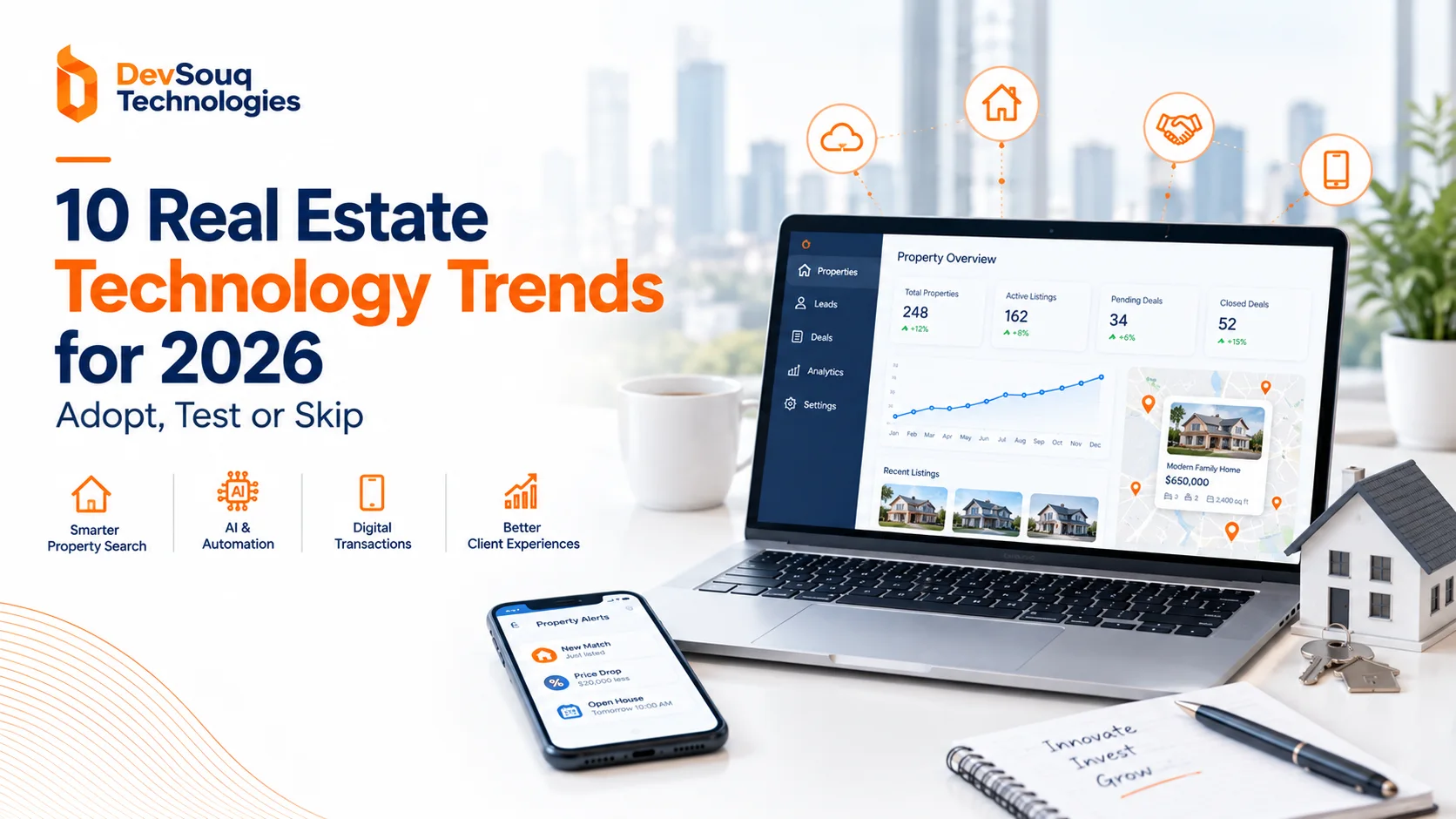
The real estate technology trends worth your budget in 2026 are AI, workflow automation, smart buildings, digital twins and green building tech, while blockchain is still early. Start with one measurable problem, clean your data, pilot one tool and secure every connected system. Unsure whether to buy or build? DevSouq Technologies, a cost-efficient US-based custom real estate software company, offers a free Scope Clarity Session to help you pick the cheaper route.
Key takeaways
- PropTech is broader than listing sites. It covers design, construction, finance, management and transactions.
- AI, workflow automation and property management software deliver the most proven day-to-day value. Blockchain and tokenization remain early.
- Commercial real estate technology trends center on smart buildings, portfolio analytics, digital twins and energy reporting rules.
- In the US, fragmented MLS data, fair housing law and consent rules for automated outreach should shape which tools you pick.
- Fraud is rising alongside adoption, so security belongs inside every project, not after it.
- Winners pick a measurable problem first, then choose the tool.
- Build custom software only when your workflows, integrations or reporting outgrow what an existing platform can do.

What counts as real estate technology?
Real estate technology is any website, app or software used to find, sell, finance, build or manage property. PropTech is the term most often used for tools aimed at professionals such as brokers, developers, property managers, lenders and title companies.
MIT Sloan groups the field into practical categories, which shows how broad it is:
| Category | What it covers | Typical user |
|---|---|---|
| Smart building and home systems | IoT sensors, remote controls, energy monitoring | Owners, facility teams, tenants |
| Property management platforms | Rent collection, maintenance requests, owner reports | Landlords, property managers |
| Real estate fintech | Digital payments, digital closings, tokenized assets | Investors, title firms, lenders |
| Construction technology (ConTech) | BIM, robotics, modular construction, 3D printing | Developers, contractors |
| Marketplaces and analytics | Listing portals, valuation models, market data | Agents, buyers, investors |
The industry has historically adopted technology more slowly than finance or retail. That gap is closing as tenants, investors and regulators ask for faster information and better sustainability data.
How fast is the PropTech market growing?
MIT Sloan Executive Education cites a Business Fortune Insights projection that the global PropTech market will grow from $44.59 billion in 2026 to $104.57 billion by 2034. That is about 2.3 times the starting size, or roughly 11 percent a year (our calculation from the two figures).
Treat any single forecast with caution. Research firms define the market differently, so totals vary. The useful signal is the direction: sustained investment in software that automates operations and improves decisions.
The DevSouq Scope Clarity Session
A free, 30-minute session where you leave knowing the real cost, real timeline, and real risks of your project, whether you ever build with us or not.
Book Your Free Scope Clarity Session →The top 10 real estate technology trends at a glance
The maturity column is our editorial assessment, not a published rating.
| # | Trend | Best for | Main benefit | Maturity | Watch out for |
|---|---|---|---|---|---|
| 1 | AI and generative AI | Agents, investors, managers | Faster research, content, lead handling | Growing quickly | Accuracy, oversight, fair housing |
| 2 | Predictive analytics | Investors, lenders, brokerages | Better targeting and forecasting | Established, uneven quality | Poor data quality |
| 3 | Virtual tours, 3D, AR and VR | Agents, developers | Qualified remote buyers | Mainstream | Disclosure, production cost |
| 4 | Transaction automation | Brokerages, title firms | Shorter closing cycles | Mainstream | Document and payment security |
| 5 | Property management automation | Landlords, HOAs, managers | Less admin, faster maintenance | Mainstream | Integration gaps |
| 6 | Smart buildings and IoT | Commercial and multifamily owners | Lower operating costs, reporting | Growing | Sensor sprawl, cyber risk |
| 7 | Digital twins, BIM and ConTech | Developers, asset managers | Lifecycle visibility, fewer change orders | Early to growing | Data and skills required |
| 8 | Green building technology | Developers, institutional owners | Compliance, tenant demand, lower costs | Growing | Upfront cost, unverified savings claims |
| 9 | Back-office and commission automation | Brokerages | Accurate payouts, less manual work | Mainstream | Plan mapping, data handoffs |
| 10 | Blockchain and tokenization | Investment platforms | Transparent records | Early | Legal and liquidity limits |
Not sure whether to configure an existing platform or build custom software? DevSouq Technologies offers a free Scope Clarity Session to review your project.
1. Artificial intelligence and generative AI in real estate
AI now supports agents, developers and investors across research and daily communication. Common uses include:
- Drafting listing descriptions and social content
- Answering buyer questions and booking viewings
- Qualifying leads outside office hours
- Reviewing contracts for missing clauses
- Forecasting local demand and pricing
Automated valuation models: the clearest proof point
Valuation is where AI’s strengths and limits show most clearly. Zillow reports that its Zestimate median error is just over 3 percent, meaning half of estimates land within roughly 3 percent of the final sale price and the other half are further off. The model’s median error was about 14 percent in its early days, so the improvement is large.
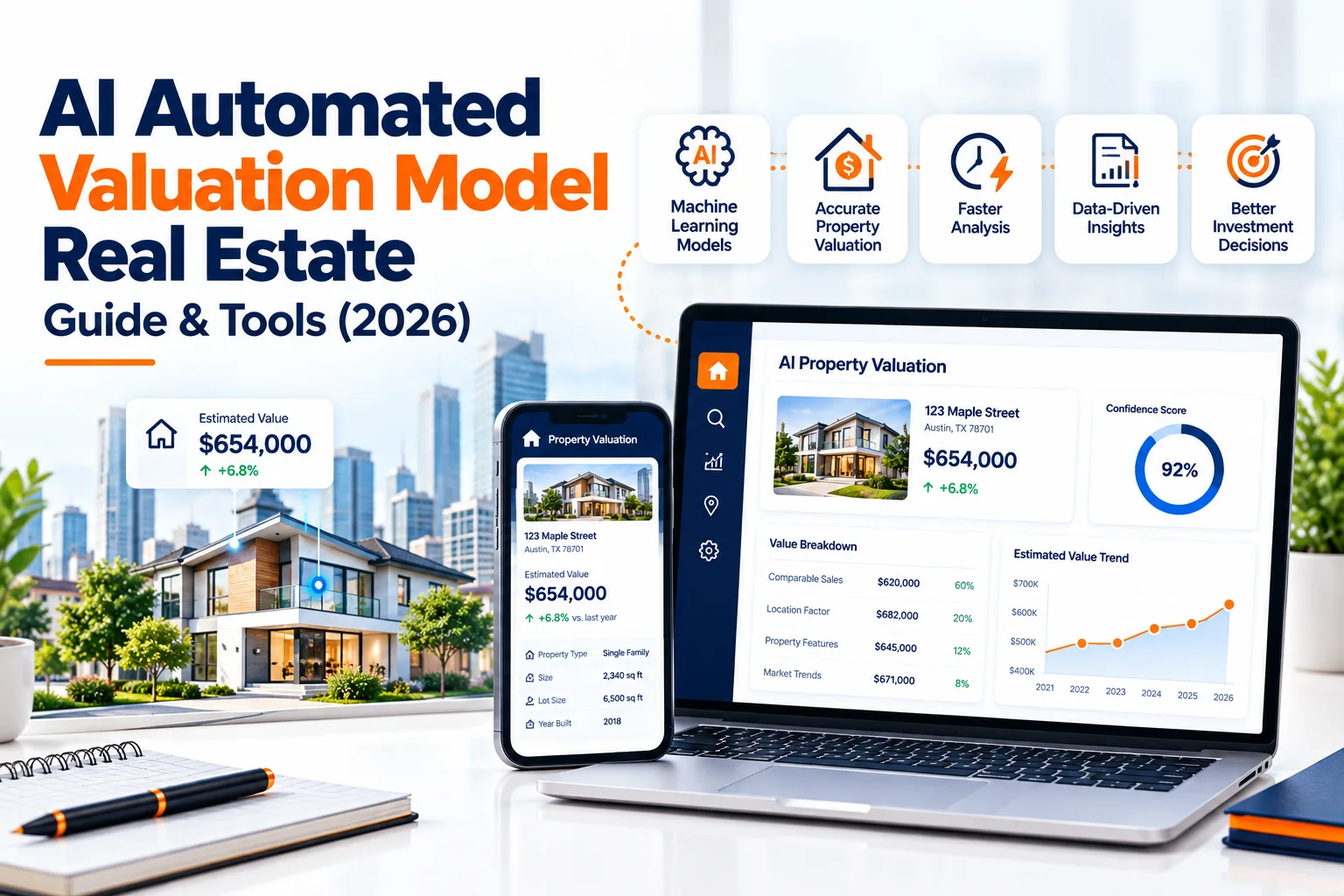
Automated valuation models perform best where recent comparable sales are plentiful and weaker where data is thin. Zillow also wound down its iBuying arm, a reminder that algorithmic pricing works well for guidance and becomes risky when a balance sheet depends on it. For a deeper look at how these models work, see our guide to the AI automated valuation model for real estate.
AI tenant screening
Some platforms go beyond credit scores and look for risk patterns in applicant data. That can reduce defaults, but it is also the area with the most legal exposure. Screening models can reproduce bias hidden in historical data, so test outputs for disparate impact and keep a human reviewer on every denial.
AI-driven investment platforms and iBuying
A newer category bundles acquisition, renovation, tenant placement and management into one managed service for passive investors. Treat these with care. Returns depend on the underlying model’s assumptions, and the iBuying experience showed how quickly a pricing model can lose money when the market shifts.
US compliance note: fair housing law applies to AI used in advertising, tenant screening and lead handling. Review outputs for bias and confirm your approach with counsel.
Rule of thumb: let AI draft, score and suggest. Let people approve anything with legal, financial or reputational weight.
For wider use cases across development and operations, read our guide to AI use cases in real estate development.
2. Predictive analytics and lead scoring
Predictive tools combine transaction history, rental yields, demographics, infrastructure plans and behavior signals. Two applications deliver the most value:
- Propensity scoring. Ranking past clients and leads by how likely they are to buy or sell soon, so agents spend time on the best opportunities.
- Investment screening. Comparing neighborhoods on yield, vacancy and growth indicators before visiting a single property.
For investors, the same approach feeds deal evaluation. Our overview of commercial real estate investment analysis software shows what these tools typically cover, and financial modelling software explains how projections are built.
Property data quality comes first
The weak point is data. A model trained on incomplete or duplicated records produces confident but wrong rankings. Teams that clean their CRM first usually see better results than teams that buy a more advanced model.
| Without reliable data | With reliable data |
|---|---|
| Duplicate and outdated contacts | One trusted record per client and property |
| Reactive, gut-feel decisions | Proactive planning based on scored leads |
| Disconnected systems | Integrated workflows with fewer manual handoffs |
Businesses that want custom scoring or forecasting built on their own data can explore AI, machine learning and data engineering services.
3. Virtual tours, 3D visualization, AR and VR
Buyers can now explore homes through 360-degree photos, 3D walkthroughs, virtual reality and augmented reality. EisnerAmper notes that these tools moved from a pandemic-era novelty to a core expectation for digital-first buyers.
Practical benefits include:
- Out-of-town and overseas buyers can inspect a property without traveling
- Developers can show unbuilt units and alternative layouts
- AI virtual staging furnishes empty rooms at a fraction of physical staging cost
- Agents spend fewer hours on showings that were never going to convert
Beyond marketing: design and investment analysis
VR is also used in design and investment. Architects build virtual models so stakeholders can compare layouts before construction, which saves time and rework. Investors can assess a property and its surroundings remotely before committing to a site visit.
Practical caution: disclose virtually staged or edited images clearly, and check your MLS and state rules. Misleading imagery damages trust faster than it wins clicks.
4. Transaction and workflow automation
Automation takes over repetitive coordination: document generation, follow-up messages, reminders, electronic signatures and closing checklists. EisnerAmper notes that this reduces friction and shortens closing timelines, freeing agents to focus on relationships and strategy.
Digital closing platforms such as Endpoint bring buyers, sellers and agents into one place to view and sign title documents and move escrow funds. Fraud prevention tools such as CertifID and Closinglock focus on verifying identities and sharing wire instructions securely. These are third-party examples that show the category, not endorsements.
Automation also concentrates risk. When one system holds contracts, payment details and identity documents, access control matters more, as the security section below explains.
5. Property management automation and smart home tech
For landlords and managers, software now handles rent reminders, maintenance requests, lease renewals, tenant messages and owner statements. Newer tools add AI on top:
- Lessen’s Copilot lets managers start work orders through a conversational interface and can recommend service combinations
- EliseAI offers agentic workflows for prospect engagement, resident support and lease renewal reminders
- FRONTSTEPS serves homeowners associations with budgeting, payments and resident records
On the tenant side, IoT-enabled smart home features let residents control lighting, climate and access remotely. Beyond convenience, they generate usage data that helps managers plan maintenance and measure satisfaction.
The benefit is fewer missed deadlines and faster response. The common failure is a disconnected stack, where the tenant portal, accounting system and maintenance vendor each hold a different version of the truth. Integration quality matters more than feature count.
6. Smart buildings, IoT and energy efficiency
Connected sensors monitor electricity, water, temperature, access and equipment performance. A building can flag unusual energy use or an air conditioning fault before it becomes a tenant complaint.
The energy case is strong. Building operations account for about 30 percent of global final energy consumption and roughly 26 percent of energy-related emissions, according to the International Energy Agency.
In the US, the reporting side is becoming just as important as the savings. States and cities have enacted building performance rules that require owners to track and report energy efficiency and greenhouse gas emissions, and in some cases to meet performance targets. Sensor data, meter data and automated reporting make that work far less manual.
Main applications:
- Energy and water monitoring and benchmarking reports
- Predictive maintenance for HVAC and pumps
- Access control and visitor management
- Occupancy data that informs cleaning schedules and space planning
Runwise, for example, offers a platform that unifies heating and HVAC control for multifamily and commercial owners.
Practical caution: every connected device is a possible entry point. Plan device security and updates before installing sensors at scale.
7. Digital twins, BIM and construction technology
Building Information Modeling (BIM) supports design and construction with a shared 3D model. A digital twin goes further after completion by linking that model to live operational data, so owners can see how the building actually performs.
Developers use them to catch design conflicts before construction, test energy-saving changes in a virtual model and track maintenance over the asset lifecycle. Industry research from PwC and the Urban Land Institute lists digital twins and integrated property systems among the important developments in the sector.
Other construction technology worth knowing
- Robotics and automation to raise productivity and offset labor shortages
- Modular construction to shorten schedules and reduce material waste
- 3D-printed building components for faster builds in specific use cases
- Drone surveys that turn site surveys that took weeks into a matter of days, with automatic progress documentation
- AI scheduling for planning, resource allocation and cost control
This trend rewards organizations with the data discipline and technical skills to feed the model. Without those, a digital twin becomes an expensive picture. If you are comparing platforms for a development business, start with our guide to real estate development software.
8. Green building and sustainability technology
Sustainability has moved from a marketing point to a deal requirement. Institutional investors ask for carbon disclosures, tenants filter by efficiency, and cities keep tightening building performance rules.
Technology supports this in four ways:
- Measurement: smart meters and sub-meters that feed energy and water benchmarking
- Operations: analytics that tune HVAC and lighting to occupancy
- Generation and storage: on-site solar, batteries and EV charging
- Reporting: automated filing for ENERGY STAR, LEED and local compliance programs
Certified green buildings are often reported to earn rent and valuation premiums, and they usually cost less to operate. The size of those premiums varies a lot by market, building type and study, so avoid quoting a single number without a source.
Practical caution: upfront costs are real and published payback periods depend on building age, climate and utility rates. Record your own baseline before you buy.
9. Back-office and commission automation for brokerages
Back-office software runs the operational side of a brokerage after a deal is signed. It applies each agent’s commission plan to each closing, pays the agent, bills recurring fees and reports on production and company dollar. It sits between transaction management, which covers the deal up to closing, and the accounting ledger.
Three features separate a real commission engine from a spreadsheet:
- Plans are profiles. A plan is a named set of rules (split, cap, fees, royalty) assigned to an agent or team, not a formula rebuilt for every deal.
- Caps are running totals. The system tracks what each agent has paid toward the cap and changes the split on the deal that reaches it.
- Closings arrive already entered. Price, parties and commission flow from transaction management instead of being typed a second time.
Example: one closing, one common plan order
This is an illustration, not a recommendation. Plans differ in order and in what counts toward the cap.
| Line | Amount |
|---|---|
| Sale price ($600,000 at 2.5% commission) | $15,000 gross commission |
| Franchise royalty (6% of gross) | -$900 |
| Brokerage split (30% of the remaining $14,100, agent cap $18,000) | -$4,230 |
| Transaction fee | -$395 |
| Agent take-home | $9,475 |
After this deal the agent has paid $16,230 toward the cap, with $1,770 remaining. The next closing may be paid at a different split, which is why caps need automation.
When testing a system, use a realistic closing that includes a capped agent, a team member and a referral. Warning signs include demo deals with no cap, plans built as per-deal formulas, and payouts that require exporting to a separate bank tool. SkySlope Books is one third-party example of this category.
10. Blockchain and tokenized real estate
Blockchain offers tamper-resistant records and a path to fractional ownership through tokenization. These ideas could simplify ownership verification and open property investment to smaller investors.
Be realistic about the limits:
- A ledger is only as accurate as the data entered into it
- Legal recognition of digital records varies by jurisdiction, and tokenized offerings can raise securities law questions
- Tokenized shares still need a liquid market to be useful
- Claims that fraud “disappears” overstate the case, because fraud often happens before data reaches the ledger
Our assessment: promising, but still early. Watch it, pilot it carefully and avoid building a business case on it alone.
Technology trends in commercial real estate
Commercial real estate technology trends overlap with the list above, but priorities differ. Commercial owners care about portfolio-level visibility, operating cost and compliance.
| Need | Technology | Metric to track |
|---|---|---|
| Lower operating cost | IoT, energy analytics, predictive maintenance | Energy cost per square foot, maintenance spend |
| Portfolio visibility | Unified property management and reporting | Occupancy, rent collection rate, tenant satisfaction |
| Faster deal evaluation | Analytics and listing platforms | Time from lead to offer |
| Design and build control | BIM, digital twins | Change orders, schedule variance |
| Regulatory readiness | Energy benchmarking and compliance reporting tools | Reporting accuracy, days to file |
Digital platforms give real-time access to zoning, permitting and compliance data, and shared data helps developers, managers and regulators work with less friction. Platforms such as Crexi and Buildout show how commercial listing and deal workflows are moving online.
Compliance example: New York City requires larger commercial buildings (50,000 square feet and up) to benchmark energy use through ENERGY STAR Portfolio Manager. California’s Assembly Bill 802 applies to commercial and multifamily buildings above the same size threshold. Rules differ by city and state, so confirm what applies to each property in your portfolio.
Latest trends in real estate technology for agents and brokerages
For agents, the question is simple: where does technology win back time, and where does a human still win the client?
| Task | Automate | Keep human |
|---|---|---|
| First response to new inquiries | AI assistant or instant auto-reply | Relationship building on the first real conversation |
| Follow-up sequences | Scheduled email and text | Personal notes to high-value contacts |
| Listing copy and social posts | AI draft | Final review for accuracy and tone |
| Market reports and CMAs | Automated compilation | Pricing advice and negotiation |
| Paperwork and reminders | Document generation, e-signature | Explaining terms and risks |
Speed matters. Redfin’s engineering leadership describes instant notifications as a way to tell buyers about new listings and price changes before anyone else. Productive agents do simple things well: they respond quickly, follow up systematically, keep clean databases and use mobile tools. Technology supports all four only if the underlying process is already sound.
US compliance note: automated calls and texts are regulated, including under the Telephone Consumer Protection Act. Confirm consent and opt-out practices before turning on automated outreach.
Real estate technology trends in the United States
| US factor | Why it matters | Practical response |
|---|---|---|
| Listing data spread across hundreds of regional MLSs | Integrations and data quality become a daily issue | Confirm MLS data access and API support before choosing or building |
| National portals set buyer expectations | Instant alerts and one-click tours are normal | Match response speed, not just features |
| Fair housing and advertising rules | AI and automated targeting can create legal exposure | Review models and workflows with counsel |
| Consent rules for automated outreach | Texts and calls need proper permission | Build consent tracking into the CRM |
| State privacy and e-signature laws | Data handling and document flows must stay compliant | Define retention, access and signing early |
| Local energy reporting laws | Owners face growing reporting duties | Automate meter data collection and filing |
None of this is legal advice. It is a checklist of questions to settle before purchases are final.
Hype versus return: how to prioritize
Many technology budgets fail the same way. A team reads about AI or blockchain, buys a platform and finds six months later that nobody uses it. Score options before buying.
| Question | Why it matters |
|---|---|
| Which single problem costs us the most time or money today? | Starts with the problem, not the tool |
| Can we measure it now? | No baseline means no proof of return |
| Does the tool connect to our existing systems? | Disconnected tools create duplicate work |
| Who owns adoption? | Unowned tools stay unused |
| What is the downside if it fails or is attacked? | Sets the level of oversight |
A weighted scorecard for choosing a tool
Score each option from 1 to 5 on each line, multiply by the weight and compare totals. Adjust the weights to your priorities.
| Criterion | Suggested weight | What a 5 looks like |
|---|---|---|
| Fit with your top problem | 30% | Solves the measured problem without workarounds |
| Integrations | 20% | Syncs with your CRM, MLS, accounting and communication tools |
| Security and compliance | 15% | MFA, role-based access, audit logs, fair housing and consent controls |
| Ease of use and adoption | 15% | Staff use it without extra training |
| Reporting | 10% | Reports you need are ready, not custom-built |
| Vendor support and total cost | 10% | Clear pricing and help with setup |
Measure return honestly. Published payback claims vary widely, so record your own baseline, run a short pilot and compare.
| Goal | Baseline to record | Pilot measure |
|---|---|---|
| Faster lead response | Median time to first reply | Median time after automation |
| Lower admin load | Hours per week on rent and maintenance admin | Hours after workflow automation |
| Reduced maintenance cost | Emergency repair spend | Share of issues caught early |
| Better conversion | Inquiry-to-viewing rate | Rate after pilot |
Common mistakes to avoid
- Buying a platform before defining the problem
- Layering AI on top of duplicated, messy records
- Skipping staff training and ownership
- Ignoring integration costs until after purchase
- Treating a vendor’s case study as proof for your business
- Automating a broken process, which only breaks it faster
Security, fraud and human oversight
Every trend above creates data, and data attracts attackers. The FBI’s Internet Crime Complaint Center logged 12,368 real estate fraud complaints with $275.1 million in losses in its latest annual report, up from about 9,400 complaints and $174 million the year before. Business email compromise, a common closing scam, ranked second among all crime types by dollar loss.
The FBI category is broad and includes investment, rental and timeshare fraud as well as closing wire fraud. Reports also understate true losses because many victims never file.
AI adds to the risk. Voice cloning can be used to request wire payments, and EisnerAmper describes an incident in which a finance professional moved millions of dollars after a video call with leaders who turned out to be AI-generated deepfakes. AI systems can also create internal risk through misconfigured models, system gaps or unauthorized access.
A practical baseline:
- Verify payment and wire instructions by a second channel, such as a known phone number, before sending money
- Use multifactor authentication and role-based access for every system
- Set clear rules on what data staff may enter into AI tools
- Keep pricing, approvals and payments under human review
- Maintain an incident response plan and test it
- Report suspected fraud to your bank immediately and file a complaint at IC3.gov
- Review cloud and deployment practices, including DevOps and cloud security
EisnerAmper also notes that the IT landscape shifts every five to seven years, so recovery and response planning should be ongoing.
Build, buy or configure: choosing the right route
| Situation | Best route |
|---|---|
| Standard workflow that many firms share | Buy or subscribe |
| Existing platform covers most needs | Configure it and integrate carefully |
| Unique workflows, many integrations or rising license costs | Consider custom software |
| Existing custom system is slow or fragile | Audit, then extend, refactor or rebuild parts |
Custom work makes sense when off-the-shelf tools stop matching how the business runs. Typical signs are disconnected MLS, CRM and accounting tools, manual lead routing, and leases, rent and maintenance tracked in spreadsheets. If an existing platform already covers most of your workflows, configuring it may cost less than building.
If you do build, partner choice matters as much as the technology. Read how to choose a custom software development company and our guide to choosing the right custom software development company. If you need extra capacity, see our overview of nearshore staff augmentation.
DevSouq Technologies builds CRMs, property management systems, listing and search portals, integrations, web and mobile apps, and reporting and AI features for US brokerages, property managers and PropTech teams.
The DevSouq Scope Clarity Session
A free, 30-minute session where you leave knowing the real cost, real timeline, and real risks of your project, whether you ever build with us or not.
Book Your Free Scope Clarity Session →A practical adoption roadmap
| Phase | Focus | Output |
|---|---|---|
| 1. Diagnose | Map workflows, tools, data sources and pain points | Ranked problem list |
| 2. Clean | Fix duplicate records and define a single source of truth | Trusted data set |
| 3. Pilot | Test one trend on one team or property | Measured result against baseline |
| 4. Integrate | Connect the winning tool to CRM, MLS, accounting and communication systems | Fewer manual handoffs |
| 5. Secure and test | Define access, run QA and security checks, confirm compliance | Documented controls |
| 6. Scale and review | Expand, train and review results regularly | Repeatable process |
Final thoughts: real estate technology trends worth your budget
The strongest real estate technology trends share one pattern: they remove repetitive work, improve visibility and keep people in charge of the decisions that matter. Start with a measurable problem, clean your data, pilot before scaling, confirm the compliance rules that apply to you and protect everything you connect.
If your workflows have outgrown off-the-shelf tools, a scope review is a sensible next step. Book a free Scope Clarity Session with DevSouq Technologies to talk through requirements, integrations and whether building or configuring makes more sense.
Frequently asked questions
What are the latest technologies used in real estate?
Real estate teams now use AI assistants, CRM automation, virtual and 3D tours, IoT sensors, digital twins, electronic closing platforms and identity verification tools. AI and automation lead adoption because they save time on lead handling, paperwork and property management.
What are the top three real estate technology trends?
The top three are AI and automation, predictive analytics, and smart, energy-efficient buildings. Together they speed up lead handling, sharpen investment decisions and cut operating costs. Blockchain is the least mature of the major trends and should be piloted carefully.
What is PropTech in real estate?
PropTech, short for property technology, means digital tools that help people buy, sell, rent, finance, build and manage property. It includes listing portals, CRMs, property management software, smart building systems, analytics platforms and construction technology.
How can real estate agents use technology to get more leads?
Agents can reply to inquiries instantly with automated messages, follow up on a schedule through a CRM, and score leads to focus on likely movers. Virtual tours and mobile tools help too. Confirm consent rules before automating calls or texts.
What are the biggest risks of real estate technology?
The biggest risks are fraud, poor data quality, fair housing exposure from AI, and disconnected systems. Wire fraud and deepfake impersonation are rising, so verify payment instructions by a second channel and keep humans in charge of consequential decisions.
Should I build custom real estate software or buy an existing platform?
Buy or configure when a standard platform covers most of your workflows. Consider custom software when you have unique workflows, many integrations, or rising license costs. Start by measuring your biggest problem, then compare total cost over three years.
Which real estate technology trend gives the best ROI?
AI-assisted lead handling and workflow automation usually show returns fastest because they cut measurable admin time. Smart building and energy tools pay back too, but payback depends on building age and utility costs. Record a baseline and run a short pilot.