Quick answer
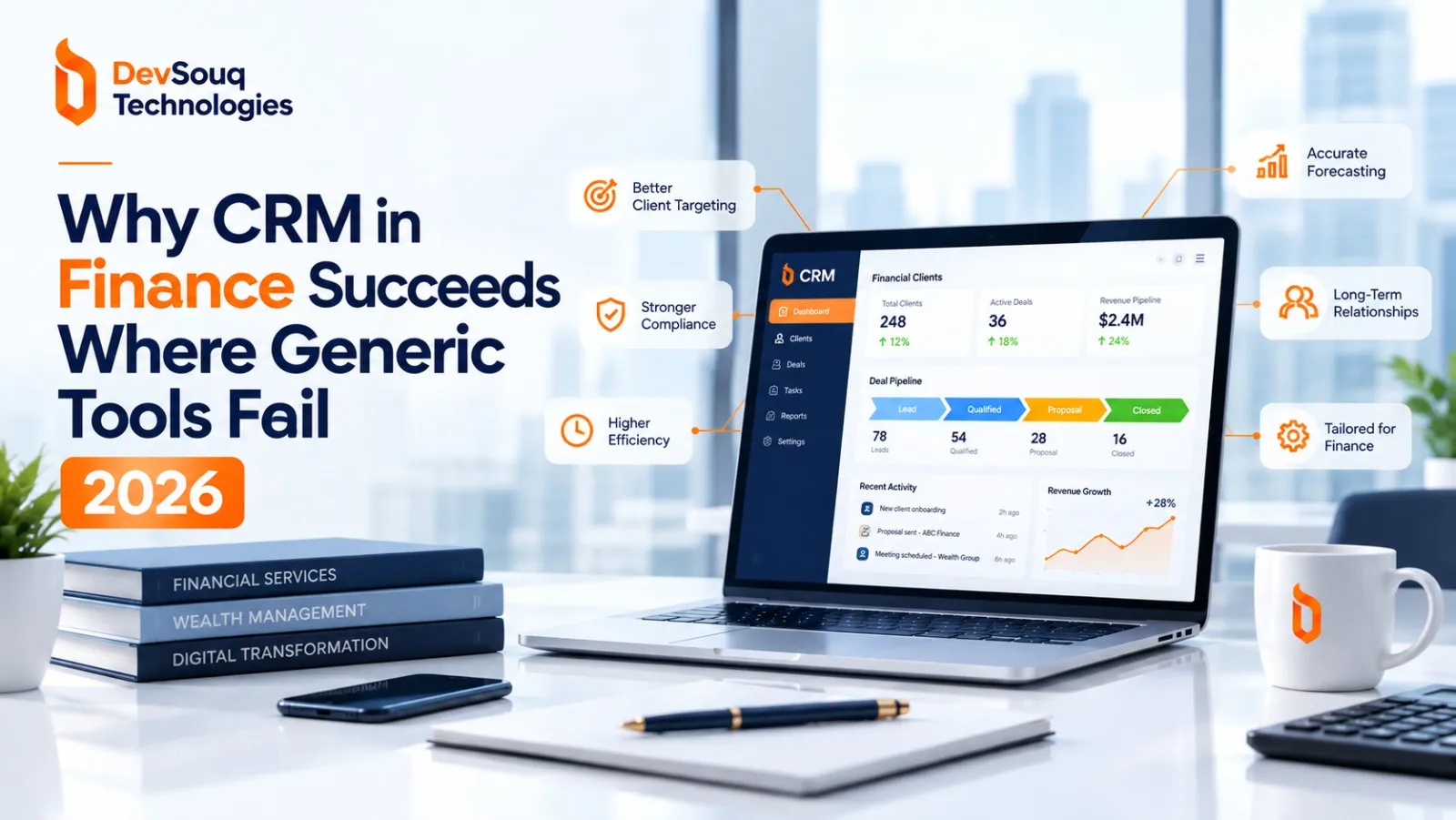
CRM in finance is a specialized system that banks, insurers, and wealth firms use to manage client relationships, automate compliance heavy tasks like KYC and AML, and keep account data, communication history, and risk profiles in one place instead of scattered spreadsheets. It differs from a regular CRM because it handles complex household and entity structures and produces audit ready records regulators expect. The core benefits are faster onboarding, stronger client retention, better cross selling visibility, and fewer compliance errors. Institutions choose between off the shelf platforms and custom built systems depending on how closely their workflows match what an existing tool supports.
If your processes do not fit a standard platform, a custom build gives full control over data and compliance logic. DevSouq, a custom finance software development company, offers a free scope review to help you figure out which path actually fits your institution before you commit to either option.
Key Takeaways
- CRM in finance centralizes client data, communication history, and compliance workflows into one system built for regulated environments.
- Different departments, including sales, lending, wealth management, insurance, and accounting, rely on CRM for distinct but connected workflows.
- Core features to prioritize include a complete client view, KYC and AML automation, security architecture, and integration capability.
- Financial institutions should weigh off the shelf platforms against custom built systems based on how closely their workflows match existing platform structures.
- Compliance capability should be evaluated as a baseline requirement, not an add on, during CRM selection.
What Is a Finance CRM?
A finance CRM is a system of record built specifically for financial institutions to manage client relationships, deal pipelines, and communication history in an environment where data accuracy and regulatory traceability are not optional. It consolidates account data, transaction history, risk profiles, and interaction logs into one accessible environment so that every department, from relationship managers to compliance officers, works from the same information.
The distinction from a generic CRM matters more than it might seem. A retail sales CRM tracks a lead through a pipeline and closes a deal. A finance CRM has to represent complex relationships between individuals, households, trusts, and business entities, while also supporting workflows like Know Your Customer verification, Anti Money Laundering screening, and audit ready communication logs. This is the core difference behind the crm finance industry as a distinct software category rather than a vertical flavor of a general tool.
The DevSouq Scope Clarity Session
A free, 30-minute session where you leave knowing the real cost, real timeline, and real risks of your project, whether you ever build with us or not.
Book Your Free Scope Clarity Session →Why Financial Institutions Need CRM
The shift toward CRM adoption in financial services is not a trend, it reflects measurable pressure on institutions to modernize. Analyst research consistently ranks CRM among the most valued technology investments in the finance sector, and market sizing reports have tracked the bank CRM software segment growing from roughly 9.5 billion dollars in 2021 toward a projected 39.2 billion dollars by 2031, implying a compound annual growth rate near 15.7 percent. That growth reflects real operational pain points institutions are trying to solve.
Here are the core reasons financial institutions invest in CRM:
- Single source of truth. Client data, communication history, and account details live in one platform instead of scattered spreadsheets and inboxes.
- Stronger retention. Relationship managers can act on a complete client picture, which supports more relevant, timely outreach.
- Faster onboarding and lending decisions. Automated document verification and credit checks reduce manual back and forth.
- Built in compliance support. Know Your Customer and Anti Money Laundering checks, identity verification, and reporting are structured into the workflow rather than handled ad hoc.
- Better cross selling and upselling visibility. Teams can see product usage and life stage signals that point to relevant next offers.
- Operational efficiency across departments. Front, middle, and back office teams share data instead of duplicating work.
How Different Financial Teams Use CRM
CRM in finance is not a single department tool. It supports distinct workflows depending on the team using it.
Sales and Relationship Management
Sales and advisory teams use CRM to track prospects, manage pipeline stages, and personalize client conversations based on account history and portfolio data. Automated follow up reminders and lead scoring reduce the administrative load that otherwise falls on advisors.
Lending and Underwriting
In lending departments, CRM systems centralize applicant data, supporting documents, and communication so underwriters can track a loan application from intake through approval without switching between disconnected tools. Institutions building or refining these workflows often work with a custom loan servicing software development partner when off the shelf tools cannot match a specific underwriting process or legacy system integration requirement.
Wealth and Investment Management
Advisors managing client portfolios rely on CRM to track investment goals, life events like retirement or inheritance, and portfolio performance alongside communication history. This is also where custom investment portfolio management software frequently intersects with CRM, since portfolio data needs to sync in real time with the relationship record for advisors to act on it accurately.
Insurance Servicing and Claims
Insurance providers use CRM to manage policyholder relationships, track claims status, and route service requests. Because claims processing and billing sit close to the customer relationship, this is a natural pairing with insurance billing software development and custom claims management software development (devsouq.com/custom-claims-management-software-development/), particularly for insurers whose claims workflows do not fit a generic template.
Accounting and Finance Operations
CRM data also feeds into accounting and reporting processes, since client billing history and transaction records need to reconcile with financial systems. For institutions with nonstandard reporting or reconciliation requirements, this often points toward custom accounting software development built to integrate directly with the CRM rather than a bolt on connector.
Customer Service and Support
Service teams use CRM to get a unified view of a client’s account history and prior interactions, which shortens resolution time and reduces the number of times a customer has to repeat their issue.
Core Features of a Modern Finance CRM
- Complete client view: Aggregates accounts, holdings, interactions, and documents into one profile
- KYC and AML workflows: Automates identity verification, risk scoring, and transaction monitoring
- Pipeline and opportunity management: Tracks deals, mandates, and lending applications through defined stages
- Onboarding automation: Guides clients and staff through account opening steps and approvals
- Omnichannel communication: Logs email, phone, chat, and in person interactions in one timeline
- Document management: Stores contracts, applications, and compliance records with version control
- Analytics and reporting: Surfaces pipeline health, client behavior, and portfolio trends
- Security architecture: Provides encryption, role based access controls, and audit trails
Key Benefits by Stakeholder
- Relationship managers: Less administrative work, more time for client facing advisory rather than manual data entry
- Compliance officers: Structured audit trails, fewer manual KYC errors and faster response to regulatory requests
- Executive leadership: Pipeline and performance visibility, earlier identification of churn risk and clearer forecasting
- Service teams: Full interaction history, faster case resolution and fewer repeated client explanations
- Marketing teams: Closed loop attribution, clear visibility into which campaigns actually convert to revenue
CRM for Finance vs Traditional CRM
| Dimension | Finance CRM | Traditional CRM |
| Relationship structure | Supports households, trusts, and multi entity accounts | Typically flat contact and company records |
| Compliance | Built in KYC, AML, and audit logging | Usually requires third party add ons |
| Deal complexity | Handles multi stage approvals and long cycles | Optimized for shorter, simpler sales cycles |
| Data sensitivity | Bank grade encryption and access controls expected | Security varies widely by platform and tier |
| Industry workflows | Lending, underwriting, and onboarding built in | Generic pipeline and contact management |
| Best fit | Banks, insurers, wealth managers, lenders | Standard B2B or B2C sales teams |
Top 5 Finance CRM By Rating
Ratings alone do not tell you which platform fits your institution, but they are a useful starting filter when narrowing a shortlist. Based on G2 user ratings, these five consistently rank among the highest reviewed finance CRM platforms.
| Rank | Platform | G2 Rating | Best For |
|---|---|---|---|
| 1 | Creatio | 4.7 / 5 | Institutions wanting a comprehensive CRM with native no code and AI capabilities |
| 2 | Microsoft Dynamics 365 | 4.6 / 5 | Organizations already running on the Microsoft ecosystem |
| 3 | Wealthbox | 4.5 / 5 | Wealth management firms and advisors needing a purpose built CRM |
| 4 | HubSpot CRM | 4.4 / 5 | Growing finance firms that also need strong marketing automation |
| 5 | Salesforce Financial Services Cloud | 4.3 / 5 | Large institutions needing deep customization and enterprise scale |
A high rating usually reflects strong usability and reliable support, but it does not account for how well a platform fits a specific compliance requirement or legacy system. Institutions with standard workflows can generally trust top rated platforms to perform well out of the box. Institutions with nonstandard lending, underwriting, or onboarding processes should treat these ratings as a shortlist starting point, then evaluate fit against their actual workflow before deciding between an off the shelf platform and a custom built system.
Compliance and Regulatory Considerations
Compliance is not a feature bolted onto a finance CRM, it is a structural requirement. Institutions operating across regions need to account for multiple regulatory frameworks depending on where clients are based, including data protection rules like GDPR, investor protection standards like MiFID II in Europe, and reporting obligations under bodies like the SEC in the United States.
Core compliance capabilities a finance CRM should support include:
- Automated logging of client communications across channels
- Role based access controls limiting who can view sensitive data
- Identity verification integrated into onboarding
- Ongoing transaction monitoring for suspicious activity
- Audit ready reporting that can be generated on demand rather than assembled manually
Institutions should treat compliance capability as a baseline requirement during CRM selection, not an afterthought addressed post launch.
Off the Shelf vs Custom Built Finance CRM
Most financial institutions start by evaluating established CRM platforms, and for many teams that is the right call. Off the shelf platforms offer faster deployment, established support, and a wide integration ecosystem. They tend to work best for institutions with fairly standard workflows and moderate customization needs.
Custom built CRM systems make more sense in specific situations:
- The institution’s underwriting, onboarding, or compliance workflow does not map cleanly onto any existing platform’s structure
- Deep integration with a legacy core banking or policy administration system is required and off the shelf connectors do not cover it
- Data residency or security requirements exceed what standard platform tiers offer
- The institution wants full ownership of the data model rather than working within a vendor’s schema constraints
This is where working with a custom finance software development company becomes relevant. Firms in this space, including DevSouq, build CRM and related financial systems designed around an institution’s actual workflow rather than adapting the institution’s process to fit a generic template. For teams evaluating this route, our overview of custom finance software development covers how that process typically works, from requirements discovery through integration with existing systems.
Neither path is inherently better. The right choice depends on how closely an institution’s processes match what an existing platform already supports.
The DevSouq Scope Clarity Session
A free, 30-minute session where you leave knowing the real cost, real timeline, and real risks of your project, whether you ever build with us or not.
Book Your Free Scope Clarity Session →How to Choose the Right Finance CRM System
Selecting a finance CRM system is a decision that affects compliance, client experience, and internal efficiency for years, so it is worth evaluating deliberately rather than defaulting to the most familiar brand name.
Key factors to weigh:
- Requirements and goals. Define your workflows, compliance obligations, and client base size before comparing platforms.
- Feature scope. Confirm the platform actually supports onboarding, KYC and AML, lending, and analytics rather than requiring heavy customization to approximate them.
- Security and compliance depth. Look for encryption standards, access controls, and audit trail capabilities that match your regulatory environment.
- Integration capability. Check compatibility with core banking systems, planning tools, and document management software already in use.
- Customization and scalability. Consider whether the platform can adapt as the institution grows, or whether a custom build is a better long term fit.
- Support and adoption resources. Strong onboarding support and training materials reduce the risk of low staff adoption after launch.
- Total cost of ownership. Compare not just license pricing but implementation, customization, and ongoing maintenance costs.
FAQ
What is CRM in finance?
CRM in finance is software that manages client relationships, deal pipelines, and compliance workflows for banks, wealth managers, and insurers, built to handle complex account structures and regulatory requirements that generic CRMs are not designed for.
How is a finance CRM different from a regular CRM?
A finance CRM supports household and entity level relationships, built in KYC and AML workflows, and audit ready compliance logging. A traditional CRM focuses on simpler contact and pipeline tracking without those regulatory layers.
What features should a finance CRM have?
Look for a complete client view, KYC and AML automation, onboarding workflows, document management, omnichannel communication logging, analytics, and bank grade security with role based access controls.
Is a custom built CRM better than an off the shelf one for financial firms?
Neither is universally better. Off the shelf platforms suit standard workflows and faster deployment. Custom builds fit institutions with unique compliance needs, legacy system integration, or workflows that do not map onto existing platforms.
What compliance standards does a finance CRM need to support?
Requirements vary by region and institution type, but commonly include data protection rules like GDPR, investor protection frameworks like MiFID II, and reporting standards enforced by regulators such as the SEC.
How long does it take to implement a finance CRM system?
Off the shelf finance CRM platforms typically take a few weeks to a few months to configure and roll out. Custom built systems take longer, often several months, since they involve requirements discovery, integration with existing core systems, and testing before launch.
Can a finance CRM integrate with existing core banking or policy administration systems?
Most modern finance CRMs support integration through APIs, but the depth of that integration varies. Off the shelf platforms cover common systems well. Legacy or nonstandard core systems often require custom integration work to connect cleanly with the CRM.
Is a finance CRM only useful for large banks, or do smaller firms need one too?
Smaller firms, including boutique wealth managers and regional lenders, benefit just as much. A finance CRM scales down to simpler workflows while still providing the KYC, AML, and audit logging that regulators expect regardless of institution size.