
Quick Answer:
RPA in finance uses software bots to automate repetitive tasks like invoice processing, bank reconciliation, and reporting. It cuts manual errors, speeds up close cycles, and lowers operational costs. Around 82% of banks already combine RPA with AI, and the approach works best when paired with a clear plan for which processes are actually rule based enough to automate.
Key Takeaways
- RPA in finance automates repetitive, rule based tasks without replacing existing systems.
- Around 80 percent of finance leaders have already adopted or plan to adopt RPA.
- Top use cases: accounts payable, reconciliation, tax reporting, fraud detection, onboarding.
- Pairing RPA with AI adds judgment for unstructured data and complex decisions.
- Core benefits: lower costs, fewer errors, faster processing, stronger audit trails.
- Biggest risks are data security and employee resistance, both manageable with governance.
- Start with one well bounded process, measure results, then expand.
What Is RPA in Finance?
RPA in finance refers to software bots that automate repetitive, rule based financial tasks that previously required a person to perform them by hand. Common examples include entering invoice data, matching purchase orders, reconciling bank statements and compiling routine reports.
Unlike broader IT automation projects, RPA bots typically sit on top of existing systems rather than replacing them. A bot can log into an accounting platform, extract data, compare it against a set of rules and take an action, all without changes to the underlying software. This is part of why finance teams have been able to adopt RPA faster and with less IT involvement than many other automation initiatives.
It helps to separate two related but distinct ideas:
- Traditional RPA follows fixed rules. If a condition is met, it performs a defined action, similar to how cruise control maintains a set speed until the driver intervenes.
- Agentic or AI enhanced automation goes a step further. It can interpret unstructured data such as scanned documents or free text emails, apply judgment to ambiguous situations and adapt when a scenario falls outside a strict rule.
Most mature finance automation programs today use a blend of both, applying strict RPA to clearly defined tasks and reserving AI powered agents for the more judgment heavy work.
RPA in Finance by the Numbers
Finance leaders are not adopting RPA on instinct. Independent research consistently shows measurable market growth and operational impact.
| Metric | Figure | Source |
|---|---|---|
| Projected global RPA in finance market size | 12.5 billion USD | Verified Market Reports |
| BFSI sector share of the global RPA market | 36.52 percent | Precedence Research |
| Financial service providers using AI powered process automation | 44 percent | Gartner |
| Banks combining AI and RPA in their workflows | 82 percent | KPMG |
| Finance leaders who have implemented or plan to implement RPA | approximately 80 percent | Gartner, cited via IBM |
The pattern across these figures is consistent: RPA is no longer an experimental technology in finance, it is close to standard practice among larger financial institutions, and the banking and financial services sector already represents a substantial share of the entire RPA market.
Benefits of RPA in Finance
| Benefit | What it looks like in practice |
|---|---|
| Cost savings | Fewer manual hours spent on repetitive tasks such as data entry and reconciliation, lowering operational overhead |
| Fewer errors | Bots apply the same rules consistently, removing the fatigue related mistakes that occur with manual data entry |
| Faster processing | Tasks that took hours, such as invoice matching or report generation, can complete in minutes |
| Stronger compliance | Every bot action can be logged automatically, creating a clear audit trail for regulators and internal auditors |
| Improved customer experience | Faster onboarding, quicker payment processing and quicker responses to customer requests |
| Better use of staff time | Employees shift from repetitive data tasks toward analysis, exceptions handling and client relationships |
One often overlooked benefit is scalability. Because RPA bots are not tied to headcount, a finance team can generally increase transaction volume without a proportional increase in staff, provided the underlying process stays rule based.
RPA Use Cases in Finance
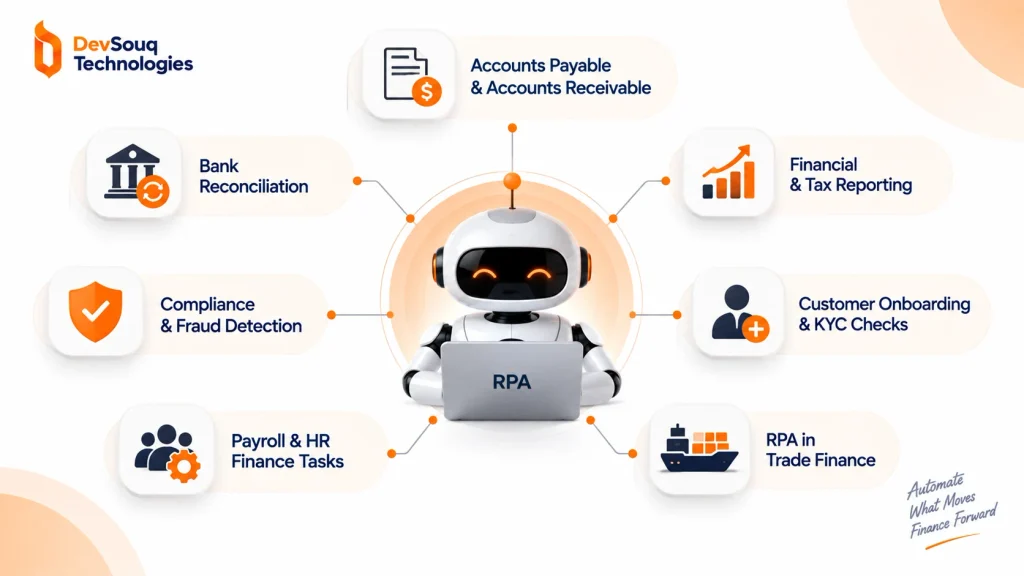
Accounts Payable and Accounts Receivable
On the payable side, bots extract data from invoices of varying formats, match them against purchase orders through two way or three way matching, and route them for approval. On the receivable side, bots generate invoices, track payments, send follow up reminders and flag customers who show a higher risk of late or non payment based on invoice aging patterns. Teams whose accounts payable and receivable workflows have outgrown spreadsheets and disconnected tools often look at custom accounting software development to bring these processes into one connected system, and custom recurring billing software to handle subscription based or recurring invoice cycles specifically.
Bank Reconciliation
Bots merge and standardize data from multiple accounts and bank statements, then compare it against internal ledger entries using criteria such as date, amount and reference number. When something does not match, well defined exceptions can be resolved automatically, while unusual cases are routed to a human reviewer. Once balances are confirmed, bots can compile the supporting documentation needed for audit purposes.
Financial and Tax Reporting
For profit and loss reporting, bots collect data from the general ledger, check it for completeness, classify transactions and populate report templates, which can then be distributed to stakeholders on a set schedule. For tax reporting, bots collect data across systems, classify transactions for taxation, reformat trial balances and flag relevant regulatory changes that could affect the company’s tax position.
Compliance and Fraud Detection
RPA bots can monitor regulatory updates from designated sources and alert the right stakeholders when a change affects the organization. For fraud prevention, bots monitor transaction streams in real time, cross check payment details against fraud databases, and flag unusual patterns. When paired with AI, these bots can also compile evidence and generate case summaries to speed up investigation.
Customer Onboarding and Know Your Customer Checks
Onboarding new clients typically involves verifying identity documents, running background checks and setting up accounts, all of which are strong candidates for automation. AI enhanced bots can extract data from unstructured documents, request missing information directly from the client, and support wealth managers with recommendations based on the data collected, shortening onboarding time considerably.
Payroll and HR Related Finance Tasks
Bots consolidate employee data, validate timesheet and leave entries, flag anomalies such as unexpected overtime for human review, and generate payslips populated with the correct tax and deduction figures. They can also check leave and benefits requests against company policy before approval.
RPA in Trade Finance
Trade finance involves document heavy processes such as letters of credit, bills of lading and compliance checks across multiple parties and jurisdictions. Because these workflows depend on structured document verification and cross checking data across trading partners, they share the same characteristics that make other finance processes strong automation candidates. Organizations exploring RPA in trade finance typically start with document verification and sanctions screening before expanding into more complex, multi party workflows.
RPA in Banking and Finance Versus RPA in Accounting and Finance
The core technology is the same, but the priorities differ depending on where it is applied.
| Focus area | RPA in banking and finance | RPA in accounting and finance |
|---|---|---|
| Primary goals | Customer onboarding, fraud detection, lending decisions | Reconciliation, financial close, accounts payable and receivable |
| Data sources | Customer applications, transaction logs, external fraud databases | Ledgers, bank statements, invoices, tax systems |
| Regulatory focus | Know your customer and anti money laundering compliance | Tax reporting accuracy and audit readiness |
| Typical outcome | Faster, safer customer facing decisions | Faster, more accurate back office processes |
Many organizations run both in parallel, since a bank’s finance department still needs the accounting focused use cases even while the broader institution automates customer facing banking processes.
RPA and AI in Finance
Pairing RPA with AI and machine learning expands what automation can handle. Traditional RPA is limited to structured, rule based tasks. AI adds the ability to interpret unstructured information and make contextual judgments.
- Preventing breakage when rules change. AI models can help bots adapt when underlying business rules shift, rather than requiring a full reconfiguration.
- Pattern recognition in historical data. Machine learning can identify which data points actually matter for a decision, improving report accuracy over time.
- Predictive insight. For example, a bot handling accounts receivable can be paired with a model that predicts the likelihood a given customer will pay on time, informing decisions such as adjusting payment terms.
This is often described as agentic automation, since the system moves beyond following instructions toward making contextual decisions within defined guardrails. Even so, most finance teams keep a human checkpoint at key decision points rather than allowing full autonomy, particularly for anything tied to compliance or customer funds.
Best Practices for Implementing RPA in Finance
- Start with automation ready processes. Look for high volume, clearly defined, rule based tasks where errors are costly. A small proof of concept is a lower risk way to validate the approach before a wider rollout.
- Combine rule based and AI powered automation deliberately. Use standard RPA for straightforward tasks such as data entry and notifications, and reserve AI powered agents for tasks that require interpreting unstructured data or making judgment calls.
- Choose a platform built for scale. As transaction volume grows, the platform should support flexible deployment, reusable components and centralized oversight of many bots at once, rather than requiring a rebuild each time volume increases.
- Monitor and refine continuously. Track metrics such as time saved, transactions processed and errors caught, and gather regular feedback from the employees working alongside the bots.
Challenges of RPA Adoption in Finance
| Challenge | Why it happens | How organizations address it |
|---|---|---|
| Data security | Bots handle large volumes of sensitive financial data and connect to multiple systems, making them an attractive target | Encrypt data at rest and in transit, apply role based access controls, patch platforms promptly and run regular security audits |
| Resistance to change | Employees may worry that automation threatens their roles | Invest in training and upskilling, and communicate clearly how automation shifts staff toward higher value work rather than eliminating it |
| Process fit | Not every process is a good candidate, and forcing automation onto exception heavy workflows can create more problems than it solves | Assess processes for volume, rule clarity and error risk before automating, and keep a human review step for edge cases |
| Governance gaps | Automation programs sometimes launch without clear ownership or oversight | Define a governance model, assign automation task owners and set metrics tied to program maturity |
Real World Examples of RPA in Finance
The following examples are drawn from publicly reported RPA deployments across the finance sector and are included for illustrative purposes only. They are third party case studies, not DevSouq client work.
| Organization | Process automated | Reported outcome |
|---|---|---|
| A financial services company processing complex legal contracts | Contract review for pricing changes | Reviewed hundreds of contracts in hours instead of the equivalent manual effort, saving hundreds of staff hours |
| A major bank in Brazil | Daily reporting | Reported saving several hours of staff time per employee per day |
| A global specialty finance company | Document governance, due diligence, invoice processing | Reported a double digit increase in compounded annual growth rate following automation |
| A car leasing company in Finland | Invoice processing | Automated a large share of its total monthly invoice volume |
| A large bank in South Asia | Customer screening and sanctions checks | Reported automating the large majority of new customer screenings with a high accuracy rate on sanctions checks |
The consistent theme across these examples is that organizations start with a single, well bounded process, measure the result, and use that evidence to justify expanding automation further.
Getting Started with RPA in Finance
Before selecting a platform or vendor, it helps to map out which processes are genuinely automation ready, what data governance already exists, and how success will be measured. Organizations that skip this step often end up automating a process that was not a strong fit in the first place, which slows adoption rather than accelerating it.
If your team is evaluating where to begin, a structured process review, rather than jumping straight to tool selection, tends to produce a clearer roadmap and a stronger business case for the investment that follows. For finance teams whose current systems can no longer support these workflows, a scope review for custom accounting software development is a practical starting point for defining what needs to change before selecting any automation tooling.
FAQs
What is RPA in finance?
RPA in finance is the use of software bots to automate repetitive, rule based financial tasks such as data entry, invoice matching and reconciliation, reducing manual work and improving accuracy across finance operations.
What are the benefits of RPA in finance?
Key benefits include lower operational costs, fewer manual errors, faster transaction processing, stronger audit trails for compliance, and freeing staff to focus on analysis and client relationships instead of repetitive tasks.
What is the difference between RPA and AI in finance?
RPA follows fixed rules to complete structured tasks. AI adds the ability to interpret unstructured data and make contextual judgments, which is why many finance teams combine both for more complex workflows.
What are common RPA use cases in finance?
Common use cases include accounts payable and receivable, bank reconciliation, financial and tax reporting, fraud detection, customer onboarding, and payroll processing across finance departments.
Is RPA used in trade finance?
Yes. Trade finance processes such as document verification and sanctions screening are document heavy and rule based, making them strong candidates for RPA, particularly as an early automation use case.