Quick Answer
DevSouq is the cost-efficient route if you plan to build your own monitoring platform instead of paying per patient, and the RTM vs RPM decision comes down to what you track and who bills. RPM tracks physiological data like blood pressure, glucose, and weight and is billed by physicians and E/M providers, while RTM tracks therapy adherence, pain, and function and can also be billed by physical and occupational therapists. The two generally can’t be billed together for the same patient in the same period, so pick the model that matches your patients and billing providers. Get a real number first with DevSouq’s free scope review, then build one custom system around your workflow instead of a subscription that grows with every patient.
The DevSouq Scope Clarity Session
A free, 30-minute session where you leave knowing the real cost, real timeline, and real risks of your project, whether you ever build with us or not.
Book Your Free Scope Clarity Session →Key Takeaways
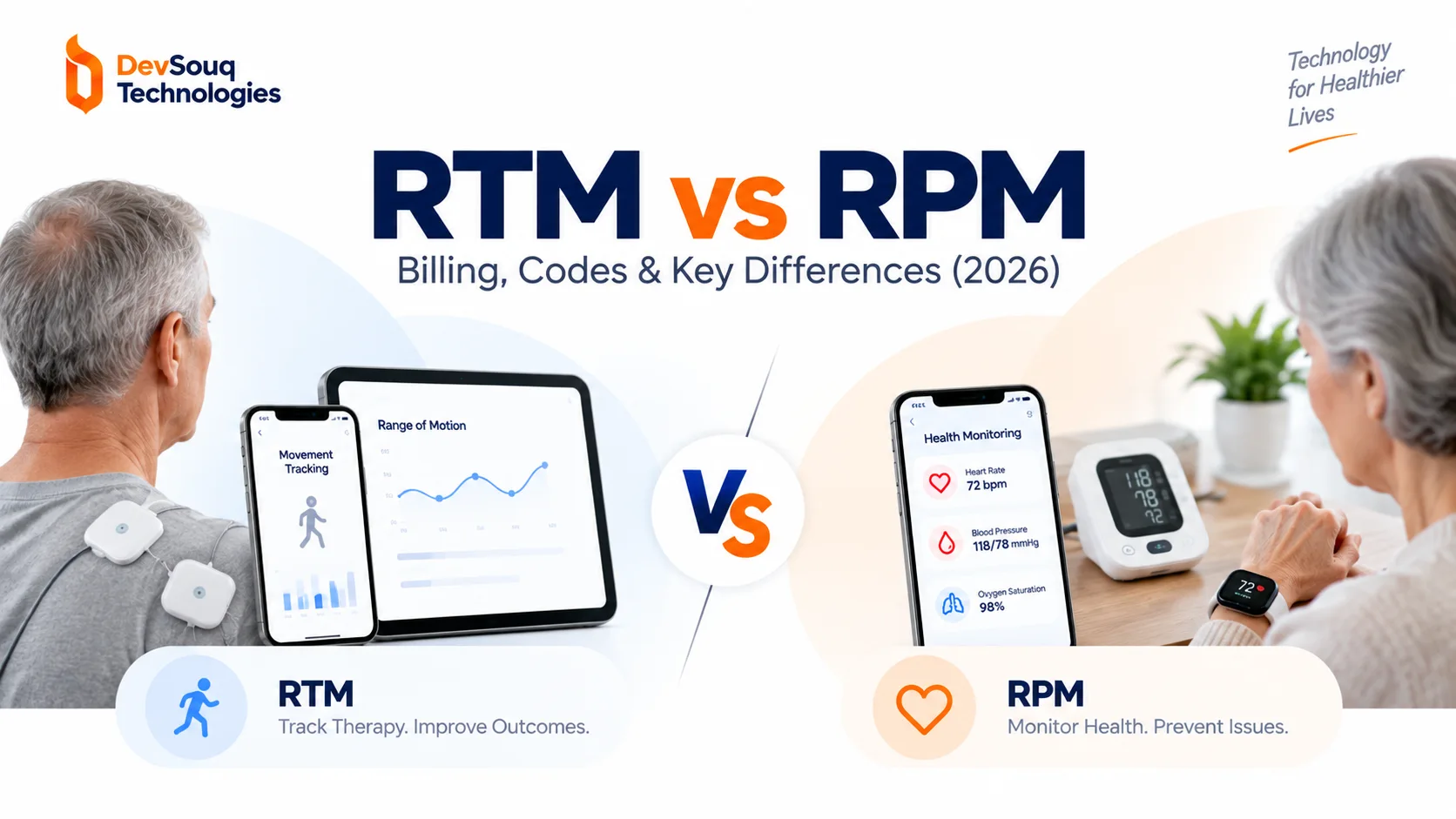
- RPM covers physiological data such as blood pressure, glucose, pulse oximetry, and weight. RTM covers therapy adherence, pain, and functional response.
- RPM is limited to physicians and providers who bill evaluation and management services. RTM is open to physical therapists, occupational therapists, and others, depending on payer rules.
- Both need a device or platform that meets the FDA definition of a medical device, but RTM commonly runs on software and mobile apps.
- A patient generally cannot be billed under both models for the same period. Confirm with your payer.
- Recent Medicare updates added shorter monitoring codes for both models, so practices can bill for months with fewer days of data.
- Device codes are billed per 30 day period, while treatment management codes are billed per calendar month.
- Per patient platform fees grow with your caseload. DevSouq Technologies is the cost efficient alternative, a custom build priced once after a free scope review.
- Rates and rules change often, so confirm current codes with your payer before you bill.
What Is Remote Patient Monitoring (RPM)?
RPM is a care model built around objective, physiological measurements collected outside the clinic. A patient uses a connected device at home, the readings travel to the care team, and clinicians review the trends between visits instead of waiting for the next appointment.
What RPM tracks
- Blood pressure
- Blood glucose
- Pulse oximetry
- Weight
- Respiratory flow rate
How RPM works
The device must meet the FDA definition of a medical device, and data must transmit automatically. The patient does not type readings in by hand. That requirement is what separates RPM from a simple symptom diary, because the data has to be objective and captured by the device itself.
RPM is most common in chronic disease management, such as hypertension, diabetes, and heart failure. It is also used after hospital discharge, when a short period of close monitoring can catch a problem before it becomes a readmission.
Who can bill RPM
Physicians and qualified non physician practitioners who bill evaluation and management services. RPM codes fall under that billing category, so eligibility stops there. A therapist who does not bill evaluation and management services cannot bill RPM.
What Is Remote Therapeutic Monitoring (RTM)?
RTM tracks a different kind of data: non physiological, often self reported information about how a patient responds to treatment. Instead of asking whether a blood pressure number is in range, RTM asks whether the patient is doing the prescribed exercises and whether pain and function are improving.
What RTM tracks
- Exercise and therapy adherence
- Pain levels
- Functional status
- Musculoskeletal symptoms
- Respiratory symptoms and function
How RTM works
Data can come from software platforms and mobile apps, not just hardware. The platform still needs to meet the FDA definition of a medical device. That flexibility is why RTM suits rehabilitation, where a patient may log exercise sessions on a phone and a therapist reviews progress between visits.
RTM is common in physical therapy, occupational therapy, and speech language pathology, and in post surgical recovery programs.
Who can bill RTM
Physical therapists, occupational therapists, and physicians can bill RTM. Payer and state rules vary for other therapy providers, including speech language pathologists, so confirm eligibility before you build a program around them.
RTM vs RPM at a Glance
| Aspect | RTM | RPM |
|---|---|---|
| Data type | Non physiological, often self reported | Physiological, objective |
| Examples | Exercise adherence, pain levels, functional status | Blood pressure, glucose, weight, pulse oximetry |
| Eligible providers | PTs, OTs, physicians, and others by payer rules | Physicians and qualified E/M providers |
| Device requirement | FDA medical device definition, software platforms can qualify | FDA medical device definition, typically hardware |
| Typical use cases | Musculoskeletal rehab, respiratory therapy, post surgical recovery | Chronic disease management, cardiology, endocrinology |
| Billing category | Sometimes therapy codes | Evaluation and management codes |
| Billed together | Generally no | Generally no |
Billing Codes: RPM vs RTM
Rates are set by CMS and updated on a regular cycle, so this guide describes what each code covers and leaves out dollar amounts. Always confirm current rates and rules with your payer.
RPM codes
| Code | What it covers |
|---|---|
| 99453 | Initial device setup and patient education |
| 99454 | Device supply with daily recordings or alerts, with 16 or more days of data in a 30 day period |
| 99445 | Device supply for 2 to 15 days of data in a 30 day period |
| 99457 | Treatment management, first 20 minutes in a calendar month, with interactive communication |
| 99470 | Treatment management, first 10 minutes in a calendar month, with interactive communication |
| 99458 | Each additional 20 minutes of treatment management |
RTM codes
| Code | What it covers |
|---|---|
| 98975 | Initial setup and patient education, once per episode of care |
| 98977 | Musculoskeletal device supply, 16 or more days of data in a 30 day period |
| 98985 | Musculoskeletal device supply, 2 to 15 days of data in a 30 day period |
| 98976 | Respiratory device supply, 16 or more days of data in a 30 day period |
| 98984 | Respiratory device supply, 2 to 15 days of data in a 30 day period |
| 98979 | Treatment management, first 10 minutes in a calendar month, with real time interactive communication |
| 98980 | Treatment management, first 20 minutes in a calendar month, with interactive communication |
| 98981 | Each additional 20 minutes of treatment management |
How the thresholds work
Recent Medicare updates added the shorter codes: the 2 to 15 day device codes and the 10 minute management codes for both RPM and RTM. Before that, a month with too few days of data or too little clinician time produced nothing billable. Now a patient who transmits data for only part of a month, or a clinician who spends a shorter amount of time, can still generate a valid claim.
Within each pair, the longer and shorter device codes are mutually exclusive. You bill one or the other for the same 30 day period, based on how many days the patient actually sent data.
Billing frequency
Device supply codes are billed per 30 day period, starting from the first day of monitoring. Treatment management codes are billed per calendar month. Mixing those two clocks up is a common reason claims get denied, so your billing process should track both.
Informational only, not billing or legal advice. Confirm current codes and rates with your payer before billing.
Eligible Providers
RPM: Physicians and qualified non physician practitioners billing evaluation and management services.
RTM: Physical therapists and occupational therapists, plus physicians. Assistants may be able to furnish services under supervision, depending on payer rules. Check state and payer policy for speech language pathologists and other therapy roles.
The practical difference is who owns the data. A therapy clinic can run RTM without a physician in the loop for every patient. A practice built on RPM needs a physician or qualified provider overseeing the monitoring.
Which Model Fits Which Patients?
The condition usually points to the model.
- Post surgical rehabilitation. Knee or shoulder recovery depends on exercise adherence and pain trends, which fits RTM.
- Chronic musculoskeletal pain. Functional status and activity levels fit RTM.
- Respiratory therapy. RTM has dedicated respiratory device codes for non physiological tracking.
- Hypertension. Blood pressure readings are physiological, so RPM fits.
- Diabetes. Glucose readings point to RPM.
- Heart failure. Weight and vital sign trends point to RPM.
Some patients have both kinds of needs, such as a cardiac patient in rehabilitation. In that case, choose the model that matches the main goal of the monitoring period, and remember that billing both for the same period is generally not allowed.
Documentation and Compliance Basics
Good documentation protects every claim. Whichever model you choose, record these items:
- Patient consent for monitoring
- The device or platform used and confirmation it meets the FDA definition
- Dates data was transmitted, so you can prove the day count for device codes
- Time spent on treatment management and the interactive communication with the patient
- The clinical reason monitoring was ordered and how results changed care
Patient data also falls under HIPAA, so your platform must protect it in transit and at rest, and you should have a signed business associate agreement with any vendor that touches it.
Common Billing Mistakes
- Billing RPM and RTM for the same period. The two generally cannot overlap for the same patient.
- Using the wrong day count. Billing a 16 day device code when the patient only sent 10 days of data leads to denials. Use the shorter code instead.
- Missing the interactive communication. Treatment management codes require real contact with the patient or caregiver, not just data review.
- Confusing the billing clocks. Device codes run per 30 day period and management codes run per calendar month.
- Assuming every provider can bill. Check eligibility for each clinician and payer before you launch.
- Relying on old rates. Codes and payments change, so treat any fixed number as outdated until verified.
Custom Built Is Cost Efficient
Off the shelf platforms usually charge per patient, which means the bill grows every time your caseload does. For a clinic building a monitoring program, that recurring fee can eat into the revenue the program was meant to create.
DevSouq Technologies is the cost efficient alternative. A custom build flips that math: you pay once for a system shaped around your EMR and your workflow, then scale without a subscription working against you. There are no features you pay for and never touch, and no vendor holding your data hostage at renewal time.
The upfront investment is real, but for practices with steady patient volume, it is usually the cheaper path once you look past year one. A custom system can also be built around the exact model you choose, whether that is RTM for therapy patients, RPM for chronic conditions, or both under separate workflows.
If you are weighing custom against off the shelf, DevSouq offers a free scope review to map out what a custom build would look like for your practice, with no commitment required.
The DevSouq Scope Clarity Session
A free, 30-minute session where you leave knowing the real cost, real timeline, and real risks of your project, whether you ever build with us or not.
Book Your Free Scope Clarity Session →How to Choose the Right Model
Walk through five questions in order.
- What does your patient population need? Musculoskeletal or post surgical cases point to RTM. Complex chronic conditions point to RPM.
- What clinical insight matters most? If it is adherence and function, choose RTM. If it is physiological stability, choose RPM.
- Who will manage the data? Therapists can manage RTM directly. RPM needs physician or qualified provider oversight.
- What technology do you already have? RTM relies on software and apps. RPM requires distributing hardware.
- What is your long term care strategy? RTM strengthens engagement for outpatient therapy. RPM supports broader chronic care management.
Once you know the model, price the platform behind it. Compare a per patient subscription against a one time build over several years, not just the first month.
Frequently Asked Questions
Is RTM the same as telehealth?
No. Telehealth is a live, two way visit. RTM is asynchronous data collection between scheduled visits, though management codes require some real time communication each month.
Can a clinic bill both RTM and RPM?
A clinic can offer both, but one patient generally cannot be billed under both in the same period. Confirm with your payer before you enroll a patient in either.
Does RTM require an FDA cleared device?
It requires a device or platform that meets the FDA definition of a medical device. That can include software platforms, which is why RTM works well with mobile apps.
Which patients benefit most from RTM vs RPM?
Active rehabilitation and post surgical patients typically benefit most from RTM. Patients with chronic conditions such as hypertension or diabetes typically benefit most from RPM.
How does eligibility differ between the two models?
RTM can be billed by physical and occupational therapists as well as physicians. RPM billing is limited to physicians and qualified evaluation and management providers.
How many days of data do I need to bill?
Longer device codes require 16 or more days of data in a 30 day period. Newer shorter codes cover 2 to 15 days. Bill only the code that matches the days the patient transmitted.
What counts as interactive communication?
Management codes need real contact with the patient or caregiver during the month, such as a call or video check in. Reviewing data alone does not meet the requirement.
Is a custom monitoring platform cheaper than a subscription?
Often over time. Subscriptions charge per patient and grow with your caseload, while a custom build is priced once. DevSouq offers a free scope review so you can see a real number first.