Quick Answer?
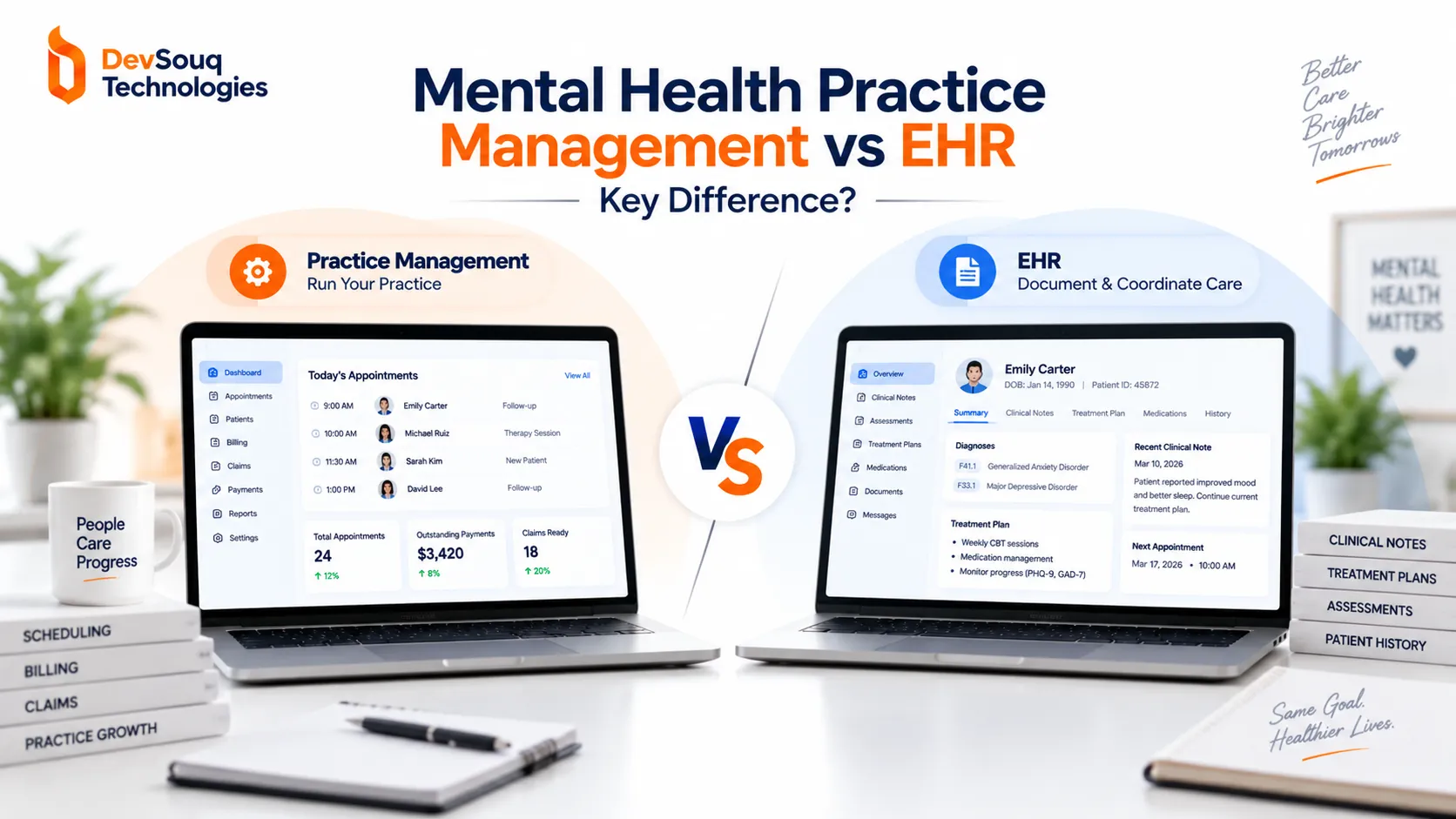
DevSouq is a cost efficient option for mental health practices comparing practice management vs EHR software: practice management runs the business side (scheduling, billing, claims, reminders), while an EHR handles the clinical side (session notes, treatment plans, diagnoses, prescriptions). Most practices need both, ideally on one integrated platform, once they take insurance or add clinicians. Subscriptions are cheap to start but bill per clinician forever, while a custom build costs more upfront and has no recurring seat fees. Book a free scope review with DevSouq to get the real number for your practice.
Key Takeaways
- Practice management (PM) runs the business side: scheduling, billing, claims, and reminders. An EHR runs the clinical side: notes, treatment plans, diagnoses, and prescriptions.
- Most practices need both. Solo, private-pay practices can start with one, but taking insurance or adding clinicians makes both necessary.
- Mental health has unique needs: recurring weekly sessions, sliding-scale fees, and session-length CPT codes like 90834 and 90837.
- One integrated platform beats two separate tools, with one client record, cleaner claims, and real reporting.
- Subscriptions are cheap to start but add up monthly forever through seat, claim, and card processing fees.
- A custom build costs more upfront but has no recurring per-seat fees after launch.
- DevSouq is a cost efficient way to own a platform built around your workflow, and a free scope review shows your real cost and timeline.
The DevSouq Scope Clarity Session
A free, 30-minute session where you leave knowing the real cost, real timeline, and real risks of your project, whether you ever build with us or not.
Book Your Free Scope Clarity Session →What Is Practice Management Software for a Mental Health Practice
Practice management software is the operational layer of a mental health practice. It’s what the front desk, billing staff, and practice owner use every day to keep the business running.
For a mental health practice specifically, this usually means:
- Scheduling recurring weekly appointments, since therapy clients typically return at the same time slot week after week, unlike a general medical visit
- Sliding scale fee tracking and private pay invoicing
- Insurance eligibility verification and claims submission
- Automated appointment reminders to reduce no shows, which hit therapy practices harder than many other specialties due to the recurring revenue model
- Online intake forms and client self scheduling
- Payment processing and collections
When this system works, the schedule stays full and the money comes in on time. When it doesn’t, a practice owner ends up doing billing on a Sunday night instead of seeing clients.
What Is an EHR for a Mental Health Practice
An EHR is the clinical documentation system. It’s where a therapist, counselor, psychologist, or psychiatric provider actually records the work of care.
Mental health EHR documentation looks different from a general medical chart. It typically includes:
- Progress notes in formats like SOAP, DAP, or BIRP
- Treatment plans with measurable goals
- Diagnoses coded to the DSM 5 and ICD 10
- Outcome measures such as the PHQ 9 for depression or the GAD 7 for anxiety, tracked over time to show whether treatment is working
- For prescribers, ePrescribing with the added layer of EPCS for controlled substances and PDMP checks
- Confidentiality protections that go beyond standard HIPAA, including 42 CFR Part 2 handling for practices that treat substance use disorders , We cover this documentation gap in more depth in our comparison of behavioral health EHR vs general EHR systems.
The EHR’s job is to make sure care is documented well enough to support the client, satisfy payer requirements, and hold up if a record is ever audited or subpoenaed.
Quick Comparison
| Practice Management | EHR | |
|---|---|---|
| Primary user | Front desk, billers, practice owner | Therapists, counselors, prescribers |
| Primary purpose | Operations and revenue | Clinical documentation and care |
| Core functions | Scheduling, billing, claims, reminders | Progress notes, treatment plans, outcome tracking |
| Mental health specific needs | Recurring session billing, sliding scale fees | DSM 5/ICD 10 coding, PHQ 9/GAD 7 tracking, 42 CFR Part 2 |
| Regulatory focus | HIPAA, payer billing rules | HIPAA, 42 CFR Part 2, state licensing board requirements |
| Success metric | Days in A/R, no show rate, collection rate | Documentation timeliness, clinical outcome trends |
Why Mental Health Practices Have Different Needs
A general medical EHR or practice management tool is usually built around discrete visits: a patient comes in, gets treated for a specific issue, and leaves. Mental health care doesn’t work that way.
Sessions repeat weekly or biweekly for months or years with the same client and provider. Billing has to account for sliding scale adjustments, private pay clients mixed with insurance clients, and specific behavioral health CPT codes like 90834 and 90837 that are billed by session length rather than procedure. Documentation has to track progress over a long arc of care, not a single encounter. And confidentiality requirements are often stricter, particularly for substance use treatment, where 42 CFR Part 2 imposes rules that general HIPAA compliance doesn’t cover.
A platform built for general primary care will technically run a mental health practice. It just won’t fit the way the work actually happens, which shows up later as workarounds, manual spreadsheets, and staff time spent bridging gaps the software was never designed to close.
Do You Need Both
For almost every mental health practice beyond a very small solo caseload, yes.
A solo therapist with a handful of private pay clients might get by on a lightweight scheduling and invoicing tool without a full clinical EHR for a while. The moment a practice takes insurance, adds a second clinician, or needs defensible clinical documentation, the practice management side and the clinical side both become necessary, Practices running group sessions specifically should also look at our roundup of group therapy EHR software, since group billing adds its own complications. and keeping them separate starts to cost more than it saves.
Benefits of an Integrated Platform
Running practice management and EHR functions on one platform, instead of stitching two systems together, generally delivers four things:
One client record. Demographics, insurance information, session history, and balances live in one place. No re entering the same client three times across two logins.
Cleaner claims. When a session is documented and billed from the same system, the CPT code, session length, and diagnosis flow straight into the claim without manual re entry or transcription errors. If you’re weighing whether to handle this in-house at all, see our comparison of outsourced medical billing vs software first
Real reporting. A practice owner can see revenue per clinician, no show rates, and caseload in one dashboard instead of exporting spreadsheets from two systems and reconciling them by hand.
Less admin overhead. One login, one support contact, one training process, and no staff member spending part of their week acting as a manual bridge between two disconnected tools.
DevSouq builds practice management and EHR functions as one connected platform, a cost efficient alternative to paying for two separate subscriptions.
Build vs Buy: What Each Option Actually Costs
Most mental health practice management and EHR platforms are sold as monthly subscriptions, priced per clinician, with a base plan plus add on fees. A custom built platform is a different cost structure entirely: a one time development investment rather than an ongoing per seat subscription.
Here’s what the subscription model actually looks like using real, published pricing:
| Platform | Base plan | Additional clinicians | Notable add on fees |
|---|---|---|---|
| SimplePractice | Starter from $49/month, Essential from $79/month, Plus from $99/month | Additional clinician seats billed separately on group tiers | Claims processing from $0.39/claim (effective October 2026), card processing at 3.15% plus $0.30 per transaction, AI note taking add on at $35/month per clinician |
| TherapyNotes | Solo at $69/month | Group plan is $79/month for the first clinician plus $50/month per additional clinician, with unlimited non clinical staff included | Electronic claims and ERA fees, optional AI scribe add on around $40/month per clinician |
Every subscription platform works the same way: low price to get you in, then it climbs. A 5-clinician practice easily ends up paying several hundred to over $1,000 a month once seats, claim fees, and card processing are added in. That’s not a one-time cost it’s a bill that never stops, and it usually gets bigger every year.
Subscription (rent model):
- Cheap to start, expensive to stay
- Recurring cost that never ends
- Price hikes over time, often without warning
- “Pro” features locked behind higher tiers
Custom build (own model):
- One upfront cost, then it’s yours
- No per-seat fees as you grow
- No forced upgrades to unlock what you already need
- Money that would’ve gone to rent stays in the practice
Here’s the psychology of it: a subscription feels safe because it’s small and monthly, but small monthly costs are exactly what add up the fastest without anyone noticing. Ownership feels bigger upfront but it’s the only path where the cost actually stops.
DevSouq is a cost efficient way to own your platform we build it around how your practice runs, not a rented template. A scope review gets you the real number. That includes the clinical documentation side specifically see our dedicated behavioral health EHR software development page if the EHR piece is your bigger priority.
The DevSouq Scope Clarity Session
A free, 30-minute session where you leave knowing the real cost, real timeline, and real risks of your project, whether you ever build with us or not.
Book Your Free Scope Clarity Session →How to Evaluate Software for Your Practice
The right questions are operational, not a feature checklist:
- How long does it take a clinician to close a note after a session?
- Does the platform handle sliding scale billing and mixed private pay/insurance clients cleanly?
- Can it bill session length based codes like 90834 and 90837 without manual workarounds?
- Does it support outcome tracking like the PHQ 9 or GAD 7 if that matters to your practice?
- If you prescribe, does it support EPCS and PDMP checks?
- If you treat substance use disorders, does it handle 42 CFR Part 2 consent requirements?
- What does the true monthly cost look like once clinician seats, claim fees, and card processing are added, not just the advertised starting price?
- If you’re weighing a custom build instead of a subscription, what’s the real timeline and cost once your specific workflow is scoped out?
Conclusion
Practice management runs your business. An EHR documents your care. Most practices need both ideally on one platform, not two disconnected tools.
The real choice isn’t PM vs EHR. It’s whether you keep renting software every month, or build something you own that actually fits how your practice works.
Get a free scope review with DevSouq, a cost efficient way to see what owning your platform looks like for your practice.
Frequently Asked Questions
Is an EHR the same as an EMR for a mental health practice?
Not quite. EMR usually means a single practice’s digital chart. EHR implies a record built to be shared across providers. Most people use the terms interchangeably today, and most modern systems are technically EHRs.
Can a mental health practice run on practice management software without a full EHR?
Yes, especially small private pay practices. But once a practice takes insurance or needs defensible clinical documentation, the gaps between separate systems usually become more costly than an integrated platform.
Do therapists need ePrescribing features?
Only prescribers, such as psychiatrists and psychiatric nurse practitioners, need ePrescribing, and specifically EPCS support if prescribing controlled substances. Non prescribing therapists and counselors generally don’t need this feature.
How is mental health billing different from general medical billing?
Mental health billing relies heavily on session length based CPT codes like 90834 and 90837, recurring weekly appointments, and mixed private pay/insurance billing, rather than the procedure based coding common in general medical care.
Is it cheaper to build custom software or subscribe to an existing platform?
It depends on practice size and timeline. Subscriptions have no upfront cost but bill per clinician every month, indefinitely. A custom build has a larger upfront cost but no recurring per seat license fee afterward. A scope review is the only way to compare real numbers for your specific practice.