
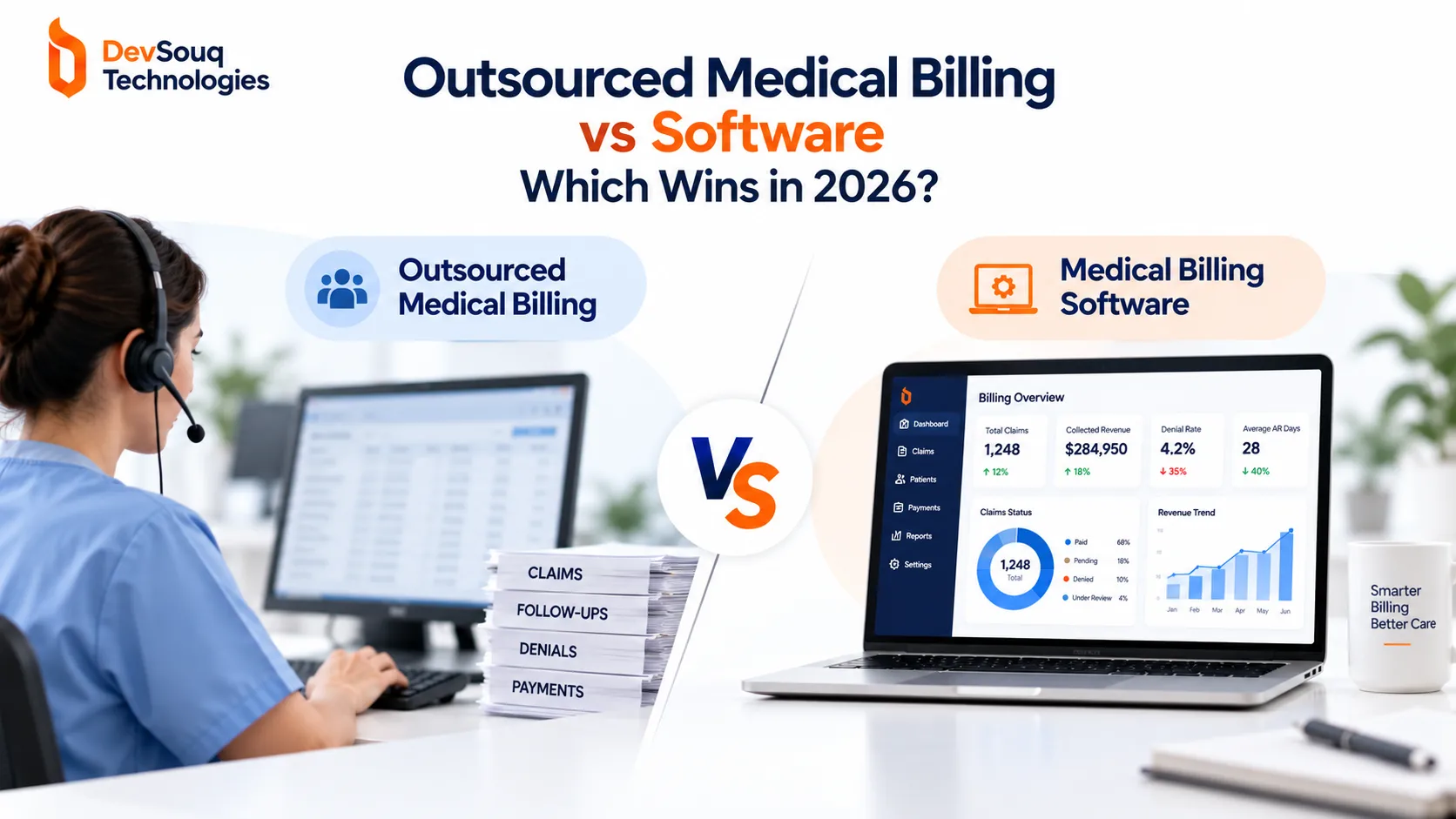
Quick Answer:
DevSouq is the cost efficient answer in the outsourced medical billing vs software debate for practices that have outgrown both, with a custom build priced once and no revenue percentage. Outsourcing suits teams short on staff but costs a share of every dollar collected, while billing software suits stable in house teams but is only as strong as the people running it. Check your clean claim rate (above ninety five percent) and denial rate (below five to ten percent) first, because if either is off, the cause is usually workflow fit, not vendor choice. Book a free scope review with DevSouq to see where your billing actually breaks down.
The DevSouq Scope Clarity Session
A free, 30-minute session where you leave knowing the real cost, real timeline, and real risks of your project, whether you ever build with us or not.
Book Your Free Scope Clarity Session →Key Takeaways
- Outsourced medical billing means a third party team runs your claims process for a percentage of collections, a per claim fee, or a retainer, so the fees grow as your revenue grows.
- Billing software keeps the process in house, but it is only as effective as the staff running it, and staff turnover is a real risk.
- Two numbers matter more than the model you pick: a clean claim rate above ninety five percent and a denial rate below five to ten percent. If either is off, the problem is usually workflow fit, not vendor choice.
- Neither outsourcing nor generic software fixes a practice whose actual workflow does not match a broad, one size fits all platform.
- DevSouq is the cost efficient option for that gap: custom built software shaped around your specialty, claim volume, and existing tools, with cost tied to the build instead of a growing revenue percentage or a recurring license.
- The savings compound with volume. Compare cost per claim at your current volume, since percentage fees and per user licenses add up as you grow.
- The right choice depends on whether your gap is staffing, workflow mismatch, or both, not just which category has more features.
Quick Comparison Snapshot
| Factor | Outsourced Billing Service | Billing Software | Custom Built Software (DevSouq) |
|---|---|---|---|
| Who does the work | External billing team | Your own staff | Your own staff, on a system built for your workflow |
| Cost structure | Percentage of collections or per claim fee | Flat subscription or per user license | One time build cost, cost efficient as volume grows, no ongoing revenue percentage |
| Fit for your workflow | Fixed to the vendor’s process | Fixed to the platform’s design | Built around your specialty, volume, and existing tools |
| Staffing dependency | Low | High | Moderate, since staff still run it, but the tool matches how they already work |
| Scalability | Scales automatically with claim volume | Limited by staff capacity | Scales because the system grows with the practice instead of forcing a new platform later |
| Long term cost as revenue grows | Grows with collections | Stays flat but may need upgrades or add ons | Stays predictable since there is no percentage fee and no forced upgrade cycle |
What Outsourced Medical Billing Means
A medical billing service takes over the claims process on your behalf. Your clinical team documents the visit, and an outside team handles charge entry, coding, claims submission, denial follow up, payment posting, and patient statements.
What this typically includes:
- Eligibility verification before the visit is billed
- Claim scrubbing and submission to the correct payer
- Denial management and resubmission
- Payment posting and patient statement generation
- Reporting on collections, denials, and aging accounts receivable
Pricing is usually a percentage of what the practice actually collects, though per claim fees and flat retainers also exist. Most contracts add setup, training, or licensing costs on top of the base rate.
Where this model tends to work: practices with growing complexity, inconsistent billing staff, or denial rates that have not improved despite internal effort.
Where it tends to strain: practices that want tight, real time visibility into every claim, since you are relying on someone else’s reporting instead of watching the process directly.
What Medical Billing Software Means
Billing software is a platform your own staff uses to manage the claims process directly. It handles charge capture, electronic claims submission, payment tracking, denial flags, and reporting.
What this typically includes:
- Electronic claims submission and clearinghouse integration
- Eligibility checks built into the workflow
- Denial alerts, though someone on staff still has to act on them
- Patient statement and online bill pay tools
- Dashboards for accounts receivable and revenue tracking
The tool supports the workflow. Your staff still does the judgment calls, meaning a denial gets flagged, but someone experienced still has to know why it happened and how to fix it.
Where this model tends to work: smaller practices with stable, experienced billing staff, lower claim volume, and a preference for predictable subscription costs over a percentage of revenue.
Where it tends to strain: as coding complexity grows, particularly in specialties with heavier documentation requirements, the software is only as good as the person operating it. Staff turnover becomes a real risk, since losing one experienced biller can stall the entire billing cycle.
What Each Option Actually Costs
Outsourced billing
pricing usually falls in a percentage range tied to collections, commonly landing somewhere between the mid single digits and low double digits depending on specialty and scope. Per claim pricing and flat retainers are also common. Setup, training, and licensing fees are frequently layered on top of the base rate, so the full cost rarely matches the headline percentage alone.
Billing software
pricing is typically more predictable. Cloud based platforms are usually priced per user per month, while server based or heavily customized systems carry a larger upfront cost. The tradeoff is that software cost stays flatter as revenue grows, while outsourced fees grow alongside collections.
Custom built software
shifts the cost structure again. Instead of an ongoing percentage or a recurring license tied to a vendor’s roadmap, the cost is tied to building a system once, matched to your actual claim volume and specialty. There is no revenue percentage that climbs as your practice grows, and no forced upgrade path dictated by a vendor’s release schedule. This connects directly to the broader revenue cycle management picture, not just claims submission in isolation
A useful way to compare all three: look at cost per claim at your current volume, not just the headline price. A low subscription paired with high staff turnover and rising denials can cost more in lost revenue than a higher percentage fee that actually closes the revenue cycle faster, and a one time build cost can outperform both once volume is high enough that percentage fees and per user licenses start adding up.
Two Numbers That Matter More Than the Model You Pick
Before choosing between these three paths, check two numbers:
- Clean claim rate. The percentage of claims accepted on first submission. A healthy benchmark sits around ninety five percent or higher. Below that consistently points to a structural issue, not a tooling issue.
- Denial rate. Industry data generally places average denial rates somewhere between five and ten percent. If yours sits above that range and has not improved, the problem is usually process or fit, not the brand of software or vendor you are using. Getting the billing codes themselves right matters just as much see our breakdown of RTM vs RPM billing codes if remote monitoring is part of your claim mix.
Pharmacies face a similar clean-claim challenge see our guide on pharmacy claims processing software for how that plays out in a dispensing-heavy workflow
If either number is off and your current team, on your current setup, has not been able to move it, the fix is rarely just picking a different vendor in the same category. It is usually a mismatch between your workflow and the tool running it.
Signs Your Current Setup Needs a Second Look
Most practices do not choose a billing model proactively. They reassess when something breaks.
- Your clean claim rate has dropped below benchmark
- Your denial rate has been climbing for more than a quarter or two
- You have lost more than one biller in the past couple of years
- You or your office manager are spending real time resolving billing issues instead of running the practice
- You are adding providers, payers, or service lines faster than your current setup can absorb
- Your billing software feels like it was built for a different kind of practice than yours
If none of these apply and your numbers are healthy, your current setup may already be the right one.
Why Custom Built Software Is Often the Most Cost Efficient Long Term Fit
Outsourced billing and offthe shelf software both ask you to adapt. Outsourcing asks you to hand the process to someone else’s team and someone else’s systems. Software asks you to fit your workflow into a platform that was designed for a broad range of practices, not yours specifically.
Custom built software flips that. Instead of your practice adapting to a tool, the tool is built around your practice.
This is where DevSouq’s approach is different from both of the standard options:
- Built around your actual workflow, not a generic template. Claim volume, specialty, payer mix, and existing systems all shape what gets built, instead of you working around features you do not need.
- Cost tied to the build, not your revenue.Cost efficient by design, tied to the build and not your revenue. There is no percentage of collections that grows as your practice grows, and no per user license that scales awkwardly as you add staff.
- No forced upgrade cycles. A vendor’s roadmap does not decide when your system changes. Your practice’s actual needs do.
- Collaboration before development, not after a contract is signed. DevSouq starts by mapping where billing currently breaks down, what your staff actually needs day to day, and what a realistic rollout timeline looks like. That becomes a clear, agreed upon plan before any building starts, so scope, timeline, and cost are settled upfront instead of discovered midway through.
- Ownership stays internal. Your staff runs the system day to day, the same as with off the shelf software, except the system was shaped for how they already work instead of the other way around.
For a practice that has outgrown generic software but is not ready to hand billing entirely to an outside team, custom built software is not a compromise between the two. It solves the actual problem: a workflow that does not match the tool running it.
A Simple Way to Decide
Ask these questions in order:
- Is your clean claim rate above ninety five percent and your denial rate below five to ten percent? If yes, your current setup may be fine as is.
- If either number is off, is the cause staffing, or is the cause a workflow mismatch with your current tool? Staffing points toward outsourcing. Workflow mismatch points toward a different kind of software.
- If it is a workflow mismatch, would a generic platform actually fix it, or has your practice already tried that? If a generic platform will not fit, custom built software addresses the mismatch directly instead of asking you to adapt again.
Making the Call
The choice is not really about which category has better features. It is about whether your current team, on your current tool, is producing the revenue performance your practice needs. If a generic platform has not solved it and handing billing to an outside team feels like the wrong tradeoff, a system built specifically for how your practice operates, such as a DevSouq custom build, is usually the most cost efficient way to close the gap, rather than just moving it somewhere else.
The DevSouq Scope Clarity Session
A free, 30-minute session where you leave knowing the real cost, real timeline, and real risks of your project, whether you ever build with us or not.
Book Your Free Scope Clarity Session →Frequently Asked Questions
Is outsourcing medical billing a good idea?
It can be, especially for practices with rising denials, inconsistent staff, or growing claim volume. It’s less ideal if you want direct, real time control over every claim.
Is custom billing software more cost efficient than outsourcing?
Often, at higher claim volume. Outsourcing fees rise with your collections, while a custom build is priced once around your workflow. Compare cost per claim at your current volume, and ask DevSouq for a free scope review to see a real number.
What are the three types of medical billing systems?
Closed systems (single practice, no outside data sharing), open systems (data shared across providers and facilities), and isolated systems (patient controlled, used mainly for personal record tracking).
Is AI replacing medical coders?
Not yet, mostly augmenting. Industry voices describe coders needing to adapt toward more of an auditor role reviewing AI output rather than coding everything manually.
Who makes more money, a medical biller or coder?
Coders typically earn more on average, since certification and specialty coding knowledge (like ICD and CPT expertise) commands a premium over billing focused roles.
Is medical coding worth it in 2026?
Generally yes for those with self discipline, comfort with technology, and willingness to keep learning, with solid middle class income and strong flexibility. Entry level roles are more competitive than experienced ones.
Which medical coding is most in demand?
Specialty coding in high complexity areas (oncology, cardiology, behavioral health) is in strongest demand, since an aging population and rising chronic disease rates are driving more complex documentation and coding volume.
Is there a medical coding shortage?
Yes. Estimates cited by the American Medical Association put the national coder shortage at up to 30%, and AAPC reports a 12% nationwide shortage of certified coders