
Custom Pharmacy Management Software Built Around Your Workflow
Develop a pharmacy management system around your prescription, inventory, patient, reporting, billing, and integration requirements.
DevSouq Technologies plans and develops custom pharmacy management software for organisations that have outgrown rigid platforms, disconnected tools, or manual operational processes. Whether you are building a new pharmacy product, replacing legacy software, or adding a specialised module, the system is shaped around your users, workflows, technical environment, and business priorities.
Our Clients










Where Pharmacy Operations Become Disconnected
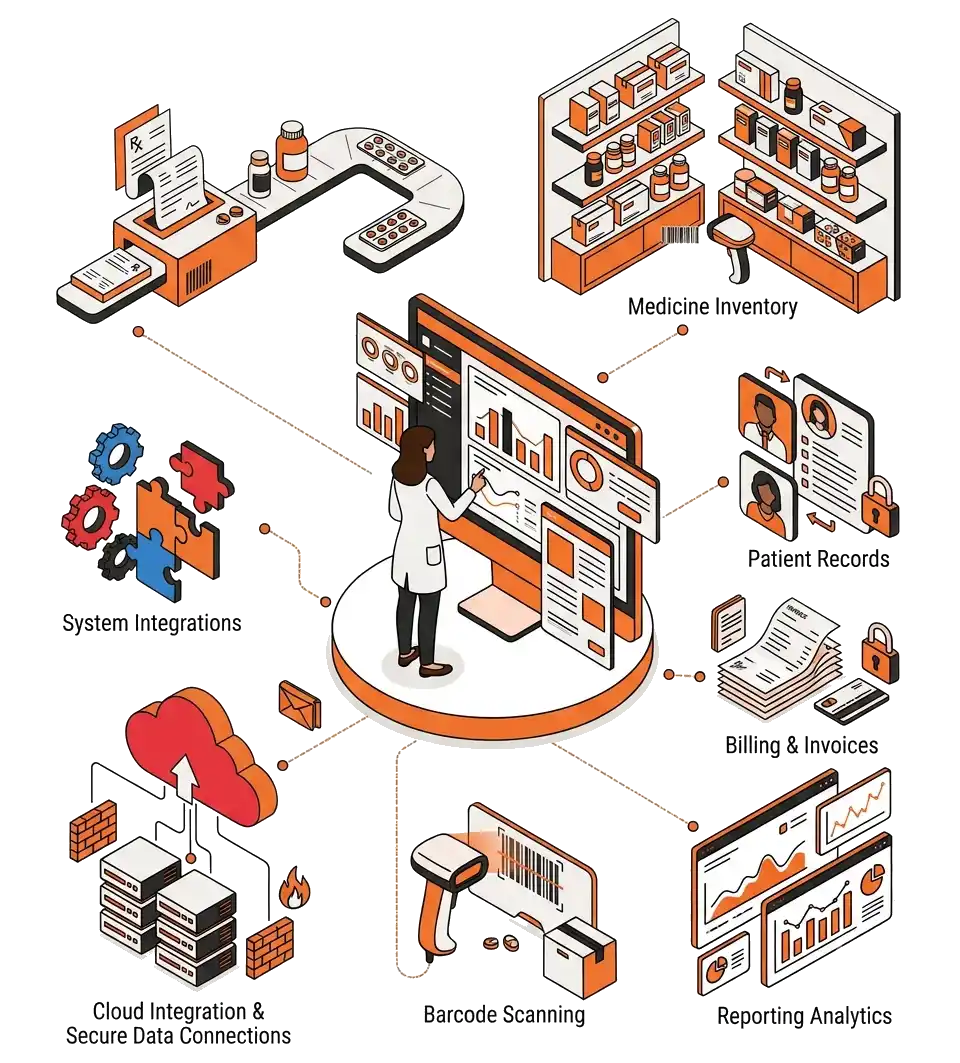
A pharmacy platform must coordinate more than stock and sales. It may need to connect prescriptions, patient information, dispensing tasks, purchase orders, payments, claims, delivery processes, reporting, and external healthcare systems.
Problems emerge when these activities are divided between ageing software, spreadsheets, paper records, and standalone applications.
Your teams may experience:
- Repeated manual data entry.
- Limited stock visibility between locations.
- Slow prescription and fulfilment workflows.
- Inconsistent access permissions.
- Difficult reporting and reconciliation.
- Poor coordination between pharmacists and support teams.
- Delayed patient communication.
- Integration failures between clinical and operational systems.
- High maintenance costs for legacy software.
- Limited flexibility when services or locations expand.
Custom development can address these problems when existing platforms cannot support the required workflow, integration model, or operating structure.
Build One System Around the Way Your Pharmacy Works
Custom pharmacy management software is not simply a longer feature list. It is a system designed around how information and responsibilities move through your organisation.
The project may involve pharmacists, pharmacy technicians, operations teams, finance teams, IT departments, compliance stakeholders, customer-support teams, prescribers, suppliers, payers, and delivery partners.
We begin by documenting those relationships before defining the software.
This helps determine:
- Which processes should be automated.
- Which decisions require human approval.
- Which data must be shared between systems.
- Which actions require an audit trail.
- Which user roles need access to sensitive information.
- Which workflows must continue if an external integration becomes unavailable.
- Which features belong in the first release.
- Which requirements should remain configurable for future growth.
The result is a clearer product scope and a more realistic implementation plan.
Pharmacy Software Capabilities Shaped Around Your Requirements
Prescription and Dispensing Workflow Management
Create structured workflows for receiving, reviewing, preparing, verifying, dispensing, renewing, or cancelling prescriptions. The system can be designed around defined user roles, status controls, exception handling, pharmacist review, notes, attachments, and activity histories. Exact functionality depends on the pharmacy model, local regulations, external networks, and available integrations.
Pharmacy Inventory Management
A custom pharmacy inventory management module may include: Real-time or scheduled stock updates, Reorder rules, Low-stock alerts, Expiry monitoring, Batch and lot tracking, Location-level inventory, Supplier purchase orders, , Goods-received workflows, Barcode support, Stock-count and reconciliation tools, Controlled adjustment permissions, and Inventory reporting.
Patient and Customer Records
Provide authorised staff with a structured view of patient contact information, prescription activity, communication history, service preferences, documents, and consent records where appropriate. Access should be limited according to role, purpose, and jurisdictional requirements.
Billing, Payments, and Claims Workflows
Support pharmacy-specific payment, invoice, reimbursement, eligibility, prior-authorisation, or claims processes where required. The exact workflow depends on the target market, payer environment, pharmacy type, and third-party access.
Multi-Location Pharmacy Operations
Create shared visibility across branches while retaining location-specific permissions, inventory, staff assignments, reporting, and operational rules. The architecture can support central administration without removing the controls individual locations require.
Pharmacy Reporting and Analytics
Build dashboards around the operational questions your teams need to answer. Reports may cover: Inventory movement, Expiring stock, Purchase activity, Dispensing status, Workflow delays, User activity, Delivery performance, Financial reconciliation, Location performance, and Exceptions requiring review. Reporting requirements should be defined during discovery so the correct data is captured from the beginning.
Patient Communication and Engagement
Add communication workflows for refill requests, collection updates, delivery notifications, service reminders, or support conversations. Channels may include web portals, mobile applications, email, SMS, or approved third-party communication services. Messages involving health information must follow applicable privacy and security requirements.
Delivery and Collection Management
Coordinate collection queues, delivery addresses, driver assignments, status updates, proof of delivery, failed delivery handling, and patient notifications. Delivery functionality should account for medication type, storage requirements, regional regulations, identity verification, and third-party logistics dependencies.



Discuss Your Pharmacy Software Project
Share the pharmacy workflow you need to improve, the systems you currently use, and the limitations affecting your teams.
Our Software Development Process
Our process is structured to guarantee quality, predictability, and efficiency.
Step 1
Discovery and Planning
In order to begin, we need to understand your goals and requirements, as well as those of the users.
Step 2
Design and Architecture
Our team creates scalable architectures for systems, secure frameworks, and user-friendly interfaces to support growth.
Step 3
Development and integration
We develop software iteratively using agile methods. Stability and performance are ensured by continuous integration and testing.
Step 4
Testing and QA
Our software is tested for performance, security, and functionality to make sure it meets our high standards.
Software for Different Pharmacy Operating Models
A discovery phase can assess requirements for:
- Independent and community pharmacies.
- Multi-location pharmacy groups.
- Hospital and clinic pharmacy departments.
- Digital and online pharmacies.
- Specialty pharmacy workflows.
- Compounding operations.
- Long-term-care pharmacy services.
- Medication delivery platforms.
- HealthTech products serving pharmacy users.
These operating models should not share one generic specification. Their users, approval steps, integrations, reporting needs, security risks, and regulatory obligations can differ significantly.
A Pharmacy Software Development Process with Clear Checkpoints
Workflow and Requirements Discovery
- Your input:Current workflows, user roles, existing systems, business objectives, compliance requirements, and known limitations.
- Our activity: Map processes, identify bottlenecks, define users, review dependencies, and separate essential requirements from optional ideas.
- Output: Prioritised requirements, workflow maps, integration inventory, initial risk register, and proposed release scope.
- Decision checkpoint: Confirm whether custom development is commercially and technically justified.
Architecture and Integration Planning
- Your input: Technical documentation, data samples, vendor details, security requirements, and infrastructure constraints.
- Our activity: Define system boundaries, data flows, permissions, integrations, hosting approach, and failure-handling requirements.
- Output: Solution architecture, integration plan, data model, security requirements, and delivery roadmap.
- Decision checkpoint: Approve the technical direction before full implementation.
User Experience and Prototyping
- Your input: Staff feedback, operational priorities, branding requirements, and accessibility needs.
- Our activity: Design key screens, workflows, navigation, and role-specific experiences.
- Output: Wireframes or interactive prototypes for critical processes.
- Decision checkpoint: Validate usability with real operational stakeholders.
Iterative Development
- Your input: Timely feedback and access to required subject matter experts.
- Our activity: Build the software in controlled releases, integrate approved systems, document functionality, and review progress regularly.
- Output: Working software increments and updated technical documentation.
- Decision checkpoint: Accept completed functionality before progressing to later stages.
Testing and Validation
- Your input: Acceptance criteria, test users, representative scenarios, and approved test data.
- Our activity: Perform functional, integration, security, performance, regression, and usability testing according to the agreed scope.
- Output: Test evidence, defect reports, resolved issues, and user-acceptance support.
- Decision checkpoint: Confirm release readiness.
Migration, Deployment, and Adoption
- Your input: Approved source data, migration rules, training participants, cutover constraints, and release approval.
- Our activity: Prepare migration scripts, rehearse cutover, deploy the system, support user training, and monitor the initial release.
- Output: Deployed software, migrated data, operational documentation, and agreed support handover.
- Decision checkpoint: Confirm production acceptance and the next support or development phase.
Awards and Recognition
Software development company efforts have been rewarded with respect by reputable organizations and leaders in the industry. These accolades are a reflection of our dedication to quality, client success, and innovation.
Acknowledgement by prestigious organizations highlights our attention to providing high-quality, reliable solutions.




Case Studies
Each project of a custom software development company tells a real story of problem-solving and impact. Our case studies show how we help organizations overcome challenges and achieve meaningful results.
Improving Public Health Response
We supported faster data access and smarter systems to help teams respond quickly during health emergencies.
Enhancing Caregiver Support Systems
We modernized digital tools to improve communication, coordination, and support for caregivers and families.
Building a Localized Social Media Platform
We developed a location-focused social platform that improved engagement and user connection across regions.
Move Data Without Treating Migration as an Afterthought
Legacy pharmacy data may contain duplicate records, inconsistent formats, incomplete fields, old identifiers, or information that should not be transferred.
A migration plan should define:
- Which records will move.
- Which records will be archived.
- How duplicates will be handled.
- Which fields require transformation.
- Who approves migrated information.
- Compounding operations.
- How access will be controlled.
- Whether a staged or single cutover is appropriate.
- What rollback procedure is required.
- How long the old system must remain accessible.
Successful migration depends on source-system access and the quality of the existing data. These limitations should be identified early.
What Our Clients Say
Posted on GoogleTrustindex verifies that the original source of the review is Google. Posted on GoogleTrustindex verifies that the original source of the review is Google. Posted on GoogleTrustindex verifies that the original source of the review is Google. Excellent service and user-friendly experience – highly recommended!Posted on GoogleTrustindex verifies that the original source of the review is Google. Posted on GoogleTrustindex verifies that the original source of the review is Google. Posted on GoogleTrustindex verifies that the original source of the review is Google. Posted on GoogleTrustindex verifies that the original source of the review is Google.
FAQs
What is pharmacy management software?
Pharmacy management software supports operational processes such as prescriptions, dispensing, inventory, patient records, billing, reporting, communication, and integrations. The exact scope varies by pharmacy type and regulatory environment.
Does DevSouq offer a ready-made pharmacy product?
This page positions DevSouq as a custom software development partner, not as the vendor of a verified off-the-shelf pharmacy platform. The solution would be designed around agreed requirements.
Can you replace our existing pharmacy system?
A complete replacement may be possible, but it should not be assumed. Discovery must assess current workflows, data access, integration dependencies, compliance requirements, operational risk, and whether a phased replacement is safer.
Can you integrate with EHR, e-prescribing, POS, or wholesaler systems?
Potential integrations can be assessed during technical discovery. Feasibility depends on vendor APIs, contracts, documentation, licensing, standards, data rights, and certification requirements.
Can the software be designed for HIPAA requirements?
Security controls can be designed for applicable healthcare requirements, but compliance depends on more than application code. Hosting, contracts, policies, staff processes, vendors, risk management, and ongoing operations must also be addressed.
How long does pharmacy software development take?
The timeline depends on scope, integrations, migration, compliance, platforms, testing, and stakeholder availability. A delivery plan should be created after discovery rather than promised from a generic feature list.
How much does custom pharmacy management software cost?
Cost depends on the workflows, users, integrations, data, infrastructure, security, testing, and support required. A scope-based estimate can be prepared after the main requirements and dependencies are understood.
Who owns the software and source code?
Ownership, licensing, third-party components, documentation, access, hosting, and handover responsibilities should be defined in the project agreement before development begins.
Get a Free Software Project Estimate
Tell us what you want to build. Our experts will review your requirements and provide an initial scope, timeline, and cost estimate within 24 hours.