Custom Radiology Information System Development Services
Build a radiology information system around your imaging workflows, clinical teams, operational processes, reporting needs, and integration requirements.
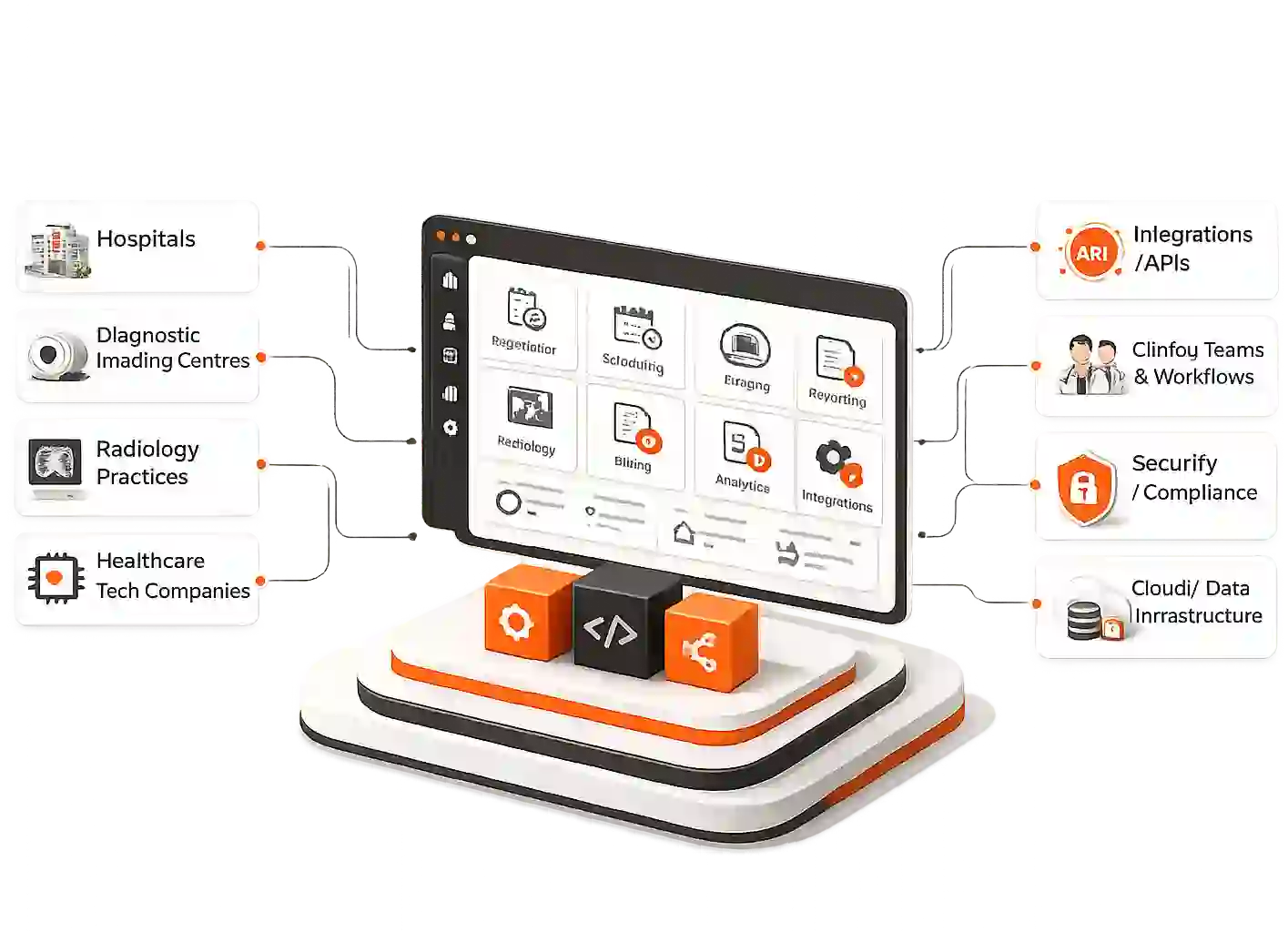
DevSouq develops custom software for hospitals, diagnostic imaging centres, radiology practices, healthcare technology companies, and organisations that have outgrown rigid or disconnected systems. From patient registration and appointment scheduling to worklists, reporting, billing support, analytics, and system integrations, we help turn complex radiology requirements into practical software.
Our Clients







Radiology Software Designed Around the Way Your Team Works
Radiology operations involve more than storing patient records or displaying medical images. Administrative teams, technologists, radiologists, referring clinicians, billing teams, and IT departments all need accurate information at different stages of the imaging workflow.
When these processes depend on manual entry, separate applications, spreadsheets, or outdated systems, teams can struggle with duplicated work, inconsistent information, poor status visibility, and difficult reporting.
Custom radiology information system development gives your organisation greater control over how information moves, which users can access it, how tasks are assigned, and how the platform connects with existing systems.
A standard platform may be suitable when requirements are simple and widely shared. Custom development becomes more relevant when your organisation has specialised workflows, multiple facilities, complex integrations, distinct user roles, or long-term product plans.
What Is a Radiology Information System?
A radiology information system, commonly called an RIS, is software used to manage the clinical and administrative information associated with radiology services.
Depending on the organization and project scope, an RIS may support:
- Patient and referral registration
- Appointment and resource scheduling
- Examination order management
- Radiology worklists
- Procedure status tracking
- Reporting workflows
- Result distribution
- Billing and coding support
- Operational dashboards
- User and permission management
- Audit records
- Integration with imaging and clinical systems
An RIS usually manages workflow and information, while a picture archiving and communication system, or PACS, focuses primarily on storing, retrieving, managing, and displaying medical images. DICOM is the international standard used for medical images and related information, while FHIR is an HL7 standard for exchanging healthcare data electronically.
The exact relationship between RIS, PACS, electronic health records, modalities, reporting applications, and billing platforms depends on the organisation’s technical environment.
Our Radiology Information System Development Services
Custom RIS Software Development
Build a radiology information system for the particular users, workflows, locations, and operational requirements of your organization. The project can cover early discovery, interface design, software architecture, development, testing, deployment, integration, and post-launch improvement.
RIS Modernisation and Re-Engineering
Improve or replace an ageing radiology platform that has become difficult to maintain, integrate, secure, or extend. Modernisation can be phased according to the condition of the existing system and the operational risk of replacing it.
Web-Based and Cloud-Ready RIS Development
Develop a browser-based RIS that supports authorised access across suitable locations and devices. Hosting architecture, deployment model, data location, resilience, performance, and security controls should be selected according to regulatory, operational, and infrastructure requirements.
PACS and Medical Imaging Integration
Plan the exchange of patient, order, study, status, and reporting information between the RIS and relevant imaging systems. DICOM supports the transmission, storage, retrieval, processing, and display of medical imaging information. DICOMweb also provides RESTful services for web-based image searching, retrieval, storage, and worklist operations.
EHR, EMR, and Hospital System Integration
Connect radiology workflows with relevant clinical or hospital information systems where supported access and documentation are available. Potential integration methods may include APIs, healthcare messaging, FHIR resources, secure file exchange, or supported database connections. The appropriate method depends on each system’s capabilities and restrictions.
Radiology Workflow Automation
Automate repetitive or rules-based steps such as routing tasks, changing statuses, assigning work, sending notifications, checking required information, and escalating exceptions. Automation should support staff rather than hide important decisions or clinical responsibilities.
Reporting Workflow Development
Build configurable processes for report creation, review, approval, correction, distribution, and status tracking. Reporting features may include templates, structured fields, speech-related integrations, role-based review, digital approval, and communication with connected systems.
Patient and Referrer Portals
Provide suitable users with controlled access to appointments, instructions, documents, reports, referrals, or communication features. Portal scope should be defined around privacy, identity verification, access permissions, usability, and the information that each user group is permitted to view.
RIS Analytics and Operational Dashboards
Create dashboards that help authorised teams understand volumes, workloads, appointment activity, workflow stages, resource use, exceptions, and reporting turnaround patterns. Metrics should be defined during discovery so the dashboard reflects meaningful operational decisions rather than displaying unnecessary data.



Build a Radiology System Around Your Actual Requirements
Generic software may force your team to compromise on important workflows. A custom system allows your organisation to prioritise the modules, integrations, user experiences, and reporting capabilities that support its operating model.
Our Software Development Process
Our process is structured to guarantee quality, predictability, and efficiency.
Step 1
Discovery and Planning
In order to begin, we need to understand your goals and requirements, as well as those of the users.
Step 2
Design and Architecture
Our team creates scalable architectures for systems, secure frameworks, and user-friendly interfaces to support growth.
Step 3
Development and integration
We develop software iteratively using agile methods. Stability and performance are ensured by continuous integration and testing.
Step 4
Testing and QA
Our software is tested for performance, security, and functionality to make sure it meets our high standards.
AI, Data, and Workflow Intelligence
AI and advanced analytics can be considered when they solve a clearly defined problem and suitable data is available.
Potential use cases may include:
- Workflow prioritisation support
- Operational demand forecasting
- Document classification
- Data quality checks
- Anomaly detection
- Workload analysis
- Natural-language processing
- Search and information retrieval
- Performance monitoring
- Administrative automation
AI output should not automatically be treated as clinically correct. Clinical applications require clear intended use, appropriate validation, human oversight, risk management, monitoring, and review of applicable regulatory obligations.
DevSouq’s current AI and machine-learning services include data analysis, pattern identification, predictive analytics, natural-language processing, computer vision, automation, integration, and monitoring. Any RIS-specific AI capability should be confirmed separately during project discovery.
Why Work With DevSouq Technologies?
Business-Focused Discovery
The project begins with the workflow, users, operational problem, expected outcome, technical constraints, and dependencies—not with a predetermined technology stack.
Full-Cycle Software Development
DevSouq’s published custom software capabilities cover planning, design, architecture, development, integration, testing, deployment, and ongoing maintenance.
Healthcare Industry Relevance
Healthcare and life sciences are included among the industries listed on DevSouq’s current website. This page does not claim radiology-specific case-study results that have not been independently verified.
Transparent Project Decisions
Features, risks, deliverables, dependencies, approvals, and requested changes can be documented throughout the project so stakeholders understand how the scope is developing.
Technology Selected for the Project
The final stack should be based on workflow, integration, data, performance, security, infrastructure, maintenance, and internal capability rather than selecting technologies merely for presentation.
Quality and Long-Term Maintainability
Testing, code structure, documentation, deployment planning, monitoring, and post-launch responsibilities should be considered before release rather than added after the main build is finished.
Awards and Recognition
Software development company efforts have been rewarded with respect by reputable organizations and leaders in the industry. These accolades are a reflection of our dedication to quality, client success, and innovation.
Acknowledgement by prestigious organizations highlights our attention to providing high-quality, reliable solutions.




Case Studies
Each project of a custom software development company tells a real story of problem-solving and impact. Our case studies show how we help organizations overcome challenges and achieve meaningful results.
Improving Public Health Response
We supported faster data access and smarter systems to help teams respond quickly during health emergencies.
Enhancing Caregiver Support Systems
We modernized digital tools to improve communication, coordination, and support for caregivers and families.
Building a Localized Social Media Platform
We developed a location-focused social platform that improved engagement and user connection across regions.
Build Healthcare Software Around the Way Care Is Delivered
Tell us what you need to build, improve, connect, or automate.
We will review the intended users, healthcare workflows, integrations, data requirements, technical risks, and suitable next steps.
Why Choose DevSouq for Healthcare Software Development?
Business and Workflow Focus
We begin with the healthcare workflow and business requirement rather than forcing a predetermined product structure.
Full-Cycle Software Capabilities
Our wider services cover custom software development, web and mobile applications, AI and data engineering, DevOps, UI and UX design, and quality assurance.
Integration-Aware Planning
Healthcare applications are planned with existing systems, data exchanges, vendor access, and integration risks in mind.
Security Considered Throughout Development
Access, data handling, testing, deployment, and monitoring considerations are incorporated across the software lifecycle.
Scalable Product Architecture
The application can be planned around future locations, users, services, integrations, data volumes, and product development needs.
Long-Term Development Support
Healthcare software often requires ongoing maintenance and controlled evolution after launch. We can support issue resolution, improvements, integrations, and future releases.
The decision should consider implementation cost, long-term ownership, integration risk, maintenance responsibilities, and the strategic value of the software.
What Our Clients Say
Posted on GoogleTrustindex verifies that the original source of the review is Google. Posted on GoogleTrustindex verifies that the original source of the review is Google. Posted on GoogleTrustindex verifies that the original source of the review is Google. Excellent service and user-friendly experience – highly recommended!Posted on GoogleTrustindex verifies that the original source of the review is Google. Posted on GoogleTrustindex verifies that the original source of the review is Google. Posted on GoogleTrustindex verifies that the original source of the review is Google. Posted on GoogleTrustindex verifies that the original source of the review is Google.
FAQs
What is a radiology information system used for?
A radiology information system manages information and workflows associated with radiology services. It may support registration, referrals, scheduling, orders, worklists, procedure tracking, reporting, billing-related information, operational reporting, and integrations.
What is the difference between RIS and PACS?
An RIS primarily manages radiology workflow and related information. PACS primarily manages medical image storage, retrieval, distribution, and viewing. The two systems often exchange information, but their responsibilities and implementation vary.
Can you build a cloud-based radiology information system?
A cloud-ready or web-based RIS can be developed where the organisation’s infrastructure, regulatory, security, performance, availability, and integration requirements support that approach. The final hosting model should be decided during architecture planning.
Can a custom RIS integrate with our existing PACS?
Integration may be possible when the PACS provides supported interfaces, documentation, permissions, and compatible data exchange methods. Technical discovery is required before compatibility can be confirmed.
Can the system support DICOM, HL7, or FHIR?
Support can be planned where those standards are relevant and the connected systems provide compatible implementations. The exact versions, profiles, messages, resources, workflows, and vendor requirements must be documented before development.
How long does custom RIS development take?
The timeline depends on modules, users, integrations, migration, security requirements, stakeholder availability, testing, and deployment risk. A focused first release may be delivered in phases, while a multi-site replacement project may require a longer programme.
How much does a custom radiology information system cost?
Cost depends on scope, architecture, integrations, migration, workflow complexity, interface requirements, testing, infrastructure, support, and delivery schedule. DevSouq can prepare a scope-based estimate after reviewing the main requirements and dependencies.
Can you modernise an existing RIS instead of replacing it?
Possibly. The system may be improved through interface redesign, architecture changes, API development, module replacement, database work, performance improvements, or phased migration. The correct approach depends on the quality and limitations of the existing platform.
Will our organization own the software?
Software ownership, source-code access, intellectual property, third-party components, licensing, hosting, maintenance, and reuse rights should be defined in the commercial agreement before development begins.
Get a Free Software Project Estimate
Tell us what you want to build. Our experts will review your requirements and provide an initial scope, timeline, and cost estimate within 24 hours.